

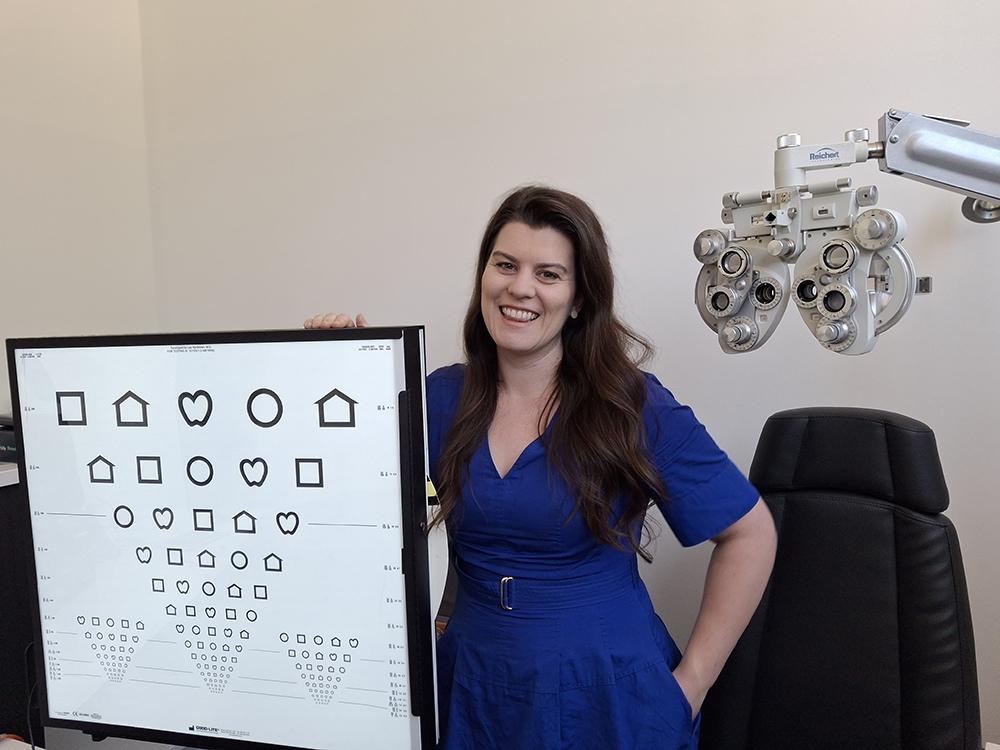
What is your role here at Flinders?
I am a lecturer and researcher in optometry at Flinders University, with a focus on paediatric vision and public health. My role includes teaching within the optometry program, supervising students, and leading research that aims to improve eye care for children and communities.
What initially drew you to the practice of optometry, and what keeps you motivated throughout your PhD?
I was drawn to optometry due to its blend of science with health care, and practical problem solving in a way that makes a real difference in people’s daily lives.
Prior to beginning my PhD I worked as a clinician in private practice. I saw numerous children who presented too late for effective treatment of amblyopia, or “lazy eye.” It was frustrating to know that earlier detection could have dramatically improved their outcomes, yet without a universal pre-school vision screening program in South Australia, many children were simply missed. Children can be very poor historians, they don’t know they see the world differently to others, and eye conditions can go undiagnosed. I find it frustrating in South Australia we still have children with avoidable blindness, which has led me to research in this space.
Through my research at Flinders, we found that 17% of children screened in year 3 in SA had an undiagnosed eye condition, and 1.3% required urgent referral for suspected amblyopia. These findings highlight that too many children start school without their best possible vision for learning. Poor vision can put them behind not only in literacy but also in broader cognitive and social development.
Screening and diagnosing vision impairments early is key to improving health outcomes for our children. This intersection between clinical observations and real-world public health impact keeps me motivated through my PhD.
Tell us about your policy advocacy work for universal eye testing for pre-school aged children.
Alongside other leaders in the South Australian eye health sector, I have launched a proposal calling for government support to introduce universal pre-school vision screening. The proposal is backed by Flinders University, Optometry Australia, the Royal Australian and New Zealand College of Ophthalmologists, Orthoptics Australia, and Vision 2020.
Vision screening is an evidence based, cost effective way to detect potentially sight threatening childhood eye conditions and ensure timely follow up. While Queensland, Western Australia, and New South Wales all have comprehensive screening programs, around 60 percent of children in South Australia currently miss out on these vital checks. Our advocacy aims to close this gap and ensure every child has an equal start when they begin school.
You can still join the voices for change, as a university researcher, academic, student, parent, glasses-wearer or simply concerned community member through our Optometry Australia do-gooder campaign.
What has been your career highlight to date?
A major highlight has been leading the Children’s Eye Screening South Australia (CESSA) study in South Australian schools. The project brought together clinicians, researchers, university students, educators, and communities, and showed how large scale screening can identify children who would otherwise be missed. We have now screened more than 1000 children, identifying significant numbers with previously undetected vision problems.
I also hope my biggest achievement is still ahead. My son will start kindergarten in 2028, and with government support and cross sector collaboration, an in-school vision screening program in SA could realistically be in place by then. I would love to see him and all four-year-olds in the state receive equitable, early vision checks.
What do you enjoy about working at Flinders?
I enjoy the supportive and collaborative culture at Flinders. There is a strong sense of purpose within the optometry program, and I value working with colleagues who share a commitment to improving community eye health. The students contribute great energy and curiosity, which makes teaching genuinely enjoyable.
Tell us about your ideal weekend.
You’ll find me at the beach, likely running after a toddler and my Groodle. Of course, wearing sunglasses and a hat for good eye health!