

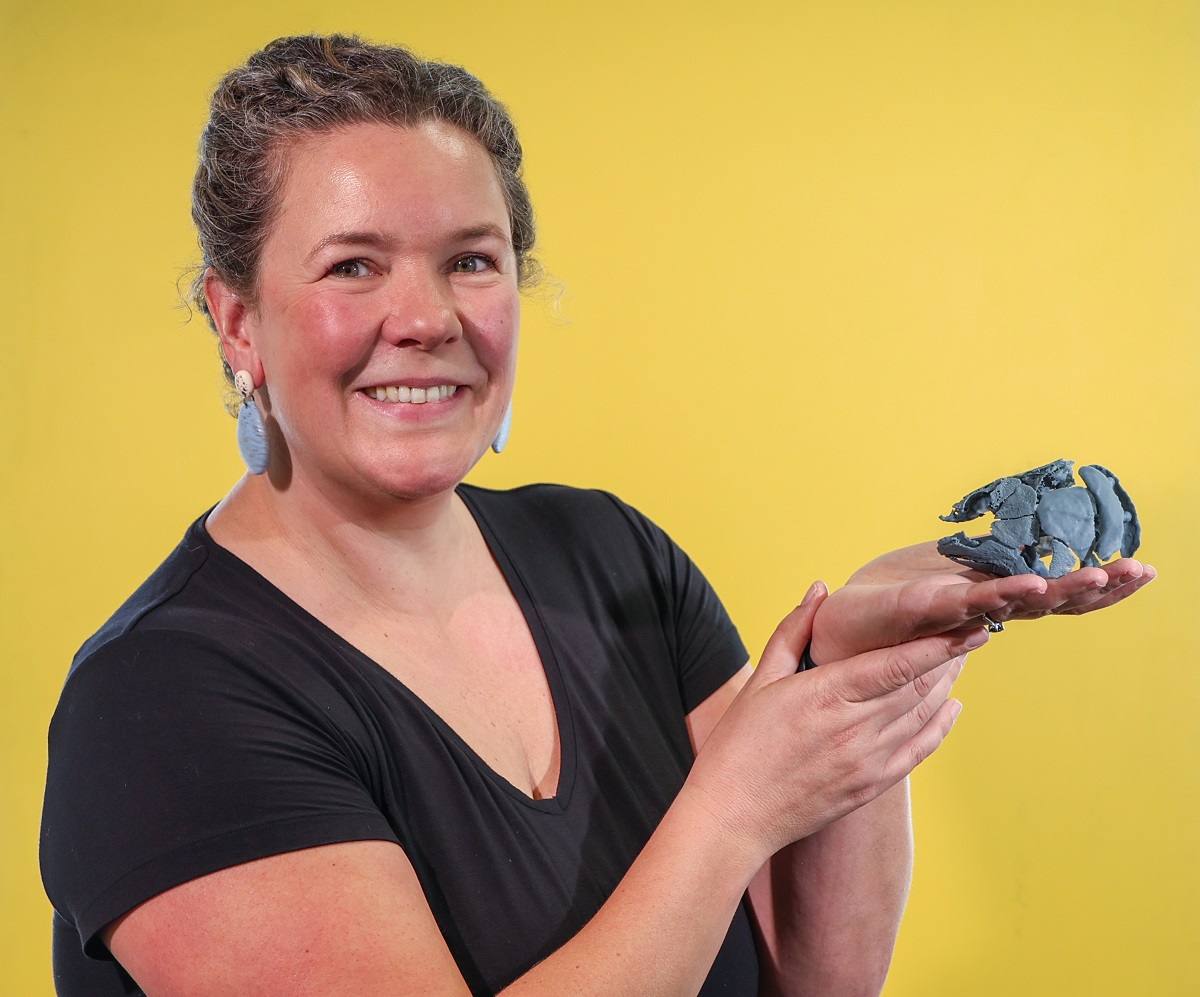
Fresh off leading an international team of experts to describe, name and analyse a new species of fossil coelacanth from Australia, we sat down with Dr Alice Clement to hear about her unusual path to paleontology and how she’s broadening her horizons by learning more about a new group of animals.
What is your role here at Flinders?
I am a lecturer and research fellow in the palaeontology group at Flinders University. This means I split my time between teaching, supervision, research (and more).
Tell us a little about your work.
I describe myself as an evolutionary biologist and palaeontologist who studies early vertebrates, such as fish and tetrapods (the first terrestrial backboned animals and all of their descendants). I’m fascinated by trying to understand how animals’ bodies change during major transitions, such as the water to land transition by the first tetrapods more than 360 million years ago. My approach is often “digital”, relying heavily on modern scanning technology and specialised software to analyse the anatomy and morphology of fossils and living animals alike.
How’d you get into that field?
Perhaps a little unusually, I wasn’t one of those kids obsessed with dinosaurs. I came to palaeontology more gradually, but always had a love for animals. I originally studied Zoology and Conservation during my undergraduate degree at the University of Melbourne, and it was a comparative anatomy class that ignited my interest in animal skeletons and eventually led me to palaeontology.
What’s your favourite thing about your work?
It would have to be the variety of things I get to do. I am privileged to be able to conduct fieldwork is some spectacular parts of the country, I get to discover things no human eyes have seen before, and contribute to expanding the wealth of knowledge about the natural world. I love trying to piece together long extinct animals, their lifestyles, and how their evolution has led to the fabulous diversity of life we see around us today.
Tell us a little about your recent coelacanth research.
I’m really proud of our recent coelacanth project. I led an international team of experts to describe, name and analyse a new species of fossil coelacanth from Australia. Coelacanths themselves are fascinating fish, with an extraordinarily long evolutionary history, and were central to one of the greatest zoological discoveries during the 20th Century. Not only that, our team compiled a huge dataset which allowed us to analyse the evolutionary rates and disparity of all coelacanths over their 410 million year history, and we could even pinpoint which external factors (tectonic plate activity) seemed to have the greatest influence of the evolution of the group.
What’s next for you?
I continue my research into early vertebrate evolution and digital palaeontology, but this period is particularly exhilarating for me as I broaden my collaborative networks and engage with experts on groups of animals that are less familiar to me. For instance, I am presently investigating the evolution of snake and lizard brains in collaboration with colleagues from Adelaide and beyond. On the teaching front, I have developed a range of ideas and plans aimed at equipping our vertebrate palaeontology graduates with the most current advancements and future directions in the field.
How do you spend your spare time?
I’ve had a lifelong love of swimming, which I try to do a couple of times a week, but also enjoy getting to the gym for weights and yoga. Other than that, I’m busy running around after an energetic three year old at home.