
 The question is not whether healthcare leadership education matters. It clearly does. The question is whether we’re preparing leaders for the world that actually exists, or continuing to teach them for a world that no longer does.
Every year, health systems across the Asia-Pacific region face the same dilemma: they need leaders capable of managing increasingly complex, integrated care delivery yet training remain fragmented, often shaped by models designed for entirely different contexts. Ask any health leader whether their system can equitably scale quality care to underserved populations, and the honest answer is usually “not without fundamental change.” Yet few healthcare management education programs actually teach leaders how to lead that change.
The Asia-Pacific region will account for approximately 20% of global healthcare spending by 2030.1 The region faces mounting pressures: aging populations, rising chronic disease burdens, digital transformation demands, persistent health inequities, and constrained budgets.2 These pressures demand healthcare leaders who can think systemically, act equitably, and drive innovation in resource-limited settings. Instead, many countries in the region are producing leaders trained primarily in financial management and operational efficiency – useful skills, but insufficient for the moment we’re in.
The Paradox: Visible Momentum, Uneven Results
The landscape of healthcare management education across Australia and Asia-Pacific is genuinely shifting. Recent trends suggests a clear movement away from ad hoc workshops toward structured, competency-based, and practice-linked programs that emphasise workplace projects, mentorship, and institutional embedding. Malaysia’s three-year Talent Grooming Programme combines workplace experience, mentoring, and formal training in ways that suggest what intentional, institutional commitment looks like.3 Vietnam’s national management training network has trained 827 managers through regional centers using project-based learning, and 132 of 218 applied projects produced measurable program output improvements.4 Thailand’s district health management learning initiatives emphasise person-centered district systems and sustained academic partnerships.5 The Philippines Field Management Training Program generated 204 applied management projects with documented service improvements, and many graduates were promoted to more responsible positions.6
Though examples exist, we notice that implementation remains profoundly uneven. While some countries develop structured, multi-year programs embedded in institutional change, most health leaders across the region still receive fragmented, short-course training disconnected from career pathways or organisational support.
Evidence from multiple Asia-Pacific countries also reveal widespread gaps in formal management training for healthcare leaders. Studies in China found low pre-appointment training among hospital directors,7 while India’s healthcare system faces unaddressed leadership capacity.8 Across the region, leadership roles are frequently assumed without prior management training. But the real problem isn’t simply the absence of training – it’s that most existing programs fail to translate learning into system change.
This paradox is worth thinking about: the region has documented success stories. Yet these remain isolated successes rather than systemic shifts. Why?
Three Barriers Keeping the System Stuck
First: The Knowledge Hierarchy and Adaptation Gap. Global health research and education still flow predominantly from north to south. High-income country models are positioned as “best practice,” while innovation emerging from low-resource settings is often overlooked.9 A health leader in India or Vietnam or Indonesia internalises that solutions come from elsewhere. Yet the evidence reveals something more complex: transnational education can work but only when curricula are deliberately adapted and support is provided for less experienced learners.10 When programs assume “one size fits all,” they fail. When they adapt to local context, they generate satisfaction and career relevance. Local competency tailoring matters. The lesson should be clear: stop importing models wholesale. Start importing evidence about how to adapt thoughtfully.
Second: Structural Curriculum Gaps. Research across India, Indonesia, and elsewhere identifies consistent deficiencies: insufficient coverage of soft skills, mentoring capabilities, financing and funding dynamics, strategic planning, and project implementation skills. Healthcare leaders are trained in financial metrics but not in leading teams through system change. They learn operational efficiency but not how to navigate political and cultural contexts. They master dashboards but not how to foster the collaborative relationships that integration demands. Meanwhile, equitable access to training itself remains profoundly unequal. Programmatic gaps cluster around sustainability, scope of curricula, evaluation linkage to careers, and uneven geographic access.
Third: The Career Pathway Disconnect. Major programmatic gaps include one-off trainings, weak linkage to career pathways, and poor evaluation of outcomes and sustainability. Mismatch between training and workplace roles undermines impact; trainees receive little institutional recognition or career progression tied to leadership learning. Variable commitment across organisations and policy environments leads to uneven implementation; political will and system-level support are identified as necessary but inconsistently present.
These barriers don’t exist in isolation. They reinforce each other. Fragmented training fails to develop systems thinking. Weak evaluation means nobody knows what works. Career pathway disconnection means leaders have little incentive to apply learning. The result: the system stays fragmented.
What This Means: A Different Role for Healthcare Education
Evidence suggests something more fundamental needs to shift. Healthcare management education in Asia-Pacific needs to move from “training leaders” to “developing leaders within systems.” This is not semantic. It changes everything:
– From importing models to adapting evidence
– From episodic courses to sustained institutional development
– From generic competencies to context-specific capability
– From individual skill-building to system transformation
– From north-to-south knowledge transfer to regional peer learning
This is what succeeds. This is what evidence supports. This is what the region’s success stories demonstrate.
On Health Leadership Insights
We have created this platform precisely because this shift is possible but not yet systematic. Health Leadership Insights is a thought leadership initiative led by health care management experts based at Flinders University, Adelaide. We believe healthcare leadership deserves rigorous, evidence-grounded, constructively critical discussion. We believe the innovations emerging across Asia-Pacific deserve to be studied and shared. We believe healthcare leaders – the people managing the systems that determine whether people live or die, whether care is equitable or reinforces privilege deserve platforms where their thinking is elevated and their experiences inform policy.
Our series includes Editor’s Desk essays like this one, where we examine defining challenges in healthcare management education and systems. But we’re also building space for voices from the field itself: opinion pieces from practitioners sharing hard-won insights, stories from inside health system transformation, leadership interviews with innovators and experts working at the frontlines. Healthcare management is not an abstract discipline. It’s practiced daily by leaders navigating impossible trade-offs, building teams across divides, arguing for equity in systems designed for efficiency. Those voices matter. Those experiences illuminate problems that academic literature sometimes misses.
Our commitment is to bring rigor and regional grounding to conversations about healthcare leadership. To ask hard questions about what works. To surface solutions emerging from the practitioners and leaders who are already working toward transformation. To build thought leadership in Asia-Pacific that reflects the knowledge, creativity, and commitment of the region’s own healthcare leaders.
A Question for 2030
By 2030, it’s conceivable that the Asia-Pacific region could have healthcare leaders developed through combinations of formal education, applied projects, sustained mentorship, and regional peer learning networks. Leaders from rural and remote areas could access development without losing their positions. Career advancement could be linked to leadership learning. Regional training networks could share solutions across countries facing similar challenges.
The success stories already documented prove this is possible. The question is whether we’re willing to make it systematic. Whether policymakers will fund long-term development in addition to short courses. Whether universities will commit to transnational partnerships grounded in adaptation rather than export. Whether organisations will link career progression to leadership learning. Whether we’ll recognise that building equitable health systems requires building equitable leadership development.
The evidence is clear. The examples exist. The pathways are documented. The only question is are we prepared to lead the change.
References
1. Bain & Company,. Asia-Pacific Front Line of Healthcare 2024 [Internet]. 2024. Available from: https://www.bain.com/insights/asia-pacific-front-line-of-healthcare-2024/
2. Balasubramanian M, Shafei A, Liang Z, editors. Innovations in Older Adult Care and Health Service Management: A Focus on the Asia-Pacific Region [Internet]. Frontiers Media SA; 2024 [cited 2024 Sept 16]. (Frontiers Research Topics). Available from: https://www.frontiersin.org/research-topics/34196/innovations-in-older-adult-care-and-health-service-management-a-focus-on-the-asia-pacific-region
3. Lee KY, Ismail M, Bakit P, Zakaria N, Zakaria N, Jinah N, et al. Building health care leadership capacity in a developing country via Talent Grooming Programme (TGP): experience sharing from the Ministry of Health Malaysia. LHS. 2023 Apr 21;36(2):219–35.
4. Do MH, Bui TTH, Phan T, Nguyen HL, Duong TA, Le BC, et al. Strengthening Public Health Management Capacity in Vietnam: Preparing Local Public Health Workers for New Roles in a Decentralized Health System. Journal of Public Health Management and Practice. 2018 Mar;24:S74–81.
5. Tejativaddhana P, Briggs D, Singhadej O, Hinoguin R. Developing primary health care in Thailand: Innovation in the use of socio-economic determinants, Sustainable Development Goals and the district health strategy. PAP. 2018 Sept 5;21(1):36–49.
6. Sucaldito NL, Tayag EA, Roces MCR, Malison MD, Robie BD, Howze EH. The Philippines Field Management Training Program (FMTP): strengthening management capacity in a decentralized public health system. Int J Public Health. 2014 Dec;59(6):897–903.
7. Liang Z, Howard P, Wang J, Xu M. A Call for Leadership and Management Competency Development for Directors of Medical Services—Evidence from the Chinese Public Hospital System. IJERPH. 2020 Sept 22;17(18):6913.
8. Gulati K, Singh AR, Gupta SK, Sarkar C. Strengthening leadership capacity: an unaddressed issue in Indian healthcare system. LHS. 2022 June 28;35(3):428–42.
9. Abimbola S. The foreign gaze: essays on global health. S.l.: IRD; 2024. 149 p. (Santé globale).
10. Liu C, Wu Q, Liang Z, Karimi L, Ferrier JA, Sheats J, et al. Adaptation strategies in transnational education: a case study of an australian Master of Health Administration Course offered to chinese managers. BMC Med Educ. 2022 Dec;22(1):52.
About the editors
Dr. Madhan Balasubramanian is Senior Lecturer and Deputy Director of Health Care Management at Flinders University, and Fellow at the Australasian College of Health Service Management. His research and leadership span health systems strengthening, workforce policy, digital health innovation, and health equity across Australia, Asia-Pacific, Europe, and the MENA region.
Professor Angie Shafei is Director of Health Care Management and Dean of Business at Flinders University, Adelaide Australia. She is recognised for transformative academic leadership, driving large-scale portfolio growth, strengthening industry and government partnerships, and advancing innovation in health care management, digital transformation, and contemporary business education.
About Health Leadership Insights
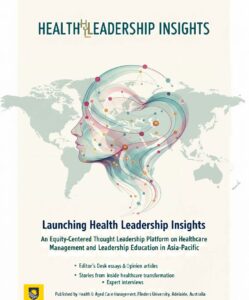 Health Leadership Insights is a thought leadership platform led by healthcare academics and researchers at Flinders University, Adelaide. We bring rigorous, evidence-grounded, and constructively critical perspectives on healthcare management education, training, and systems innovation across Australia, Asia-Pacific, and globally.
Our series features:
- Editor’s Desk essays examining defining challenges in healthcare management and systems transformation
- Opinion pieces from practitioners sharing insights from the field
- Stories from inside healthcare transformation showcasing real-world leadership challenges and solutions
- Expert interviews with healthcare leaders, innovators, and researchers working at the frontlines
Our commitment is to elevate healthcare leadership discourse. To surface solutions emerging from Asia-Pacific’s own healthcare leaders. To ask hard questions about what works. To build thought leadership grounded in regional evidence and informed by the voices of those managing health systems daily.
Submission is by invitation only. If you are interested in submitting an article, please contact the editors directly.

© 2026 Flinders University. This segment is part of Flinders Blogs Portal, and run by the Flinders Healthcare Management Team.