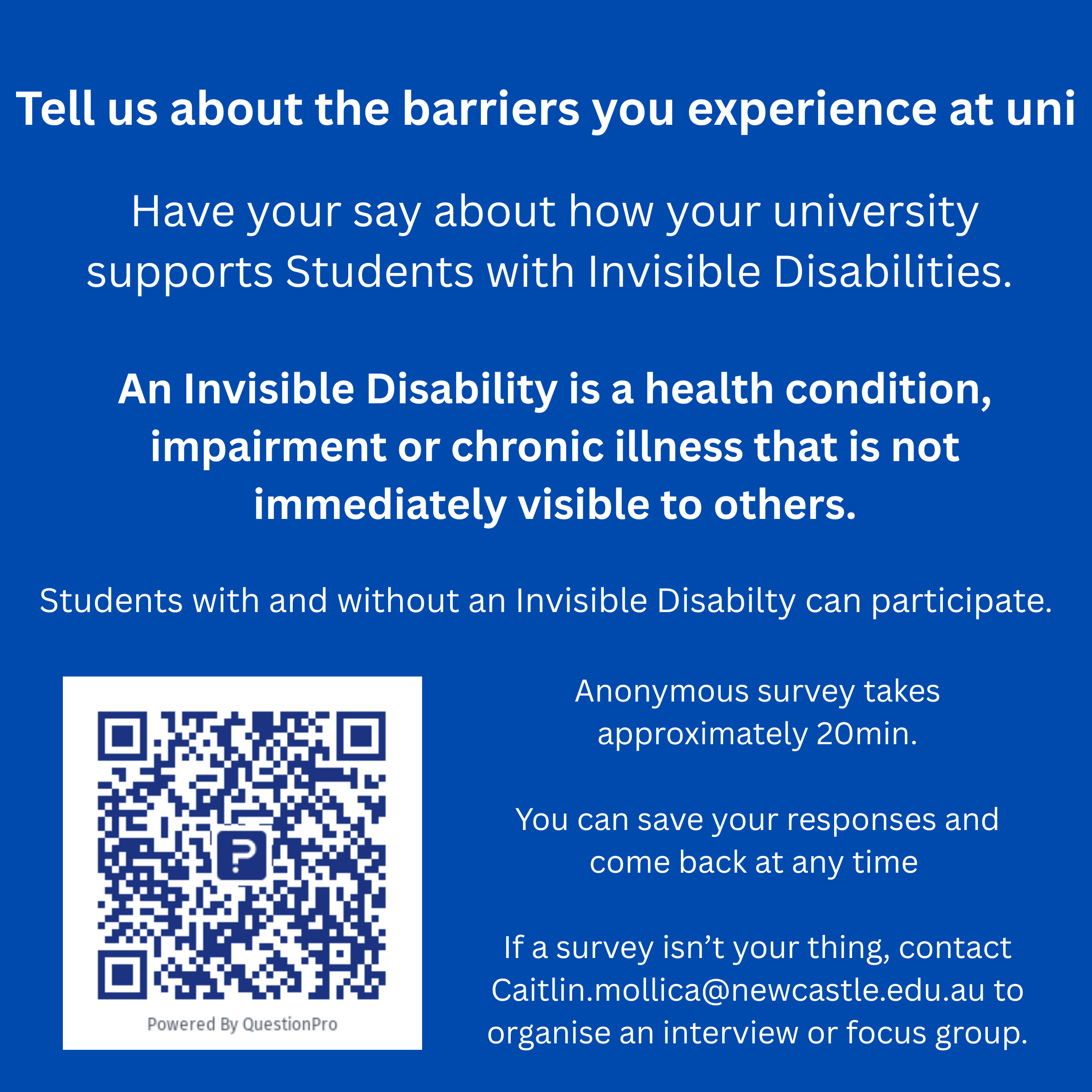


Your experience can transform higher education. Participate in a national study to support students with invisible disabilities!
Every student deserves the opportunity to succeed at university, yet those with invisible disabilities often face unseen barriers. Invisible disabilities—also known as hidden or non-visible disabilities—are conditions, impairments, or chronic illnesses that aren’t immediately obvious. They include physical, mental, and neurological conditions, among others.
Chloe, a university student with an invisible disability and the Co-founder of ‘Flinders Neurodivergent Study Support & Advocacy’, highlights these hidden challenges:
“Many of us with invisible disabilities can thrive academically. However, unnecessarily rigid or standardised forms of content delivery and assessments require many of us to learn and demonstrate our genuine abilities or knowledge in ways that are partly (or sometimes completely) at odds with how we learn and perform best. I know firsthand the isolation and exhaustion that comes with navigating higher education.”
Chloe is currently part of a national study exploring how universities can better support students with invisible disabilities. This survey is open to all students currently enrolled in Higher Education – both students who identify as having an invisible disability, as well as their peers who don’t. The research aims to understand student experiences with university support services, especially how effective reasonable adjustments are in removing barriers to education.
Reasonable adjustments are personalised forms of assistance tailored to individual needs, designed to reduce or eliminate educational barriers. These supports can be temporary or long-term, and may involve recommendations to lecturers or additional university services.
Whether or not you identify as having an invisible disability, your insights are invaluable. Your participation will help create inclusive university environments where everyone can thrive academically and socially.
How You Can Help:
-
Complete the anonymous survey (approximately 15–25 minutes). You can save your progress and return at any point.
-
Prefer a different format? Arrange an individual interview or join a collaborative focus group by contacting Caitlin Mollica at:
Caitlin.mollica@newcastle.edu.au
Language Disclaimer:
This survey uses person-first language (e.g., ‘student with disability’), but we acknowledge that many prefer identity-first language (e.g., ‘disabled student’). We respect everyone’s right to self-identify and recognise language preferences are personal.
Your experience matters. Your voice has value. Join us in shaping a more inclusive higher education experience for everyone.