

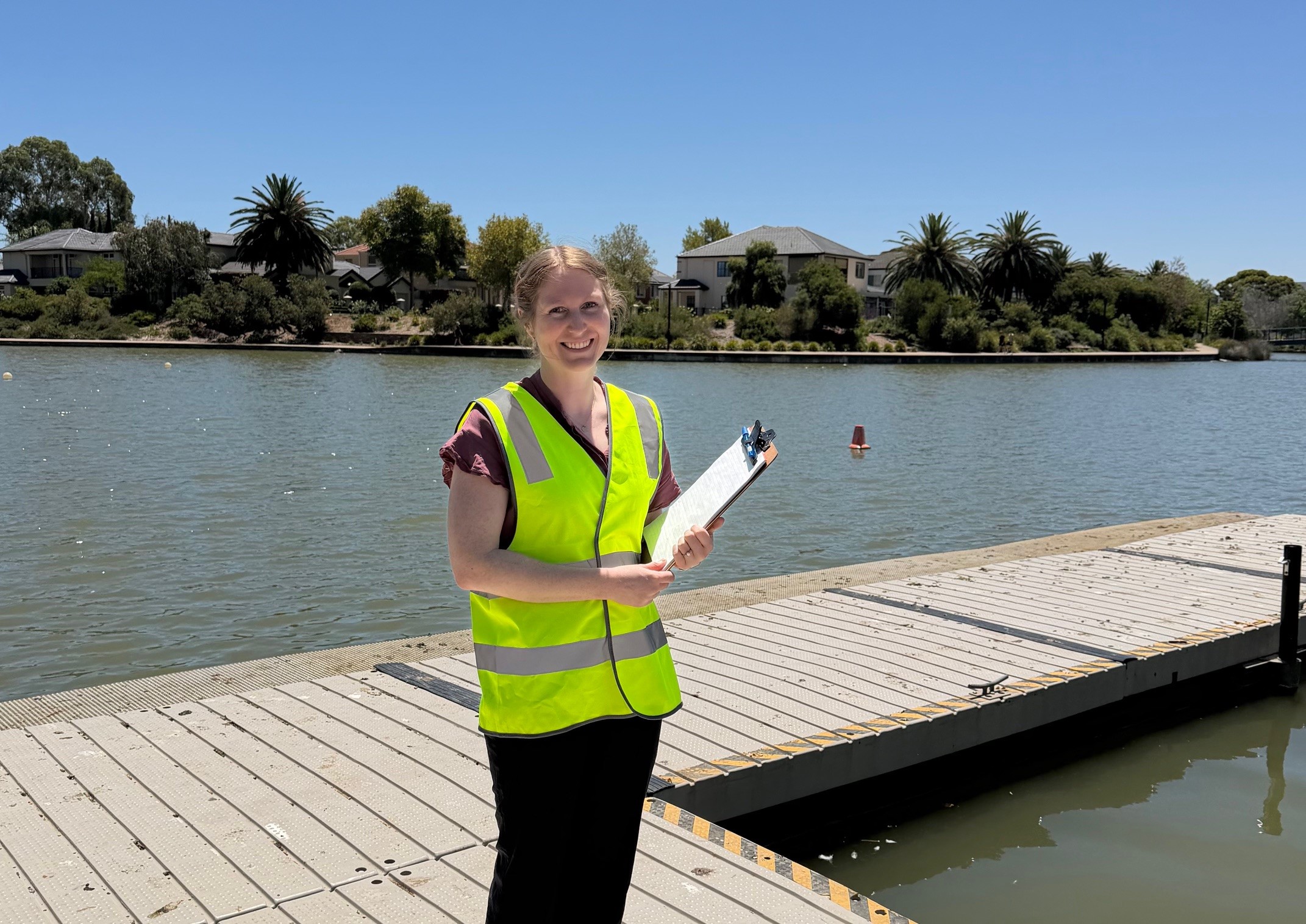
When you ask Stephanie Morey (BPsych(Hons) ’14, PhD(Psyc) ’19) how she ended up as a human factors engineer working on multi-billion-dollar defence projects, she’ll tell you it wasn’t part of some perfectly mapped-out plan. “I took some opportunities and followed them through…and it worked out well for me,” she says.
Today, Stephanie helps design systems used on some of Australia’s largest defence programs – systems where good design can literally mean the difference between mission success and disaster for its users.
Stephanie spent most of her childhood in the Adelaide Hills, “a Hills kid” living what she describes as a classic outdoorsy lifestyle. “Back then I thought I was going be a geologist,” she laughs. “I was really into rocks.”
As she got older, that curiosity shifted away from rocks and toward people. “I’ve also always been interested in people,” she says. “I became more interested in understanding how people think so it’s not surprising I ended up in a psychology kind of area.”
Finding Her Place at Flinders
Like many students, Stephanie didn’t immediately see how her interests would translate into a career. But a school visit to Flinders University changed everything.
She still remembers sitting in a psychology talk by lecturer Dr Paul Williamson. “It was about eyewitness memory… and it was just so fascinating,” she says. “It made me realise psychology wasn’t just clinical stuff, it was cognition, decision-making, forensic work… all these areas I’d never even thought about.”
When she started at Flinders, the fit felt immediate. “I just felt like I fitted in and the campus was green and ‘hillsy’ like home. I ended up spending nine years of my life at Flinders.”
Those nine years included her honours degree and a PhD, where she discovered the field that would shape her future: human factors engineering.
What Is Human Factors Engineering?
If you’ve never heard of human factors engineering, you’re not alone. Stephanie explains it in simple terms:
“It’s basically the application of studying humans. How we think, how we act, what our limitations are and using that to design systems in the world.”
That can mean anything from cockpit layouts to smartphone interfaces. “Our goal is to design systems to be as useful, usable, and efficient as possible,” she says. “If users don’t adopt a system, the system is useless.”
One of her favourite examples is the decline of BlackBerry phones.
“They had a great idea, but they lost touch with what the user needed,” she explains. “By the time the Apple iPhone came out people required more functionality – the button-heavy design of the Blackberry was a drawback compared to the flexibility of a touchscreen. A toddler can pick up an iPhone and instantly swipe because the design is so intuitive. Apple has managed to apply psychological principles really well to design. BlackBerry didn’t adapt and now you don’t see BlackBerrys around anymore.”
That, in a nutshell, is human factors engineering, designing systems to suit the user’s needs.
Defence Projects Worth Billions
During her PhD, Stephanie received a scholarship with the Defence Science and Technology Group. That was her first real look at how human-factors research influences high-stakes systems.
Later, when she moved into industry, the scale of the work expanded dramatically. “We work on big defence programs, like Navy programs, which can be multi-billion-dollar projects,” she says.
The job of a human factors engineer on these projects is to make sure the systems that operators rely on like software, control rooms, and workstations are designed for real human beings, not idealised ones.
That means understanding everything from:
- Anthropometrics: “the physical dimensions of humans. Making sure controls, seats, and spaces fit the user.”
- Cognitive workload: “how busy the mind is and how that affects performance.”
- Decision-making: “the processes involved in weighing up different options and selecting a course of action.”
- Safety impacts: “for example, a pilot misinterpreting information on a cockpit display could have catastrophic consequences.”
Sometimes, her team will build physical or digital mock-ups and bring operators into the lab to test designs. “We might run human-participant studies just like we did at uni,” she explains.
 Why Human Factors Matters – A Lot
It’s easy to underestimate the importance of designing systems around human behaviour. But the consequences can be huge.
“If a system is poorly designed, people create workarounds,” Stephanie says. “And workarounds are less safe, less efficient, and prone to failure.” When you scale that to military environments, the stakes increase dramatically.
Despite the pressure, Stephanie finds her work deeply meaningful.
“I wanted to help people,” she says. “So the most rewarding thing for me is when operators look at a new design and say, ‘This is so much better than what we had before.’”
Those moments matter because the work is often slow and highly analytical. “A lot of the time, you’re doing analysis that doesn’t seem to mean much, until you get that feedback.”
It’s a reminder that behind every interface, every system, and every control lies a human who needs to use it efficiently and safely.
A Career Built on Curiosity
Looking back, Stephanie sees a clear thread running through her childhood interests, her studies, and her career: a fascination with humans.
“I always had that interest in humans,” she says. “I just didn’t connect the dots at the time.”
But the dots connected anyway. Today she’s helping design the technologies and environments that defence personnel rely on – applying science, psychology, and empathy to make complex systems safer and easier to use.
And it all started with a curious kid in the Adelaide Hills who liked rocks, people, and figuring out how things work.