

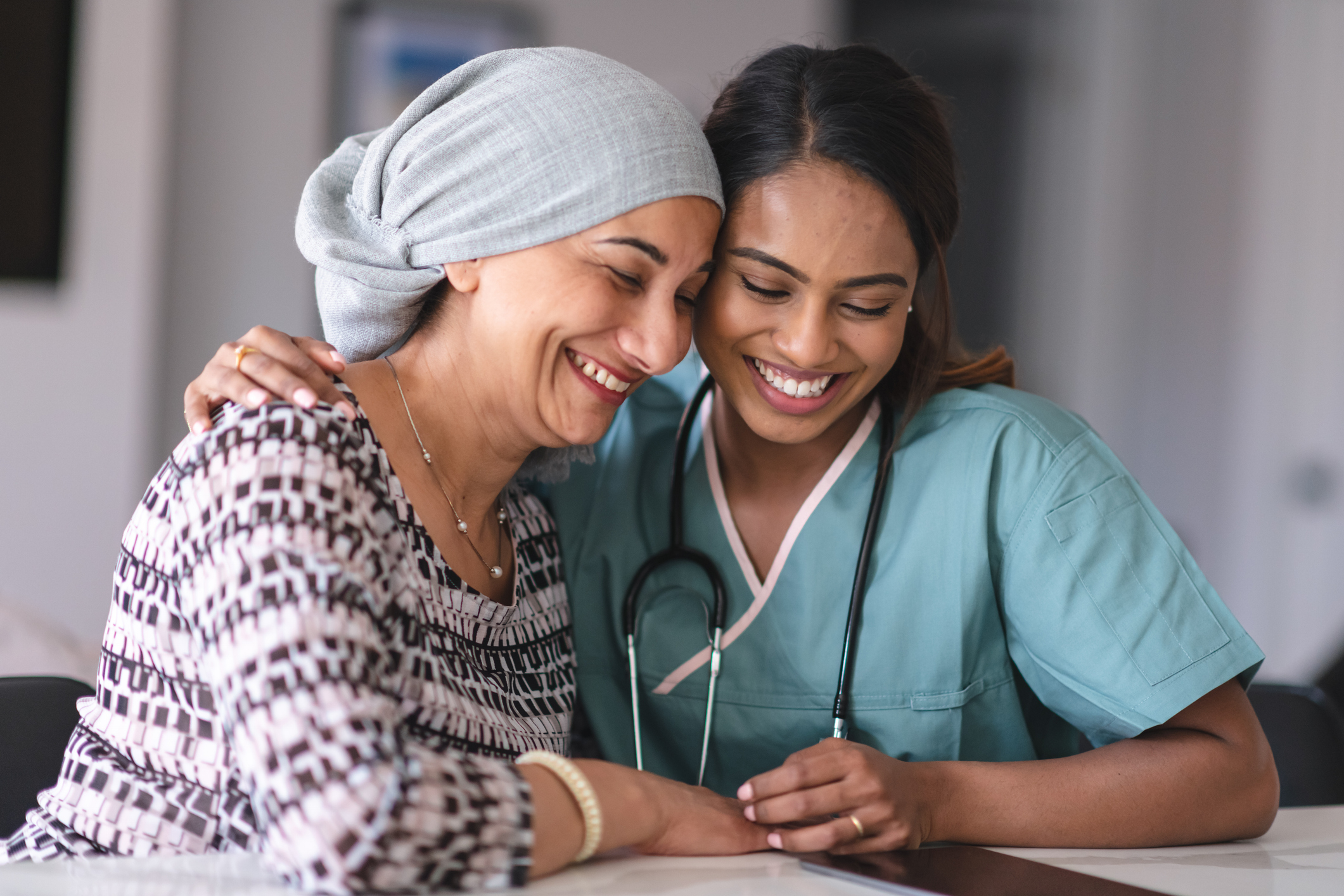
When language and cultural differences throw up barriers, access to cancer care becomes increasingly more complicated. For people in Australia whose primary language is not English, these challenges can result in critical obstacles preventing access to effective cancer care. Australia’s health system is monocultural, designed for English speakers with Western perspectives, which results in systemic barriers to accessing health care for the one in five Australians who speak a language other than English at home.
The data tells a sobering story: people from culturally and linguistically diverse (CALD) backgrounds are at higher risk of unmet needs, clinical depression and poorer quality of life, which stem from the difficulties people from other cultures can have understanding the healthcare system. Beyond language, cultural beliefs – such as fatalism, superstition or beliefs in karma or retribution, may also impact on how likely it is that an individual will access cancer care.
Helping Chinese-speaking and Vietnamese-speaking cancer survivors to live well with and beyond cancer is a specific challenge being addressed by Flinders University’s Associate Professor Carolyn Ee. To close this gap, her work moves beyond simple language translation to championing patient navigation – a dedicated effort to address cultural and linguistic disparities in cancer care.

Internationally recognised as an emerging leader in chronic disease management in primary care, Associate Professor Ee focusses on co-creating and evaluating models of cancer survivorship care that aim to improve and optimise patient outcomes, and prioritise patient wellbeing.
Associate Professor Ee says that previous research has proved valuable by identifying several barriers that affect people with CALD backgrounds from transitioning back to primary care after active cancer treatment.
“Many patients rely on bilingual GPs as trusted care coordinators, but this workforce is limited,” explains Associate Professor Ee. “Our team also demonstrated that cultural beliefs play a significant role in engagement with cancer care”.
“Patient navigation can help overcome individual, provider and systems barriers to accessing quality care in survivorship, but there is no available empirical data in Australia.”
To properly address and assess this situation, Flinders’ Caring Futures Institute researchers have created a complex study: “PatiEnt nAvigation to improve outcomes in people affected by cancer from cultuRally and Linguistically diverse backgrounds” – the PEARL study.
The PEARL study will assess the effectiveness and implementation of a patient navigation program for 292 people affected by cancer from Vietnamese-speaking and Chinese-speaking backgrounds. The PEARL study team is driven by the overall mission to ensure that high-quality cancer survivorship care is no longer a privilege of the few, but standard of care for every Australian.
The PEARL project began in 2025, supported by a Medical Research Future Fund (MRFF) Clinician Researchers: Applied Research in Health grant, and the project will continue until 2029.
Its goals are to validate a new approach to improving health outcomes for people with cancer from CALD backgrounds; to reduce barriers to survivorship care and provide improvements to health system effectiveness; to increase research capacity among specialist general practitioners; and to provide evidence on the cost-effectiveness and implementation of learnings from the PEARL study that can inform practice and policy development.
“We leverage our team’s expertise across primary care, community health, culturally appropriate approaches to healthcare, cancer survivorship, and implementation science,” says Associate Professor Ee.
“In doing so, we address a critical knowledge gap in Australia’s health care system, and deliver equitable outcomes in survivorship by ensuring that people with cancer receive the care they require – when, where and how they need it, regardless of cultural or linguistic background.
“This work ensures that people affected by cancer from Chinese-speaking and Vietnamese-speaking backgrounds can access the care that they need to live well with cancer. It will benefit them, their families and communities, the healthcare professionals on their teams, and the health system”.
This project, which involves the input of 17 research collaborators, is delivered at four locations in three Australian states – Adelaide in South Australia, Western Sydney and South Western Sydney in NSW, and Brisbane in Queensland.
The PEARL study is being conducted with 10 partner groups representing primary care, people with lived experience and multicultural health – which includes not-for-profit organisation Federation of Ethnic Communities’ Councils of Australia (FECCA), CanRevive Cancer Support Service in NSW, Inala Primary Care, Adelaide Primary Health Network, Western Sydney Primary Health Network, South Western Sydney Primary Health Network, World Wellness Group, Tong De Association of South Australia, and the Primary Care Collaborative Cancer Clinical Trials Group (PC4TG).
“PEARL builds on the extensive expertise of our partners in peer support, navigation and supportive cancer care and is directly informed by decades of consumer and end-user experience,” says Associate Professor Ee.
“We are proud to be delivering Australia’s first nationally scalable patient navigation program for Chinese- and Vietnamese-speaking cancer survivors in collaboration with our community partners. With their partnership, support and significant expertise, we are co-designing and delivering a program that will ensure all Australians with cancer can have the same outcomes – regardless of the language they speak.”
To learn more about the PEARL study, visit the Flinders Caring Futures Institute website.