


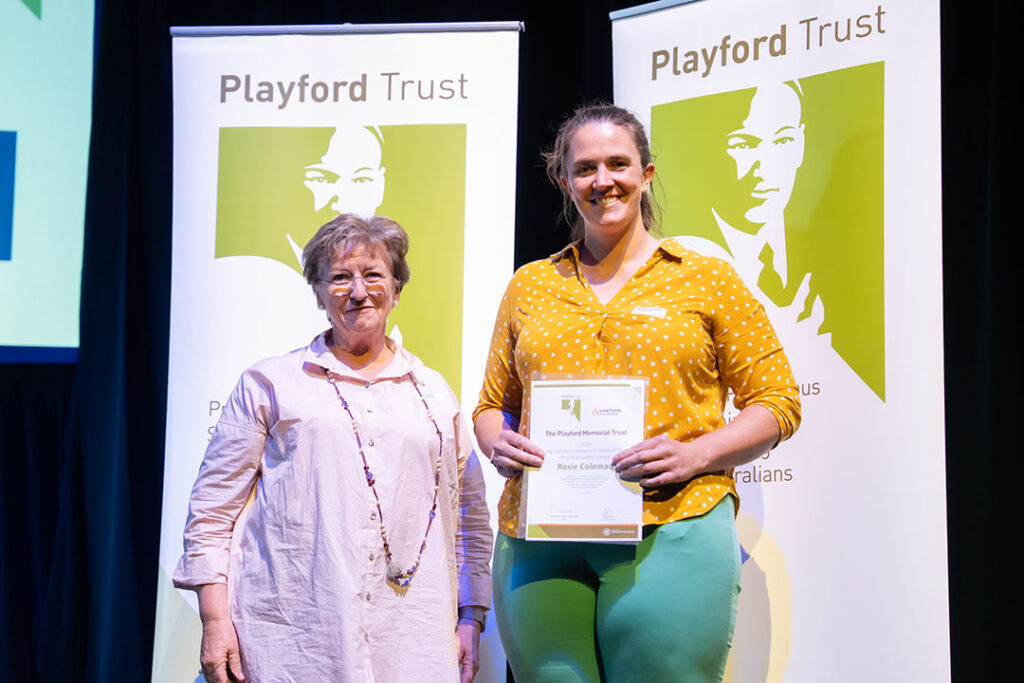
Rosie is a medical scientist with a rich blend of creative and academic experience. She began her career as a digital artist in animated television before shifting focus to science, completing degrees in psychology and medical science. After several years as a research assistant in the A Martin Gut Lab, Rosie has taken the PhD plunge and now spends her days in the Chew Worm Lab, studying brain cell biology in C. elegans.
Her current research explores how brain cells age and respond to stress, focusing on how these cells manage their proteins over time. Rosie hopes this work will reveal why brain cells are uniquely vulnerable—and how we might better support healthy ageing.
In 25 words or less, tell us what your research is about?
I use microscopic worms to research what it is about brain cells that make them particularly vulnerable to aging and neurodegeneration.
How do you believe your research will impact patient care or public health outcomes?
As a basic scientist, tangible public health outcomes are a blip on the horizon for my research. However, I hope that something I discover will be used to prevent or delay neurodegeneration in the future. The goal is always and without exception to try to make people’s lives better.
What do you enjoy most about being a researcher?
There are too many things I like about research to list, so I’ll go back to basics. Experiments. I love doing experiments and messing around in the lab. I’m one of those people that is still mind-blown about what you can do in a lab. You mean to say that I can wake up one day and go “hmm yes, I think I will genetically modify a worm to test this idea I have.” That’s wild.
What do you do when you’re not researching?
Like many scientists I am a huge nerd (don’t deny it). I am lucky enough to still have time to maintain a random variety of hobbies that include writing, sewing, playing video games and pretending to be an elf in Dungeons and Dragons. I also play soccer in an attempt to avoid becoming a sentient potato.
What advice would you give to aspiring health and medical researchers?
Be intentional. Be strategic. As a student, think about what you are doing and why you are doing it. Don’t be afraid of setting big goals and saying, “I want to do this” or “I want to be this.” It’s okay to change your mind if it doesn’t work out. In my opinion it is better to change a plan than to not have a plan in case it needs changing.