

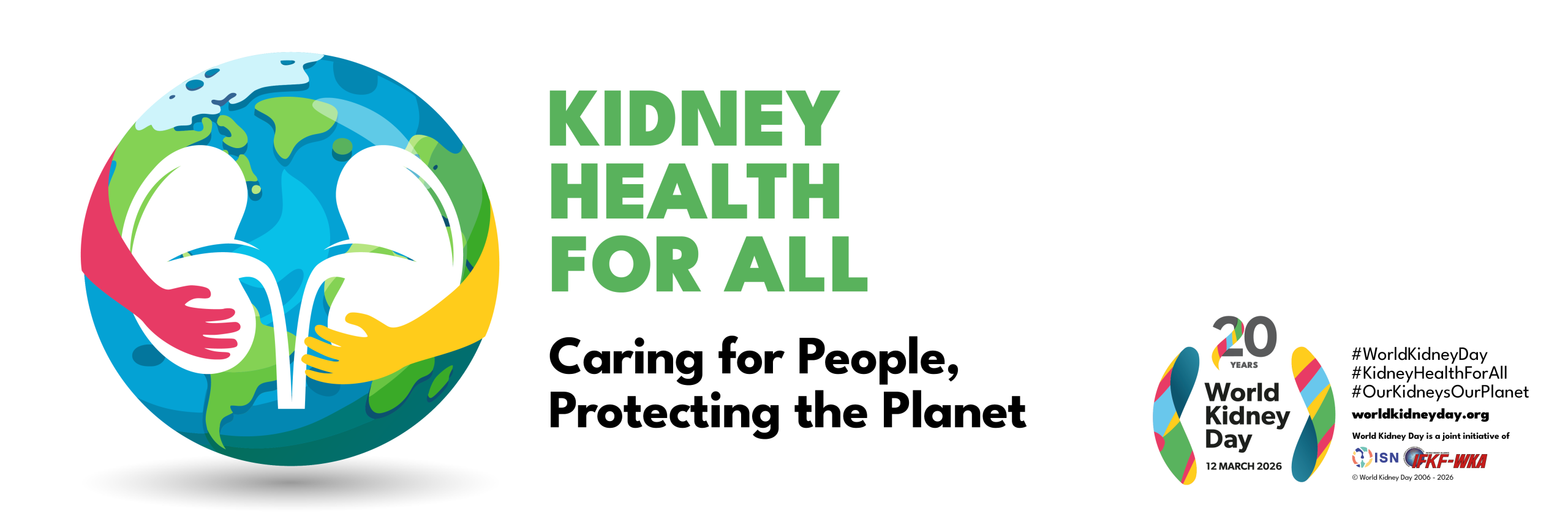

This year marks 20 years of World Kidney Day, observed globally on the second Thursday of March (in 2026, 12 March). It’s a timely reminder that kidney disease is common, often silent, and according to Kidney Heath Australia, it affects an estimated 2.7 million Australian, around one in seven adults.
At the Flinders Health and Medical Research Institute (FHMRI), researchers are tackling kidney disease through a broad and collaborative research effort spanning discovery science, clinical translation, environmental health and equitable access to care.
Together, FHMRI researchers are working to better understand how kidney disease develops, how it can be detected earlier, and how outcomes can be improved for patients and communities.
Understanding how kidneys grow, repair and adapt
Within FHMRI, Dr Darling Rojas-Canales, Senior Medical Scientist in the Renal Unit within SA Health, leads the Flinders Renal Laboratory in collaboration with Prof. Jonathan Gleadle.
Their research focuses on how kidneys grow, repair and adapt in conditions such as diabetic kidney disease and following the loss of kidney mass. Using human samples, advanced single-cell transcriptomic technologies and experimental models, the team aims to identify early disease markers and uncover new targets for treatment.
The program is increasingly moving into translational research, including strategies to support donor kidney function prior to transplantation and investigating emerging environmental exposures that may place additional stress on kidney cells.
Turning natural kidney responses into therapy
FHMRI researchers are also exploring how the body naturally adapts when kidney function is reduced.
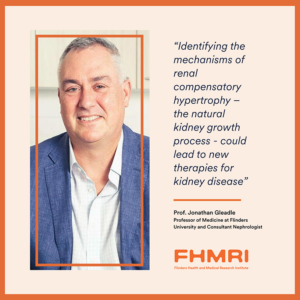
Prof. Jonathan Gleadle and collaborators are investigating why the remaining kidney enlarges and increases function after one kidney is removed. Their work focuses on whether the protein PAPP-A2 plays a key role in triggering this growth response, research that could help inform future therapies designed to preserve or enhance kidney function.
Emerging environmental risks
Another emerging focus within FHMRI is understanding how environmental exposures may influence kidney health. Darling Rojas-Canales, Prof. Gleadle and Assoc. Prof. Melanie MacGregor from Flinders College of Science and Engineering) are investigating whether nanoplastics can be taken up by kidney cells and disrupt their function.
Improving equity in kidney health
Kidney outcomes are shaped not only by biology, but also by access to care and health systems.
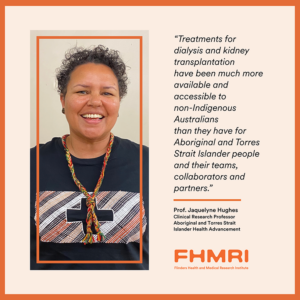
Prof. Jaquelyne Hughes leads nationally recognised research focused on improving kidney outcomes for Aboriginal and Torres Strait Islander peoples and those living in regional and remote communities.
Through her clinical and research leadership in northern Australia, and her involvement in national initiatives such as the Indigenous Kidney Transplantation Taskforce, Prof. Hughes advocates for more equitable access to high-quality kidney care regardless of where people live.
Global leadership in kidney disease research
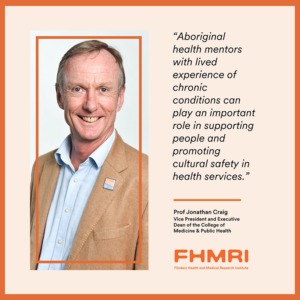
FHMRI is also home to internationally recognised kidney researcher Prof. Jonathan Craig, Vice President and Executive Dean of the College of Medicine and Public Health at Flinders University.
A paediatric nephrologist and clinical epidemiologist, Prof. Craig’s research has contributed significantly to improving the prevention, identification and treatment of chronic kidney disease, particularly in children and Aboriginal and Torres Strait Islander communities. Through leadership in international clinical trials and evidence-based guidelines, his work continues to shape kidney disease care in Australia and globally.
Advancing kidney health together
From understanding how kidney cells repair themselves, to exploring environmental risks and improving access to life-saving care, FHMRI researchers are working across disciplines to advance kidney health.
Together, the work of Dr Darling Rojas-Canales, Prof. Jonathan Gleadle, Prof. Jaquelyne Hughes and Prof. Jonathan Craig reflects the breadth of kidney research at FHMRI, connecting discovery science with real-world impact.
This World Kidney Day, FHMRI continues its commitment to improving prevention, treatment and equity in kidney health.
Are your kidneys OK?
👉 Take the quiz, learn your risk factors, and explore more about kidney health