


As the resident ‘Worm Lady’ at Flinders, Dr Yee Lian Chew spends her days studying the brains of these small creatures. Recently awarded a SA Young Tall Poppy for her science communication and research profile, we caught up with Yee Lian to chat about the pride she feels in her students, and ask why her house is also filled with tiny creatures.
What is your role and what does your work focus on?
I refer to myself as a neuroscientist, geneticist and worm-wrangler. More formally, I am the Mary Overton Senior Research Fellow in Neuroscience (Flinders Foundation) and an NHMRC Fellow, but that’s a bit of a mouthful.
My team’s research focuses on understanding the chemical profiles in the brain that control learning and memory formation. We think of learning and memory like opening up a new document and saving it on the brain’s computer, then pulling it out again when needed. Our work aims to identify the signals that encode this saved file within the brain, and define where this information is stored. We do this in the nematode ‘worm’, which has a small brain with only 300 cells, so our research allows us to visualise how single brain cells or larger networks change in living, learning animals.
Aside from my research, I’m also involved in teaching and training research students, and I do a lot of science communication and work with equity, diversity and inclusion advocacy groups both at Flinders and externally, such as the EMCR Forum (Australian Academy of Science).
What journey brought you to this point in your career?
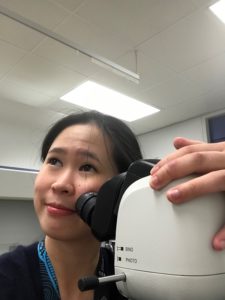 I can’t say that I ever thought as a child “I really want to be a scientist”, because for a long time I didn’t know any scientists and I had no idea that one could do science as a career.
I was certainly very curious about everything, and learning about genetics in high school was a major Eureka moment for me. It seemed to answer so many of my questions about the world.
I decided to study genetics in university, and then continued on to do a PhD so that I could do research full-time. Life has taken me to several different locations in Australia, the UK and the US during my research career, and for the past 10 years my major goal has been to understand life through the worm. My philosophy is always to do the most interesting thing and see where it takes me from there. It has worked so far!
What is something you are most proud of?
I have terrible imposter syndrome, so this is a very difficult question for me to answer. I always feel like I can never be proud of anything – but it comes much easier for me to be proud of other people. In 2020 (when I was still a Lecturer at the University of Wollongong), I had four Honours students who had a very disrupted year because of pandemic-related lockdowns and anxiety. Despite all the distress and challenges, they all graduated with excellent Honours grades. Two are now working in industry and two are pursuing PhDs – and one is in my team at Flinders! I’m definitely very, very proud of these students.
What does being named a Tall Poppy mean for you and your work?
I started formally training as a science communicator around the middle of my PhD in 2013, when I was nominated by my supervisor to be part of a program called Fresh Science (Science in Public), which still runs today. While all scientists have to communicate their science, this is usually aimed at a specific group of expert peers, and it takes a different set of skills to communicate science to people who are not experts. It takes another set of skills to do community outreach, where science is presented to the public in an interesting and digestible way. It takes serious effort to become a good science communicator, and I am not quite expert-level yet, but I have put a lot of hard work into it.
Being named a Tall Poppy was amazing because it formally recognised the efforts I have made over the years. Nowhere in my job description does it say ‘your role is to communicate science to the media and the public’, so I have basically been doing this in my ‘free time’ because I think it’s so important and I am so passionate about it. To have this recognised by AIPS is really lovely.
What does a normal day look like for you?
I spend a lot of my time just thinking about science. This may sound boring, but working out what the most interesting questions are, and how to answer them, is what I consider to be one of the most awesome parts about being a scientist. Of course, we then have to do the experiments to answer these questions – which makes up another big part of my day.
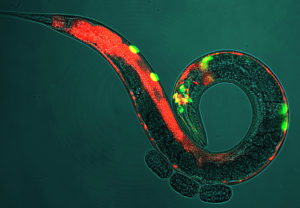
The more senior my role becomes, the more I delegate these experiments to my wonderful research students, who have projects of their own. It’s amazing to see how they make these scientific questions their own and start answering them in new and creative ways.
A lot of our experiments involve microscopes, so the day is spent mostly peering over eyepieces and watching the tiny worms (1mm in length) crawl around. We are currently investing a lot of time and energy into doing new experiments with instruments that allow us to visualise brain activity while simultaneously monitoring behavioural changes. We hope this reveal which chemical signals in the brain are required for learning and memory – not just in the little worms, but also in bigger brains.
How do you like to relax or spend your spare time?
I’m obsessed with crocheting stuffed yarn creatures (Amigurumi) – and my house is literally full of them. I have a dinosaur, a Totoro (cartoon character), a few whales, some Christmas baubles, a sheep… the list goes on. I just bought a book with patterns to make crocheted food! Fun times ahead.
Aside from this I also love baking (ugly) cakes and reading science fiction. The pandemic has made it hard to connect with family and friends in other countries but thanks to the internet, I manage to schedule regular phone calls with some of my favourite people.