

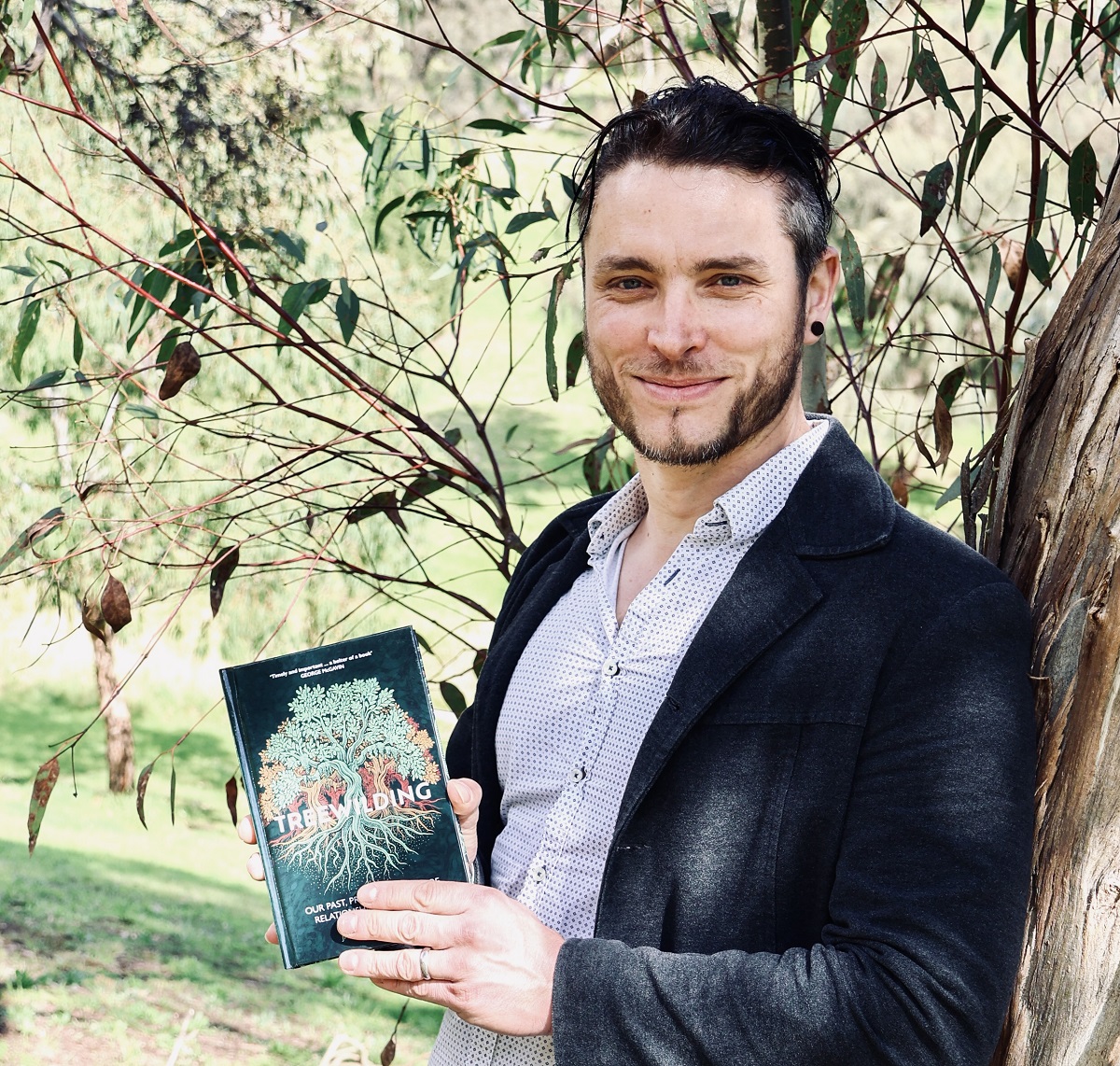
We caught up with Research Associate and Author Jake Robinson to chat about his latest book, Treewilding, which was released earlier this month.
What is your role here at Flinders?
My role at Flinders is as a Research Associate in Restoration Genomics. I’m employed on several projects, including climate-adjusted seed provenancing (leading the soil microbiome aspects) and a large National Environmental Science Program (NESP) Resilient Landscape project evaluating restoration methods across Australia. On the side, I work on aerobiome and soil ecoacoustics research, and I love to think about new ecological and evolutionary theories.
Tell us a little about your new book Treewilding.
Treewilding is all about how to restore global forests and our relationship with nature. The book draws together the latest science, Indigenous perspectives (I was lucky to interview Bruce Pascoe, author of Dark Emu) and controversies––think the ‘Wood Wide Web’ concept and Trillion Trees campaign. I also cover underappreciated perspectives, such as forests being as invisible as they are visible, and trees having senses and memory via epigenetics. I also set out pathways to a hopeful future.
How did you get into your field?
My research is quite interdisciplinary. I’ve always been interested in ecology, symbioses and ‘systems thinking’. I worked as a consultant ecologist for ten years in the UK before gaining a PhD. Along the way, I’ve acquired experience in biodiversity monitoring, molecular ecology, ecoacoustics and biodiversity-human health connections. I have degrees in ecology, ecosystem health, social research, neuroscience, and a PhD in microbial ecology. I now try to combine these disciplines to have a positive impact on the world.
Why did you decide to write a book?

I’ve always enjoyed writing. Last year, I published my first book Invisible Friends: How Microbes Shape Our Lives and the World Around Us. It aims to flip the prevailing negative narrative of microbes being “the bane of society’ on its head. This was partly a memoir of my PhD journey, and along the way, I collaborated with the world’s top microbiome scientists. I think I’m now addicted to writing books – it’s such a great creative output and allows me to translate complex research into more engaging forms. Through books, I can reach a wide audience and hopefully inspire people to think slightly differently about some of the underappreciated aspects of our world.
What’s your favourite thing about your work?
The diversity of my research is important to me and the ability to (hopefully) have a positive impact on the planet. I also love developing new tools and ways of thinking, it’s such a buzz!
Who inspires you?
I’m inspired by many people – other scientists, philosophers, artists, activists and practitioners. I’m also inspired greatly by the natural world. For instance, I write most of my books outside on a hillside, cliff top or in a forest. It’ll sound a little cheesy, but I view it as a kind of method writing, akin to the immersive experience of method acting – ‘at one’ with the perspective I seek to unravel!
How do you spend your spare time?
I love to be outside. Whether it’s riding a bike, rock climbing, kayaking or hiking. I’m quite a creative person, so I also like to paint, play musical instruments, host podcasts, etc.