

To celebrate 60 years of Flinders University, Flinders in Touch is looking back through the archives to highlight stories of impact from our past. Every month we’ll share a story about how much things have changed, or perhaps not at all, over the decades! These University highlights show how from the outset, we’ve been changing lives … together we can change 10 million lives for the better by 2035.
If you have a story that reveals something about the history of Flinders, send your idea through to communications@flinders.edu.au
Our commitment to electric vehicles started a long time ago
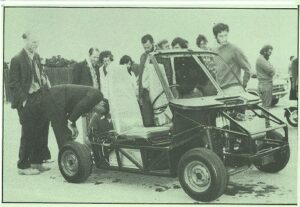
In April 1974, Flinders University hosted South Australia’s first Electric Vehicle Exhibition with thousands of people attending to see, feel and sit in over 50 electric vehicles. From lawnmowers, golf buggies and wheelchairs at the smaller end, to cars, tow tractors and forklift trucks.
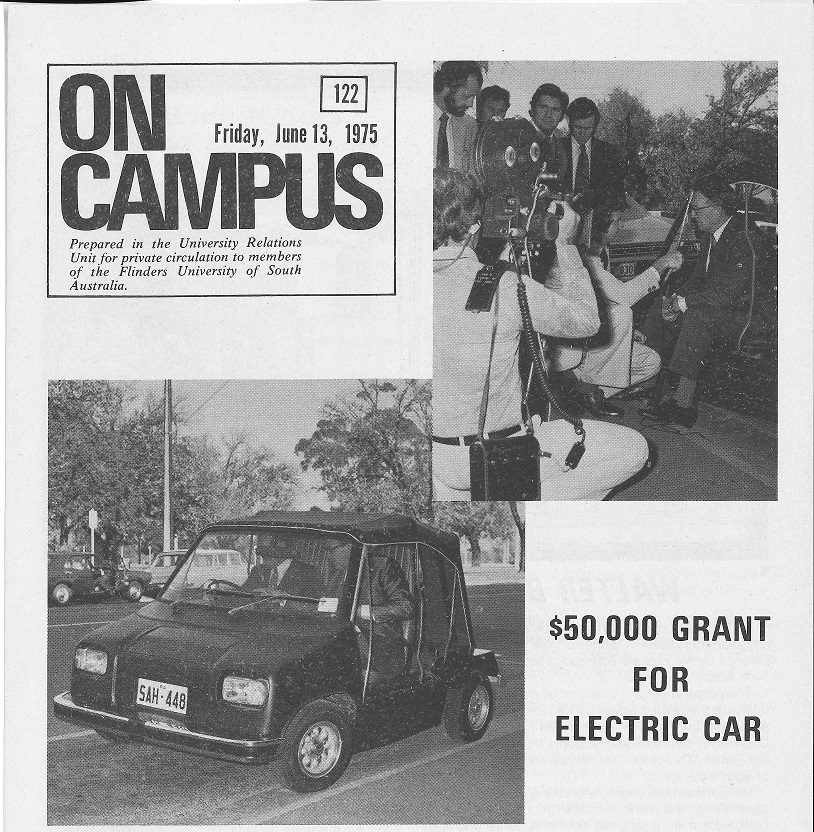
The exhibition attracted remarkable interest, but it wasn’t the first connection that Flinders had with electric vehicle research. In 1973, the South Australian government provided a total of $27,000 in grants to commence the Electric Vehicle Project. This was followed up with a whopping $50,000 in 1975.
Before the arrival of the second round of grant money, Flinders had already developed, “a small electric car technically superior in many respects to currently produced off-the-shelf electric vehicles.” Just to cement the car in Flinders’ history, they named it The Investigator.
During a time, not unlike the present, where society was grappling with rising fuel prices, the long-term hope was to kickstart an electric vehicle industry here in South Australia. This was a time when Chrysler and Holden were producing their peak number of petrol-driven vehicles and taking design ownership with Australian design modifications.
Fast forward to 2026, and Flinders’ commitment to sustainability has turned our focus back to electric vehicles. Fifty percent of Flinders fleet vehicles across South Australia and Northern Territory are either fully electric (36%) or hybrid (14%), with that number growing.

In the Flinders 2030 Sustainability Strategy, our goal is to electrify the entire small vehicle fleet and 90% of the entire fleet. Next on the agenda is the electrification of campus loop bus services.
The engineers who built The Investigator would have delighted in the 50+ EV chargers we have to choose from on campus, let alone the Vehicle-to-Grid charging capacity which might have sent a shiver through its battery.
The Investigator is currently being restored by the South Australian branch of the Electric Vehicle Association.
The Flinders staff newsletter has had a few names over the years. The main sources for this story were Flinders On Campus editions – 26 April 1974 and 13 June 1975.
Thank you to the staff at University Archives for generously helping us to access the Flinders’ archives.