

What is your role here at Flinders?
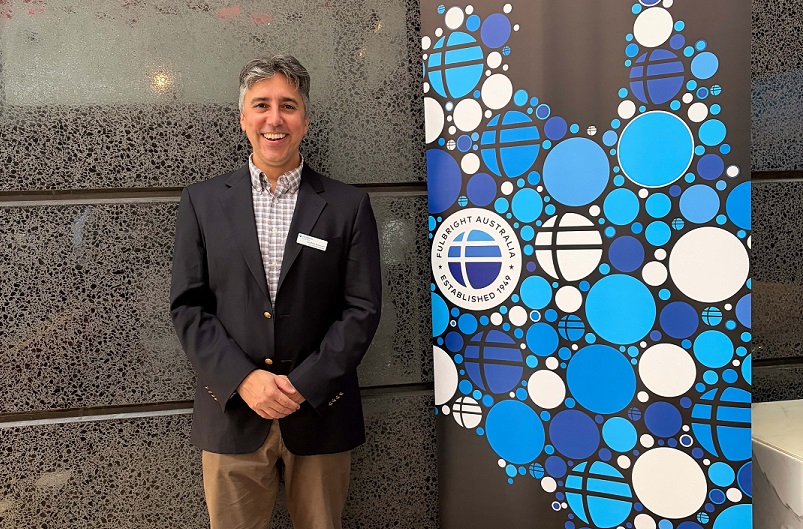
I’m at the Bedford Park campus through the end of May as the Fulbright-DeBats Distinguished Chair in Politics and Public Policy, based in the Jeff Bleich Centre for Democracy and Disruptive Technologies here at Flinders.
My research focuses on AUKUS, specifically Pillar Two, which I think is the more ambitious and under-appreciated dimension of the agreement. AUKUS is often shorthand for submarines, and given Adelaide’s deep investment in that area, that’s entirely understandable. But Pillar Two is about something broader: connecting and leveraging the innovation ecosystems of all three nations — industry, academia, and government — to strengthen regional security in the Indo-Pacific.
That plays out across a remarkably wide range of activity. It runs from the advanced manufacturing and new ventures taking shape at Tonsley, to the painstaking work of harmonising export licensing rules between Canberra, London, and Washington, to the trilaterally developed tech that our navies are already deploying in the Pacific. The ambition is real. So is the complexity.
What brings me to Australia specifically is the conviction that policy research of this kind has to be grounded in genuine listening. I’m here to hear from Australians about what’s working, what’s frustrating, and what they see coming. The United States has perspectives and resources to contribute to this partnership. But so do Australia and the United Kingdom, in ways that aren’t always fully recognised in Washington. Part of my job is to change that.
What initially drew you to studying law, and then public policy?
I joke that I was born to be a political scientist. You only need to look at my surname for evidence of that.
The honest answer, though, goes back to my parents. They were both public school teachers in New York State, and the dinner table in our house was rarely a politics-free zone. At least twice a week we’d be dissecting some decision by the state education board or a local school district, not as abstract policy but as something that directly shaped my parents’ working lives and, as I came to understand it, my own education. Politics wasn’t theoretical in our house. It had consequences.
As an undergraduate I studied political science and fell in love with a course on U.S. Constitutional Law. That combination pointed me toward graduate work that merged the two: a J.D. first, then a Ph.D. in political science. I was in school for a very long time. I have made my peace with that.
For the past seventeen years I’ve been a political scientist at RAND Corporation, a non-profit, non-partisan research organisation with deep ties to the U.S. Government and, I’d argue, one of the most genuinely rigorous policy research environments in the world. The work has ranged across national security, civil justice, and intellectual property, among other areas. What connects it is the same thing that connected law and political science for me from the beginning: the conviction that good analysis, honestly done, can make policy better. That still feels worth getting up for.
Would you like to share some thoughts on the key public policy issues facing Australia and South Australia at the moment?
Let me turn the question around, because I think it’s the more instructive framing: what can the United States and the international community learn from Australia?
Australia brings something rare to the challenges of contemporary governance: a combination of deeply held democratic values, a pragmatic policy culture, and the institutional capacity to actually get things done. That’s not as common as it should be. On energy transition, South Australia in particular has been a genuine laboratory for the world, moving faster and more boldly on renewables than almost any comparable jurisdiction. On public health, on emerging technology, on superannuation as a model for retirement security: Australia has repeatedly shown that good policy, built on evidence and sustained across governments, produces results.
There’s also something important in the university-industry-government partnerships that generates knowledge with real-world application. That model is in global demand, and rightly so.
I’ll add something more personal. I had the pleasure recently of meeting this year’s Australian Fulbrighters, who will be heading to the United States later this year. I told them to lean into the goodwill that being Australian generates because it is genuine and it is earned. Australia has built an international reputation grounded in fairness, decency, and straight dealing. That’s a form of soft power that outlasts any single administration or policy cycle.
Australia may not always be in the driver’s seat in a world still organised around Great Powers and Middle Powers. But any sensible driver should want Australia as Navigator. The land of the Southern Cross knows where True North is — and you’re not shy about saying so.
What has been your career highlight to date?
I’m my parents’ son, so perhaps it’s no surprise that when I reach for a career highlight, I reach for the classroom.
I’ve been teaching at Carnegie Mellon University’s Institute for Strategy and Technology since 2013, alongside my work at RAND. Carnegie Mellon’s motto is “My heart is in the work” and for me, that work is the students. The courses and theses, yes, but also the longer arc: watching students find their direction, plan for graduate school, and move into careers where they’re doing things that matter. That’s the highlight reel, if I’m honest.
Which is part of why I’m genuinely excited about the intensive course I’ll be offering here at Flinders in April, Contemporary Issues and Challenges for the AUKUS Partnership. It’s a one-week course, and I’m designing it to be substantive and immersive in equal measure. Students will hear from Australian and American policy practitioners, engage in Oxford-style debates on the genuinely hard questions the partnership faces, and work through exercises that put them in the role of policy advisors to ministers and defence decision-makers. The goal is to give them not just knowledge about AUKUS but a felt sense of what it’s actually like to navigate these decisions under uncertainty and constraint.
I still have finishing touches to put on the Topics Guide. But the architecture is in place. I think it will be one of the highlight weeks of my time here.
Tell us about your ideal weekend.
What I can tell you is that Adelaide has made the question almost irrelevant. The city has been setting the agenda, and I’ve been delighted to follow its lead.
I just wrapped up volunteering with Adelaide Fringe, which was one of the better decisions I’ve made since arriving. It was an extraordinary way to get to know the city, not as a visitor passing through, but as someone with a small stake in making it work. The arts scene here is thriving in a way that catches you off guard if you’re not expecting it, and the people who turn out for it, and give their time to it, say something real about Adelaide’s character.
Between Fringe, the Adelaide Festival, Adelaide Symphony performances, and Lunar New Year celebrations, Mad March (and a bit of February) has lived up to its name. So much culture; genuinely so little time.
And when I’m not at a show, you’ll find me at the Central Market. I’ve come to believe you can read a city by its market. By that measure, Adelaide is doing very well indeed. I keep finding reasons to go back. And watch out, Melbourne. Adelaide has coffee game, too!