

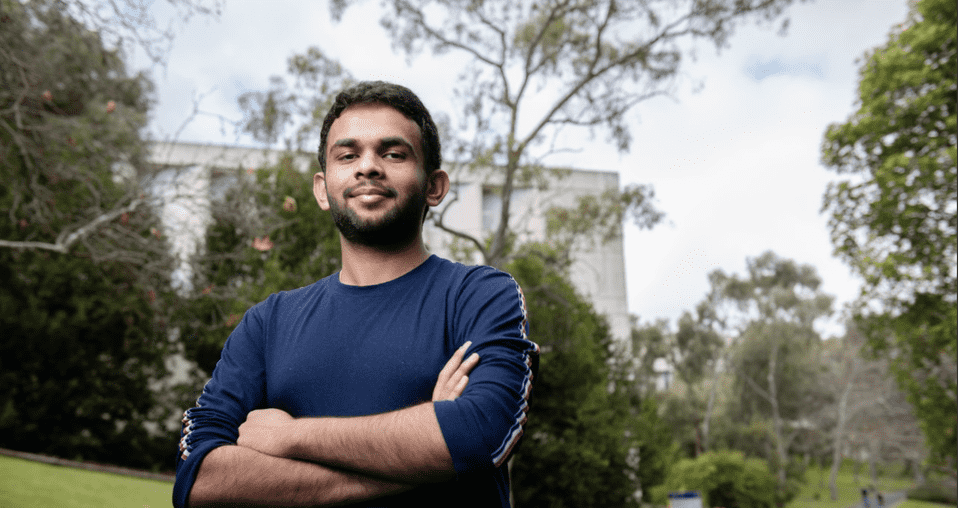
Tell us about your role as an IDS Artificial Intelligence Specialist at Flinders and what that involves.
As an Artificial Intelligence Specialist in IDS, my role is to help Flinders work out how the University can use AI in ways that are useful, responsible and sustainable.
That means I’m involved with a broad range of things, including:
- Working with teams across the University to identify where AI might be able to solve a problem and reduce administrative work.
- Helping people find information more easily, supporting better decision-making or creating new ways of working.
- Building and testing AI assistants and agents and exploring how these technologies should operate at an institutional level.
One thing I really enjoy about the role is the day-to-day variety of the work, whether that’s discussing an AI solution with a college, working through governance or strategy matters with senior leaders, running an AI session for staff or experimenting with a new technology.
There is also something special about doing this work at Flinders. I studied computer science, specialising in artificial intelligence, at Flinders, so it’s pretty cool to come full circle and now work for the University helping shape how it navigates the AI landscape.
With many narratives around artificial intelligence, how should we approach the technology moving forward?
AI is probably one of the fastest moving and most consequential technologies of my lifetime. At the moment, it’s moving faster than Melbourne’s erratic weather.
Jokes aside, I think we need to be able to hold two ideas at the same time. AI has enormous potential, but there are also legitimate questions around ethics, trust, sustainability, employment, privacy and the concentration of power around the technology.
I don’t think the answer is blind optimism or outright rejection. I think we need people willing to ask difficult questions, invest in research, build appropriate safeguards and make deliberate choices about where AI should, and shouldn’t, be used.
A book I found incredibly interesting and thought-provoking is Empire of AI by Karen Hao, which critically examines the AI industry, particularly OpenAI, and raises questions about the human, environmental and societal costs behind the rapid development of these systems.
At the same time, I think the public conversation sometimes focuses so heavily on generative AI that we forget how broad the field is. AI is being used in science to understand proteins, assist researchers, analyse complex data and develop specialised models for scientific problems. AlphaFold, for example, transformed protein structure prediction and is now used by researchers around the world across areas including disease, agriculture and antimicrobial resistance.
New technology will always be exciting and flashy, but I think from an organisational perspective, the important question is: what problem are we trying to solve and can AI help? Does AI make something better, faster or easier? Does it support the organisation’s strategy?
Outside of work I…
Outside of work, I like going to the gym, running, spending time with friends and reading – probably more reading than I realistically have time for.
Recently, I’ve developed an interest in history, human behaviour and how societies develop. At the moment I’m reading The Search for Modern China by Jonathan D. Spence, which is a very small and casual commitment at about 900 pages!
I think curiosity is probably the thread connecting most of my interests. Whether it’s technology, history, culture, food, people or something completely random that I’ve stumbled across, if I don’t understand it, there’s a good chance I’ll end up reading about it.
What quote do you live by?
There are two. The first is from James Clear’s Atomic Habits: “You do not rise to the level of your goals. You fall to the level of your systems.”
I’m very much a systems thinker. Goals are useful, but what you do repeatedly, such as your habits, discipline and the systems around you – usually determines whether you actually get there.
The second is an idea that has stayed with me and comes from Julia Galef’s The Scout Mindset: “The goal is not to be right. The goal is to find out what’s true.”
I read the book at a book club with friends and it challenged something that I think all of us do from time to time. We can become so invested in defending what we already believe that we stop being curious about whether we’re actually correct.
I like the idea of approaching things as a truth seeker rather than trying to win every argument. I’m definitely still working on that one!
What’s your favourite movie or book?
Choosing one book is difficult, but Lee Kuan Yew’s From Third World to First: The Singapore Story, 1965–2000 has really stayed with me.
Singapore’s story fascinates me. When it became independent in 1965, it was a small and vulnerable country facing unemployment, housing challenges, racial tensions, limited natural resources and considerable uncertainty about its future.
Within a few decades, it had transformed dramatically. What interests me is not only the country’s economic transformation, but the effort involved in building institutions, creating a shared national identity across different ethnic communities and thinking deliberately about the country’s long-term future.
I’m naturally drawn to stories like that: the underdog that succeeds through discipline, determination and deliberate choices.
Tell us about your favourite holiday.
My favourite holiday would probably be my solo trip to Malaysia. There wasn’t one particular attraction that made it memorable. Honestly, a very large part of the answer is the food. The food was fantastic.
Because I was travelling solo, I didn’t have to follow a strict itinerary so I could explore at my own pace, walk around, try different food and experience more of the local culture.
I really enjoy travelling that way because you get to observe how people actually live rather than moving from one tourist attraction to another.
The people I met in Malaysia were lovely and the whole trip was just so easy and enjoyable. Good food, good people, a different culture and the freedom to explore somewhere by myself.