

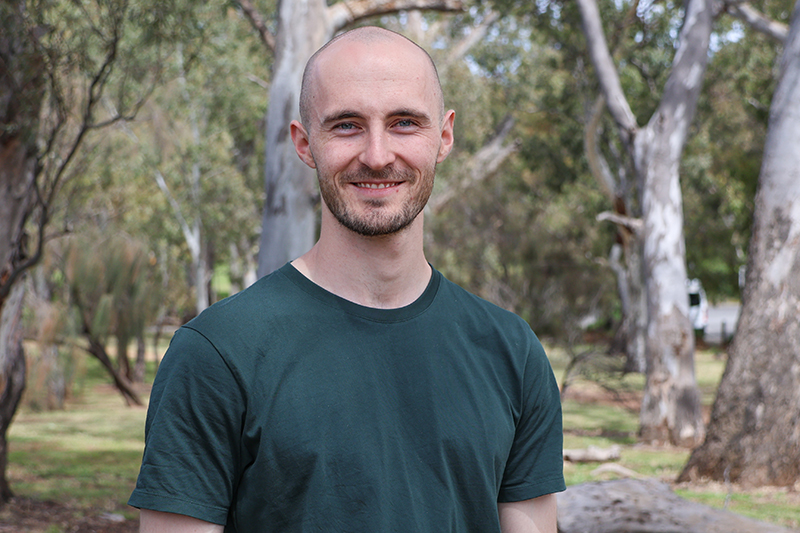
What is your role here at Flinders?
I recently submitted my PhD and am now working as a Postdoctoral Research Associate within the FHMRI: Sleep Health team. I’ve also recently enrolled in the Master of Psychology (Clinical) program as a postgraduate student.
What drew you to sleep research? And what kept you motivated throughout your PhD?
My interest in sleep began in Year 12 during psychology classes. I was fascinated by the mysterious nature of sleep and its critical role in health and daily functioning. That curiosity stayed with me, and during my third year of psychology, I completed a research placement at the Child and Adolescent Sleep Clinic at Flinders. There, I had the opportunity to engage in sleep research and observe evidence-based treatments for sleep and circadian rhythm disorders. The following year, I completed my Honours project with FHMRI: Sleep Health, which ultimately led me to begin my PhD.
On motivation—I’m not actually sure “motivation” is the right word. If I only worked when motivated, my thesis would have taken 10 years! For me it was about showing up every day and chipping away at the work. I was told early on in my candidature that a PhD is a “slow burn,” and that proved true. Consistency and commitment were key. That said, having a supportive team of advisors and colleagues, supportive family and friends, and the ability to step back from the work regularly made all the difference in sustaining the effort required to finish.
From your recent study about the relationship between sleep and physical activity, can you please share a few helpful insights?
We analysed data from over 70,000 users of two consumer health tracking devices to explore the relationship between sleep and daily step count. Only about 13% of people in our global sample consistently achieved both adequate sleep (7–9 hours per night) and physical activity (8,000 steps per day). Alarmingly, nearly 20% of users slept less than 7 hours and made fewer than 5,000 steps daily—a combination of insufficient sleep and a sedentary lifestyle.
We also found that a good night’s sleep was linked to higher activity levels the following day, and that this influence was stronger than the reverse (physical activity improving sleep). Overall, the study highlights how challenging it is to balance modern life with healthy sleep and activity habits, but it reinforces that getting 7–9 hours of quality sleep each night provides a foundation for better daytime functioning and more physical activity.
What has been your career highlight to date?
That’s a tough question because I’ve had many great experiences at Flinders. If I had to choose one, it would be the opportunity to travel to Brazil and Spain to present my PhD research at international conferences. These experiences were so valuable for networking, staying up to date with the latest science, and learning how to communicate my research findings effectively. Standing in front of a seminar hall and presenting to experts in the field was a bit surreal, but I’m proud of those moments and grateful for the opportunities.
What do you enjoy about working at Flinders?
The people, without a doubt. I’ve been fortunate to study and work alongside incredible individuals throughout my undergraduate degree, Honours year, PhD, and now postdoctoral work. Their support and inspiration have shaped my journey so far! I’d be remiss if I didn’t mention all the great coffee shops we have at Flinders that have definitely contributed to making my time here enjoyable also!
Tell us about your ideal weekend.
A Saturday morning bike ride and coffee stop with my mate, followed by a relaxing afternoon with a good book and a home-cooked dinner with my partner. On Sunday, a drive through the hills to see my family, a forest walk with the dog, maybe lunch at a café, and then an evening cooking something delicious together. Simple, but perfect for me!