

Picture this, on 20 April 1967, just one year after opening its doors, Flinders University holds its first graduation ceremony in the Matthew Flinders Theatre. With organ at the ready, Dr Robert Illing plays Bach’s Toccata and Fugue in D Minor, then Fantasia in G Minor, while the procession of all staff and academics files in.
Four awards and two honorary doctorates were conferred that day in a ceremony presided over by Chancellor Emeritus Professor Sir Mark Mitchell, and Vice-Chancellor Emeritus Professor Peter Karmel.
The very first graduand to walk across the stage was Alan Easton, who graduated with a Master of Science. Alan was followed by David Panton while William McKee received his award in absentia. The single graduate for Honours Degree of Bachelor of Science, Janet Oliver, was also absent that day.
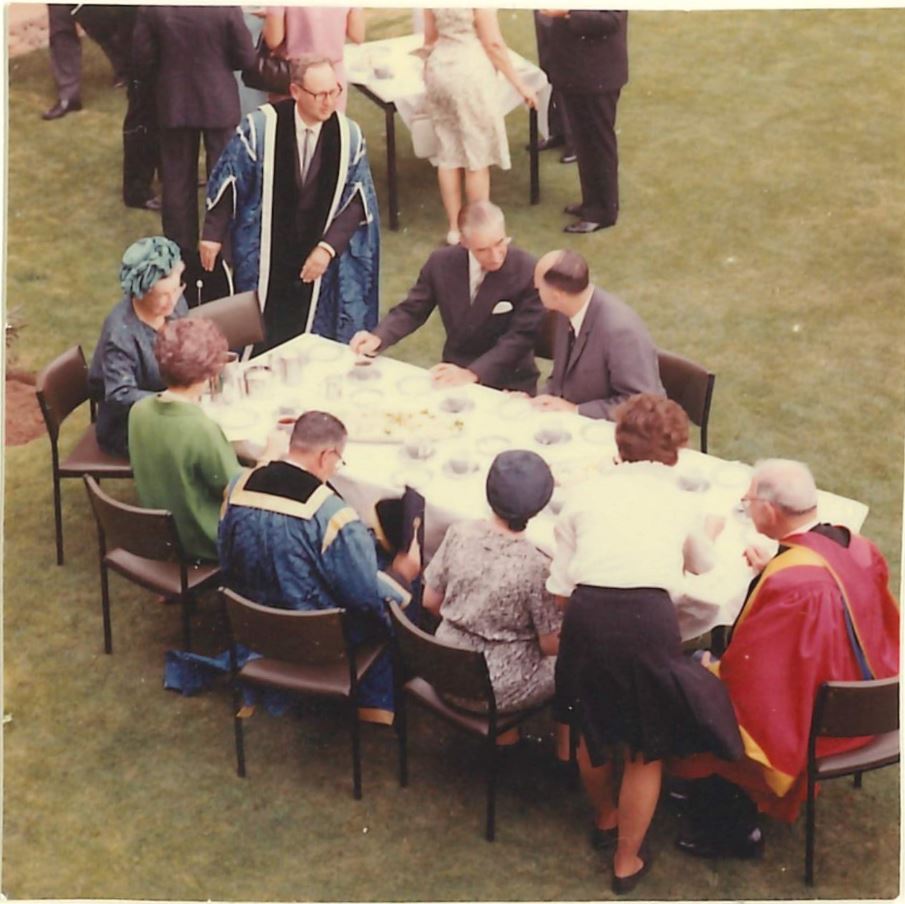
After the ceremony, everyone retired to the Language, Literature and Social Sciences courtyard for afternoon tea (with real crockery and neatly cut sandwiches).
Professor Alan Easton went on to achieve a PhD in Physical Sciences, graduating in 1971, eventually becoming a professor teaching mathematics at Swinburne University of Technology in Melbourne. He was the first in his family to study at university, and one of the first to study physical oceanography at Flinders.
 We were delighted in 2018 that Professor Easton, who remains connected as a Flinders alumnus, could join us in celebrating with Flinders’ 100,000th graduate, Sarah Wright. Sarah, who enrolled at Flinders through one of the many pathways designed to increase access to higher education, graduated with a Double Degree in Education and Health Sciences, receiving a Chancellor’s Letter of Commendation for academic excellence.
To give you an idea of how much we have grown, in 2025, Flinders celebrated the achievements of 3,766 graduates (just a slight bump up from four!). At our most recent April graduations, which ran across four days in Adelaide, we held 12 ceremonies, with 2,416 graduates and 8,786 proud guests. We continue to hold graduations across South Australia, Northern Territory, Singapore and China, and we see a steady 10% growth in the size of our ceremonies each year.
By the end of our 60th year, Flinders will have taught, guided and supported almost 150,000 graduates.
That is 150,000 people going out into the world with their expertise and understanding to deliver the impact that makes Flinders University proud.