

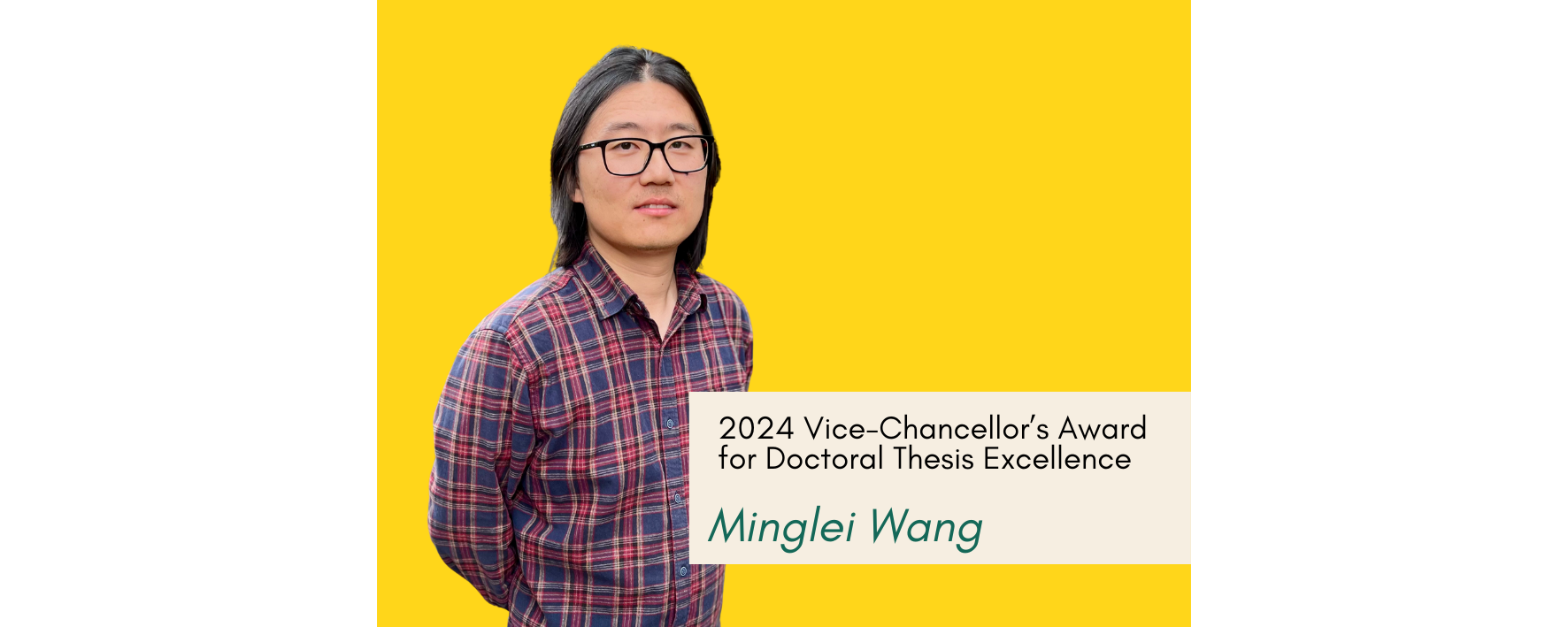
Minglei is from the College of College of Humanities, Arts and Social Sciences and is one of the 12 winners of the Vice-Chancellor’s Award for Doctoral Thesis Excellence for 2024. Minglei’s thesis was titled “Chinese Cultural Diplomacy in the 21st Century: The China Cultural Centre Project”
We invited Minglei to share insights into the PhD journey and what winning this award means.


What is your research about?
My research examines the establishment, operation, and programming of the China Cultural Centre (CCC) project within the broader context of Chinese cultural diplomacy.
What does winning the Vice-Chancellors Award for Doctoral Thesis Excellence mean to you?
Achieving this prestigious award is deeply meaningful to me on multiple levels. First and foremost, it serves as a recognition of the quality and significance of my PhD thesis, which reflects years of dedicated research and sustained inquiry. It also stands as a testament to the outstanding supervision I received from Dr. Jeffrey Gil and Dr. Nicholas Godfrey, as well as the broader support from the College of Humanities, Arts and Social Sciences—without whom this achievement would not have been possible.
On a personal level, the award represents a profound sense of self-fulfilment. It affirms the value of the intellectual and emotional investment I made throughout my doctoral journey. At the same time, this is an honour I would like to dedicate to my family, whose patience, encouragement, and unwavering belief in me provided the foundation I needed to persevere.
Finally, this award marks an important milestone in my academic career. It strengthens my confidence as a researcher and motivates me to continue contributing to my field with purpose and integrity.
What led you to undertake a PhD? What inspired or motivated you?
Before beginning my PhD, I worked in both Chinese and Australian cultural organisations, coordinating arts and cultural programs. These experiences deepened my interest in cultural diplomacy and prompted me to reflect on the broader role of culture through the lens of diplomatic studies and international relations. This combination of curiosity and reflective engagement with the field led me to undertake a PhD.
Tell us about your research
My research focuses on Chinese cultural diplomacy, with a particular emphasis on the China Cultural Centre (CCC) project. My thesis, Chinese Cultural Diplomacy in the 21st Century: The China Cultural Centre Project, examines the establishment, operation, and programming of CCCs using a diverse range of data sources. It analyses their structural and operational features, offering detailed insights into their working modes and key activities, particularly through case studies based in Australia. By investigating these dimensions, the study considers the broader implications of its findings for the CCC project, contributing to a deeper understanding of China’s cultural diplomacy in the 21st century and enriching current scholarly discussions in the field.
What has been one of the most enjoyable parts of the journey?
One of the most meaningful and enjoyable aspects of my PhD experience was the exceptional support I received from my supervisors. I was truly fortunate to be guided by Dr. Jeffrey Gil and Dr. Nicholas Godfrey, whose mentorship consistently exceeded expectations. Throughout my candidature, they provided insightful, timely feedback on my thesis, offered thoughtful suggestions for improvement, and made time for regular discussions about my research. Their dedication significantly enhanced the clarity and rigour of my work, which was ultimately awarded an A/A (degree awarded without amendments)—a result that attests to the quality of their supervision.
Beyond their support for my thesis, Jeff and Nick also involved me in a number of research initiatives. These opportunities enabled me to build valuable research experience, contribute to scholarly outputs, and deepen my understanding of academic practice. This broader engagement proved essential in preparing me for my future in academia.
Despite their demanding workloads, they consistently offered generous feedback on my written work and application materials. Their encouragement and guidance were crucial to my success in achieving several important outcomes during my candidature, including the Library (Graduate) Fellowship at the Australian Centre on China in the World, Australian National University, and the Australian Society for Asian Humanities Emerging Scholar Award.
I am deeply grateful for the time, attention, and care Jeff and Nick devoted to my development during my PhD. Their support not only made the journey intellectually rewarding, but also personally meaningful. Since completing the degree, our relationship has evolved into a collegial one, and we continue to collaborate on research and teaching. This ongoing connection has been one of the most gratifying outcomes of my doctoral journey.
What advice would you give to current or prospective PhD students?
Before starting—or even applying for—a PhD program, it’s wise to have a preliminary idea of the research area and questions you would like to explore. While these may shift over time, thinking carefully about them early on can provide a solid foundation for your work and help guide your direction.
Equally important is assessing your ability to commit to this significant undertaking over the next three to four years. You might find it helpful to talk this over with your family or close ones, especially since the PhD journey can be demanding and, at times, isolating. Having their support can make a big difference when you encounter challenges.
As you move through your PhD, be mindful about how you manage your time. While gaining broader experience is valuable, be cautious not to let other commitments interfere with timely progress toward your thesis. In my view, a thoughtful and balanced approach is best—choose opportunities that complement your research, but keep your primary focus on completing your degree within your intended timeframe.
Your relationship with your supervisors can also play a critical role in your success. Try to build a relationship based on mutual respect and open communication. Stick to timelines you’ve agreed on together, take their feedback seriously, and make the most of your meetings by coming prepared with questions and updates related to your work.
Lastly, time management deserves extra emphasis. While planning your research timeline is crucial, putting that plan into action is even more so. Self-discipline is key—managing your limited time effectively will ultimately determine how smoothly your PhD progresses.
Where are you now?
I am currently a tutor in the College of Humanities, Arts and Social Sciences and an academic support advisor in the College of Business, Government and Law.