

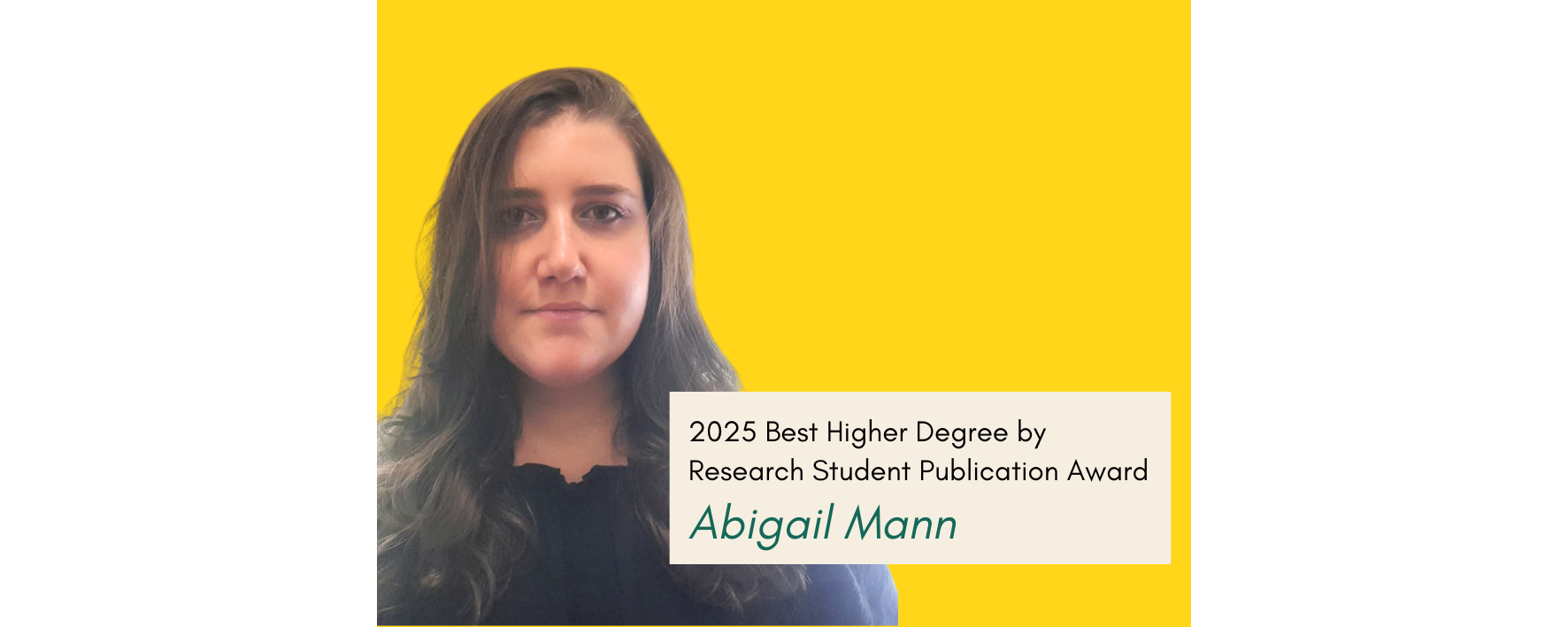
Abigail Mann is from the College of Science and Engineering and is one of the recipients for the 2025 Best Higher Degree by Research Student Publication Award and is supervised by Prof Justin Chalker and Dr Christopher Gibson.
Abigail’s publication was titled “Probe-Based Mechanical Data Storage on Polymers Made by Inverse Vulcanization”
We invited Abigail to share insights into the PhD journey and what winning this award means.


What does your publication explore?
This publication explores a proof-of-concept idea that a low-cost, robust polymer platform for mechanical data storage that addresses longstanding barriers to commercialisation. While companies such as IBM and Intel previously explored mechanical storage, high energy demands and complex, expensive polymer systems limited translation. In this study, we overcome these challenges using an inverse vulcanised sulfur polymer containing dynamic S–S bonds, enabling reversible write–read–erase cycles. Data are encoded mechanically as nanoscale indentations and erased via thermally activated S–S metathesis and polymer reflow. A central key advance is precise control over indentation depth (1–30 nm), enabling ternary rather than binary coding and increasing storage density four-fold. Importantly, data writing occurs at room temperature, substantially reducing energy requirements. The polymer used is synthesised in a single, low-cost step and supports high-density, high-fidelity information encoding, making it a compelling candidate for archival data storage.
What is your research about?
My research develops low-cost sulfur-based polymers for rewritable mechanical data storage. By exploiting dynamic S–S bonds, we can encode information as nanoscale mechanical features with high density, low energy input, and the ability to erase and rewrite the data.
Tell us about your PhD journey so far
My PhD journey has been both fulfilling and deeply rewarding. It gave me the opportunity to explore new ideas and contribute new knowledge that others can build upon. Beyond the discoveries themselves, it was exciting to help lay the foundation for future projects, particularly at the intersection of multiple disciplines where ideas and methods converged to create something new. Throughout this process, I developed a broad and versatile skill set, both technical and professional, and benefited enormously from the guidance of exceptional supervisors whose mentorship shaped not only my research, but also my growth as a scientist.
What does winning this award mean to you?
Winning the Best HDR Student Publication for this paper is a validation of both the quality and impact of this research. It highlights that the work and experiments that I dedicated my study to stands out not only in technical rigor, but in originality, execution, and contribution to the field.
Why did you choose to commence a PhD?
I commenced my PhD because I was drawn to research as a career and genuinely enjoyed the challenge and variability it offers. I was motivated by curiosity—the freedom to ask questions and work through them. What appealed to me most was the logic of it: research felt like an intricate problem-solving game, where each experiment, result, and setback provided new information to refine the next move. That intellectual challenge, combined with the opportunity to create new knowledge, made the PhD a natural and rewarding path.
What are your future goals and plans? / Where do you see your career heading in the future?
My overall goal is to build an independent research career leading innovative, cross-disciplinary projects. I aim to translate fundamental materials insights into functional systems while mentoring students and contributing to impactful collaborations across chemistry, materials science, and engineering. I have recently completed my PhD journey and have transitioned into a postdoctoral position at the University of Sydney where I pursue applications of the ideas that were formed from my PhD work.