

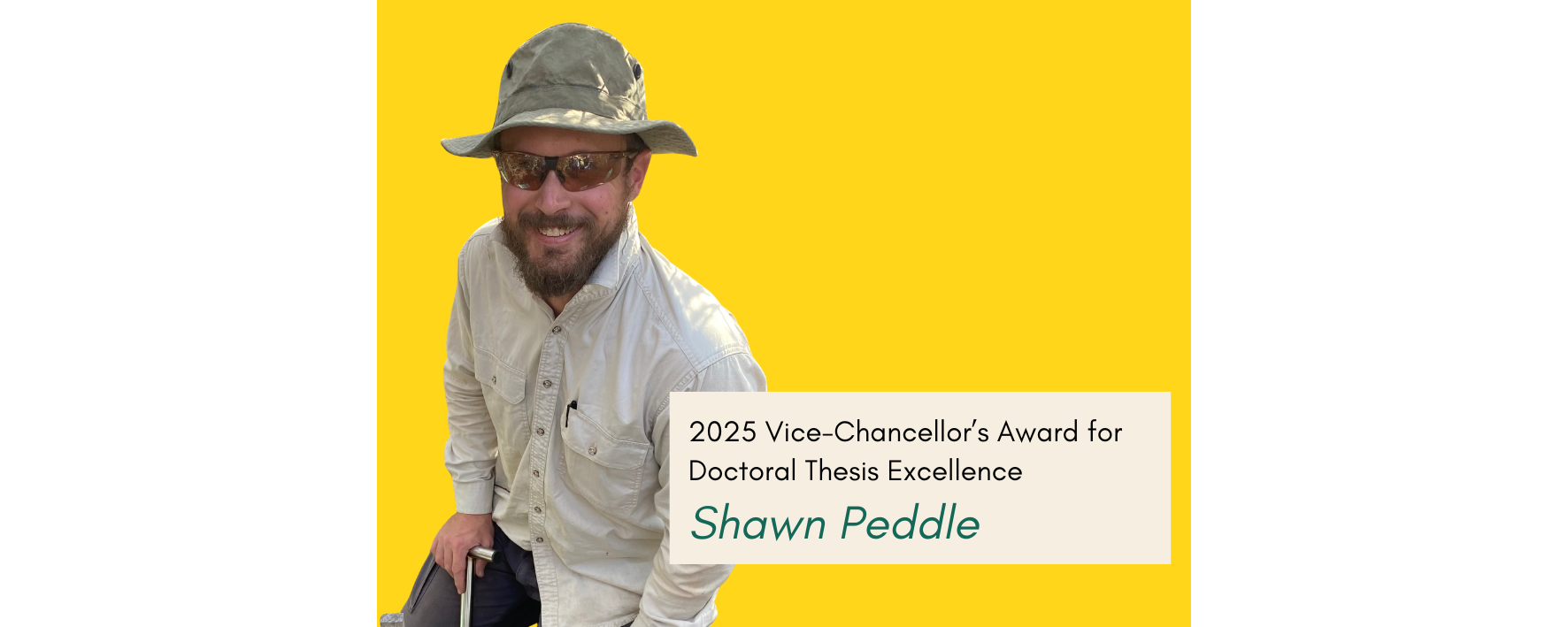
Shawn Peddle is from the College of Science and Engineering and is one of the recipients for the 2025 Vice-Chancellor’s Award for Doctoral Thesis Excellence and was supervised by Professor Martin Breed, Dr Craig Liddicoat, Professor Rob Edwards and Dr Siegy Krauss.
Shawn’s thesis was titled “Harnessing the soil microbiome to improve ecosystem restoration in a global biodiversity hotspot”
We invited Shawn to share what this award means and his research was important.


What is your research about?
My research investigates how soil microbial communities influence the recovery of degraded ecosystems, and how integrating the soil microbiome into restoration practices can improve restoration outcomes. Using field studies and genomic approaches, I identify barriers to microbial recovery and develop practical methods-such as soil translocation-to enhance the restoration of resilient, functional ecosystems.
What does winning this award mean?
This award reflects far more than my individual efforts – it is a testament to the people and environment that supported me throughout my PhD. I was fortunate to be guided by exceptional supervisors whose mentorship substantially contributed to the quality of this work, alongside a community of peers who helped and collaborated with me along the way. Just as importantly, the unwavering support of my family provided the foundation that made it possible to persist through the inevitable challenges of a PhD.
Tell us about yourself
I’m a restoration ecologist specialising in soil microbial ecology, with a focus on improving outcomes in ecosystem restoration. I came to academia as a mature student after earlier careers in reforestation and hospitality, which gave me a practical perspective and a strong work ethic that I bring to my research. My work aims to bridge fundamental ecological understanding with applied restoration practice.
What was the topic of your PhD and why is it important to you?
My PhD focused on how soil microbial communities influence the recovery of degraded ecosystems, and how they can be better integrated into restoration practice. This is important to me because current restoration approaches often overlook soil and its importance for supporting whole ecosystems, despite it underpinning many key ecosystem functions and influencing long-term success. Improving how we restore these hidden but critical components is essential for rebuilding resilient ecosystems in the face of biodiversity loss and climate change.
Where are you now?
I’m currently working as a postdoctoral research associate at Flinders University, where I continue to build on my PhD research to develop practical approaches for improving ecosystem restoration outcomes.