


Every year on 4 February, World Cancer Day highlights the people and discoveries driving progress against cancer. At the Flinders Health and Medical Research Institute (FHMRI), PhD candidates are at the forefront of this effort, translating laboratory science into knowledge that could change how patients are treated.
One of those researchers is Lucy Franzon, whose work focuses on pleural cancers, including lung cancer and mesothelioma, and on developing smarter ways to tailor treatments to individual patients.
From Flinders Student to Translational Scientist
Lucy’s pathway into cancer research began at Flinders University, where she completed a Bachelor of Medical Science (Honours). During that year she worked with her supervisors Prof. Briony Forbes and Assoc. Prof.Michael Michael, where I studied colorectal cancer, an experience that confirmed her interest in research that sits close to patient care. When she officially commenced her PhD the following March, it felt like a natural next step, continuing to build expertise in a place where discovery and clinical practice are tightly connected with supervisors Prof. Sonja Klebe and three co-supervisors: Dr Zivile Useckaite, Dr Yazad Irani and Dr Ashleigh Hocking at FHMRI.
Growing Tumours in the Lab to Help Patients in the Clinic
Cancer biology can be complex, but Lucy describes her work in simple terms.
“I grow miniature versions of a patient’s own tumour in the lab to better understand how cancers behave and respond to different treatments.”
These three-dimensional models, known as patient-derived organoids, allow researchers to test therapies in highly controlled conditions that closely reflect what happens inside the body. By observing how different tumours respond, Lucy hopes to contribute to a future where treatment decisions are guided by the biology of each patient’s cancer, rather than a one-size-fits-all approach.
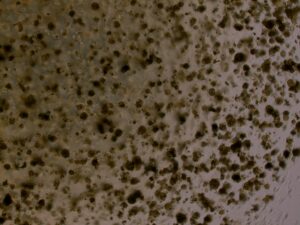
Photo: lung cancer organoid
Addressing an Urgent Need in Pleural Cancers
For many people diagnosed with pleural malignancies, current therapies are limited or unpredictable. Lucy’s research aims to uncover why some patients respond well to treatment while others do not, and how those differences might be identified earlier.
What makes her work distinctive is the way it brings together tumour organoids and immune profiling, allowing scientists to explore how cancer cells interact with the immune system. These interactions are central to modern immunotherapies, yet they have rarely been studied in depth for pleural cancers. By filling this gap, Lucy’s project could help clinicians make more informed choices and accelerate the development of new treatment strategies.
Impact Beyond the Laboratory
Although the work takes place in controlled research settings, its potential reach is wide. Patients with lung cancer or mesothelioma could benefit from more targeted therapies, while clinicians may gain better tools to guide decision-making. Researchers and industry partners could also use these models to evaluate new drugs, and the same approach may eventually be adapted to many other cancer types.
If successful, Lucy’s findings could extend beyond clinical practice and into health policy. By identifying which patients are most likely to benefit from specific immunotherapies, the research may contribute evidence that informs future Pharmaceutical Benefits Scheme decisions in Australia, helping ensure treatments are available to the people most likely to gain from them.

Photo: Lab group left to right: Lauren Mortimer, Sarita Prabhakaran, Rhys Fogarty, Lucy Franzon, Sonja Klebe, Zivile Useckaite, Yazd Irani, Arya Arul & Ashleigh Hocking.
Collaboration, Resilience and the PhD Journey
Lucy’s weeks move between experiments in the lab, analysing data, meeting with supervisors and collaborators, and troubleshooting when results do not go to plan. She also works closely with clinicians and pathology services, keeping the project connected to real-world patient needs, a defining feature of translational research at FHMRI.
Along the way, she has developed skills she never expected to gain, from project management and communication to resilience and creative problem-solving. The toughest lesson has been accepting that failed experiments are not a sign of failure, but part of the process. When progress feels slow, she returns to the bigger picture: the possibility that her work could one day improve outcomes for people living with cancer.
She is also quick to challenge the idea that PhD students work in isolation.
“In reality, research is highly collaborative,” she says.
What Comes Next
Looking ahead, Lucy hopes to expand her models to include additional immune components, link laboratory findings more closely with patient outcomes, and test a broader range of cancer types and therapies in larger patient cohorts. Each step brings the research closer to clinical application.
Her PhD is laying the groundwork for a future in translational cancer research — a career focused on ensuring discoveries at the bench move quickly and effectively into hospitals and clinics.
Investing in the Next Generation of Cancer Research
On World Cancer Day 2026, Lucy’s work is a reminder that progress against cancer depends not only on major breakthroughs, but also on the steady commitment of early-career researchers asking complex questions and persisting when answers take time.
At FHMRI, that dedication is helping shape a future where cancer care is more precise, more personalised, and filled with greater hope for patients and families alike.