

Considering the debilitating and socially restricting effect digestive and gut health issues can wreak on people’s quality of life, there is still a huge amount we don’t understand about causation. Therefore, many disorders either go undiagnosed or at best, the results of hopeful treatments are underwhelming.
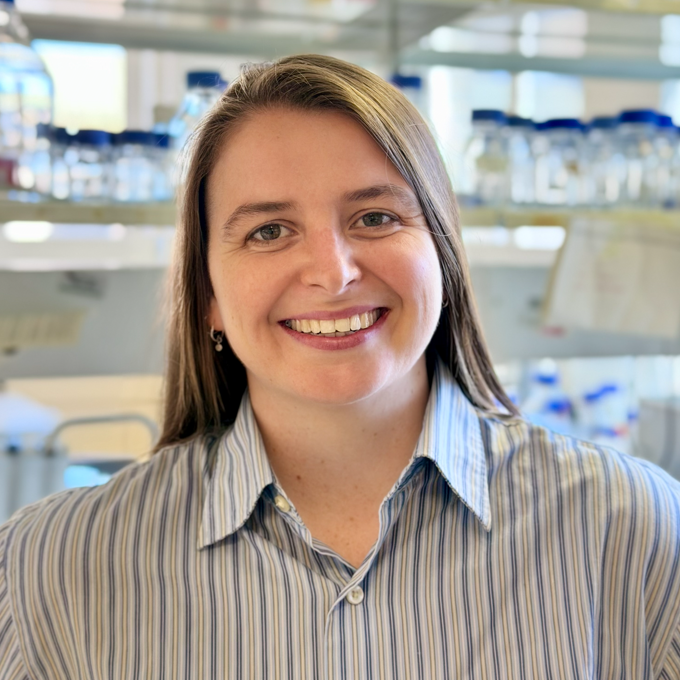
One researcher is taking up the challenge to close this knowledge gap. Dr Lauren Jones’ (BMedSc ’16, BSc(Hons) ’17, PhD(Med) ’22) innovative, award-winning research is advancing global understanding of the gut–brain axis (the bi-directional communication between the gastrointestinal tract and the brain) and its critical role in human health.
Dr Jones initially studied her undergraduate Medical Science degree at Flinders with full intentions to eventually step up to postgraduate Medicine but ended up pursuing an honours degree in Neuroscience instead.
“I distinctly remember my first research project – the PhD student in the lab at the time, Dr Kevin Smith, pointed out that the work we were doing was the first of its kind worldwide. We were quite literally creating new knowledge,” says Dr Jones.
“I fell in love with research during my honours. After much deliberation, I decided that staying in research and doing a PhD was the best path for me, because of both the passion I had developed for medical research, and the extraordinary community and calibre of research being done in the Flinders Neuroscience Department.”
Dr Jones’ work has opened new avenues for exploring how disruptions in gut signalling contribute to anxiety and other neurological conditions. Through novel experimental models and advanced imaging techniques, she is helping to create the first functional maps linking gut derived serotonin with brain activity.
Although it may sound like a niche Dr Jones had carved out from a very young age to explore, her path into the gut-brain field was actually somewhat serendipitous.
“I had the opportunity to choose a Flinders lab in which to undertake my PhD, and after several meetings with various labs, decided that Professor Damien Keating’s lab, focused on all things gut-related, was going to be the best fit for me,” Dr Jones explains.
“Once I started my project and began to discover the many wonders of the gut, such as the fact that specialised cells along the gut wall actually produce 90 per cent of the body’s serotonin, and that the intestines can continue to function outside of the body due to the fact they have their own nervous system, I became completely obsessed with the field.”
This fascination has stayed with Dr Jones ever since, ultimately leading to her current role – a Postdoctoral Research Fellow at University College London studying how the gut communicates with the brain and influences behaviour.
“My work is hugely variable – on any given day I could be running experiments, performing surgery, teaching and supervising students, reading the latest research published in the field, meeting my colleagues for thought-provoking conversations, writing up and preparing my own research publications or preparing presentations for international conferences to share my research with the world,” she says.
Her discoveries suggest the gut may play an initiating role in conditions such as anxiety, mood disorders, and neurodegenerative diseases, with potential to transform treatment approaches towards more precise therapies that improve patient outcomes. Currently, her focus has shifted specifically to obesity and uncovering evidence-based solutions to fight this complex chronic disease.
“Put simply, I hope that my current research is able to positively affect people’s lives,” Dr Jones says.
“Many people don’t view obesity as a disease or understand that it’s not as simple of a problem to tackle as many people often make it out to be.
“There are a hundred different reasons why we eat or don’t eat at any given moment, and hundreds of different things that can go wrong in the complex pathways that govern our feeding behaviour.”
Even as a young researcher, Dr Jones’ achievements have been recognised through numerous honours, including the 2023 7NEWS South Australia Young Achiever STEM Award and her selection as a finalist in the 2024 South Australian Science Awards for PhD Research Excellence.
In addition to her research achievements, Dr Jones has shown strong commitment to community and sector development. As an HDR student representative, she advocated for improved support and opportunities for research students, while her participation in STEM outreach programs has helped inspire future generations, particularly young women, to pursue careers in science. But what would she say to a fresh-faced Lauren, walking into Flinders to begin an undergraduate degree 10 years ago?
“Trust your gut!” Dr Jones says, we can only assume with tongue firmly planted in cheek.
“It’s all going to work out, and following your passion is definitely the way to go for you.
“Things won’t always work out how you imagined, and there will be plenty of challenges, both personally and professionally, but some of the unexpected turns will lead to the most exciting opportunities.”
Dr Lauren Jones was awarded a 2026 Early Career Alumni Award for significant contributions to biomedical science, advancing innovative research on the gut–brain axis and fostering STEM engagement to inspire future generations of scientists.