

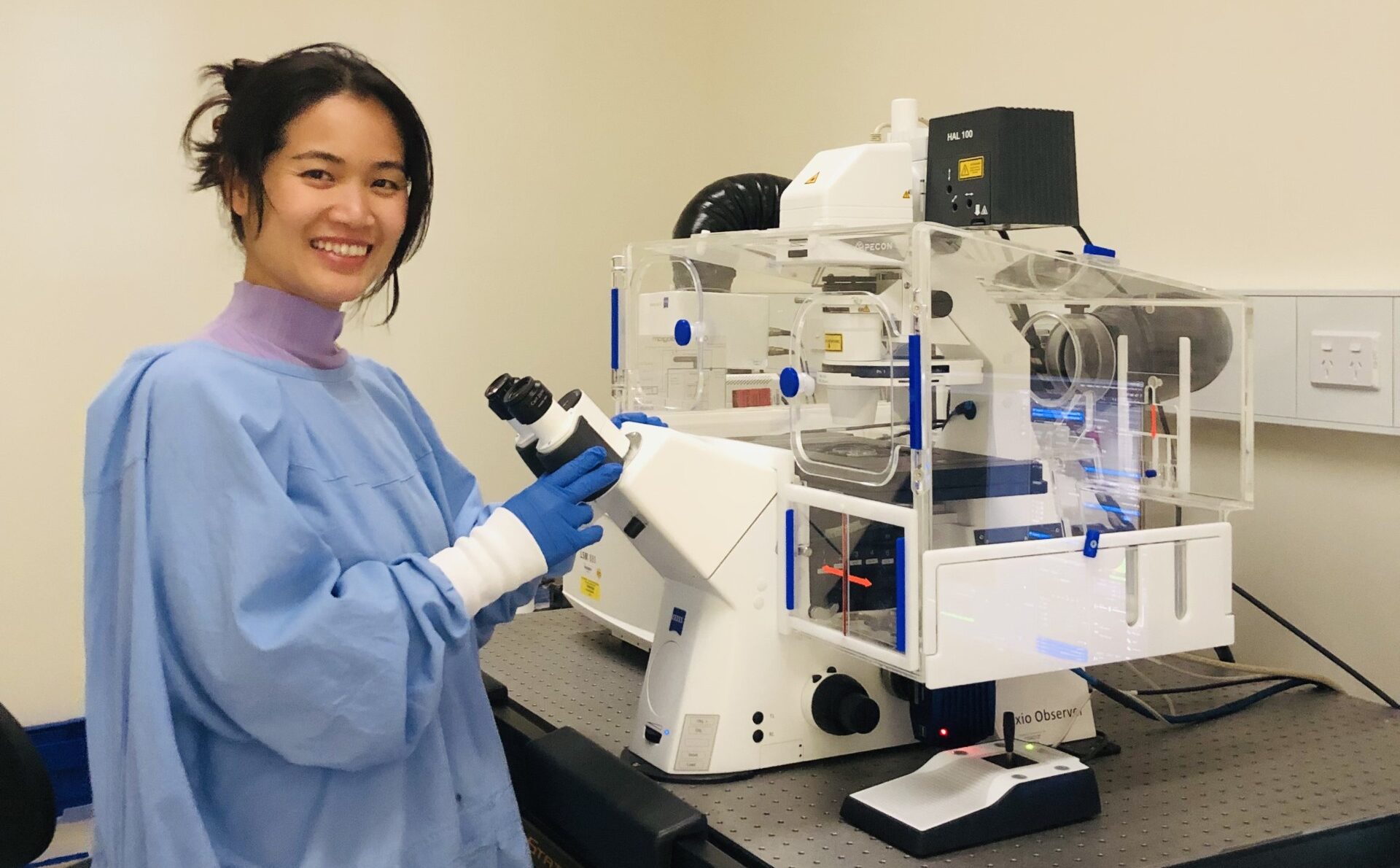
Flinders Health and Medical Research Institute (FHMRI)’s PhD candidate Angela Le is using biomaterials and nanotechnology to help improve the long-term success of medical implants.
For Angela Le, research is about more than discovery, it’s about developing solutions that can one day make a meaningful difference to patients.
Angela completed a Master of Forensic Biology at Flinders University in 2022 and is now in the final stage of her PhD in Medicine within the College of Medicine and Public Health. She is undertaking her research in the Biomedical Nanoengineering Laboratory at FHMRI, where her work focuses on engineering biomaterials that could improve the performance of medical implants, particularly for people living with diabetes and related metabolic conditions.
“I was motivated to pursue a PhD at Flinders because it offered the opportunity to conduct research with real-world healthcare impact while working in a supportive and collaborative environment,” Angela says.
Research with real-world relevance
Angela’s PhD project investigates how glucose and advanced glycation end products, known as AGEs, interact with implant surfaces. These harmful molecules can accumulate under hyperglycaemic conditions and contribute to chronic inflammation, impaired tissue healing and implant failure.
By modifying biomaterial surfaces to minimise AGE adsorption, Angela’s research aims to reduce adverse immune responses, improve tissue integration and support the long-term success of medical implants.
“As diabetes and metabolic diseases continue to rise, there is a growing need for implant technologies designed to perform effectively in disease-specific biological environments,” Angela says.
Her project brings together biomaterials engineering, genomics, proteomics and immunology to better understand how diabetes-related molecular changes can influence implant performance and healing.
The research is helping to address an important gap in knowledge, as the effects of glucose and AGE adsorption on implant surfaces and subsequent immune responses remain poorly understood.
If successful, this work could contribute to improved implant outcomes, fewer complications, reduced need for repeat procedures and better design of future medical devices for patients with diabetes and other AGE-associated conditions.
Contributing to health and medical innovation
Angela’s principal supervisor, Professor Krasimir Vasilev, says her work is making an important contribution to broader research in biomedical nanoengineering and translational medical technologies.
“Angela’s research strengthens our capacity to develop innovative biomaterials and therapeutic strategies aimed at addressing major healthcare challenges such as medical device complications associated with diabetes,” Professor Vasilev says.
“Her work contributes to the collaborative and multidisciplinary culture within Flinders, helping build knowledge and capability that extends beyond a single project.”
Professor Vasilev says the strength of Angela’s PhD lies in its multidisciplinary nature, bringing together expertise across biomaterials science, biomedical engineering, medicine, biology and translational research.
“Collaboration across disciplines is essential for solving complex health problems, and Angela has embraced this approach exceptionally well,” he says.
“These partnerships strengthen both the scientific outcomes and the pathway towards real-world impact.”

Left: Principal supervisor, Prof. Krasimir Vasilev. Right: Co-supervisor, Dr Richard Bright
Growing as a researcher
While Angela began her PhD focused on laboratory research, the experience has helped her develop a much broader set of skills.
“One skill I did not anticipate gaining during my PhD was scientific communication,” Angela says.
“Whether I am presenting at conferences, preparing manuscripts and grant proposals, or explaining complex research to diverse audiences, I have learned to communicate science clearly and effectively.”
She has also developed strong project management skills through juggling multiple experiments, collaborations and deadlines.
For Angela, one of the biggest lessons of research has been learning to value the unexpected.
“Unexpected results can be as valuable as successful experiments,” she says.
“They often reveal new insights and shape future research directions.”
Dr Richard Bright, Angela’s co-supervisor, says Angela stands out for her intellectual curiosity, resilience and commitment to improving patient outcomes.
“Angela employs a thoughtful and highly analytical approach to research, demonstrating meticulousness in experimental design and data interpretation,” Dr Bright says.
“She remains receptive to new ideas and interdisciplinary perspectives. Her approach blends scientific rigour with persistence and a keen eye for detail.”
Dr Bright says Angela has grown significantly throughout her PhD, developing confidence and maturity as an independent researcher.
“She has evolved from mainly conducting experiments to actively shaping research strategies, analysing complex results and engaging in broader scientific discussions,” he says.
Recognising emerging research talent
Angela’s achievements during her PhD include a top-viewed 2025 article, Key biomarkers in type 2 diabetes patients: A systematic review, which has received more than 42 citations.
 She has published three first-author papers in 2022, six co-author publications in 2025, and has four first-author Q1 journal publications expected this year. Angela is also the recipient of the 2026 Abacus dx Emerging Investigators Grant, valued at $50,000 AUD.
Professor Vasilev says supporting emerging researchers like Angela is essential to the future of healthcare innovation.
“Many of the major advances that improve lives begin with young researchers asking difficult questions and pursuing bold ideas,” he says.
“Supporting emerging researchers builds future scientific leadership, strengthens innovation ecosystems and ensures society continues to benefit from advances in health and medical science.”

Looking ahead
After completing her PhD, Angela hopes to pursue a postdoctoral research position where she can continue developing biomaterials and nanotechnology-based solutions to healthcare challenges.
Her goal is to help translate research innovations into clinical applications, with a focus on improving host responses to medical implants and supporting technologies that lead to better patient outcomes.
She also hopes to build stronger collaborations with industry and clinical partners to better connect laboratory research with practical healthcare solutions.
For future students considering a PhD, Angela’s advice is to choose a topic they are passionate about and embrace the challenges along the way.
“Choose a topic you are passionate about, embrace setbacks as learning opportunities, and seek support from mentors and peers,” she says.
“A PhD develops resilience, critical thinking and communication skills alongside technical expertise.”
Angela also acknowledges the support of her supervisors, Professor Krasimir Vasilev, Dr Richard Bright and Associate Professor Vi Khanh Truong, as well as the Higher Degree by Research community within the College of Medicine and Public Health.
“Their expertise, encouragement and commitment have been invaluable to my development as a researcher,” Angela says.
“I am also deeply grateful to the HDR community within the College of Medicine and Public Health at Flinders University for fostering an exceptional research environment that has supported both my academic and professional growth as an early-career researcher.”
Thinking about doing and Honours year or a pHD?
Boost your job prospects in a competitive market or open the door towards a career in research.
Discover research pathways at FHMRI’s Road to Research event on the 10th of August, on level 2 of the Health and Medical Research Building (HMRB), meet supervisors, chat with students like Angela, and explore projects – free pizza provided.