

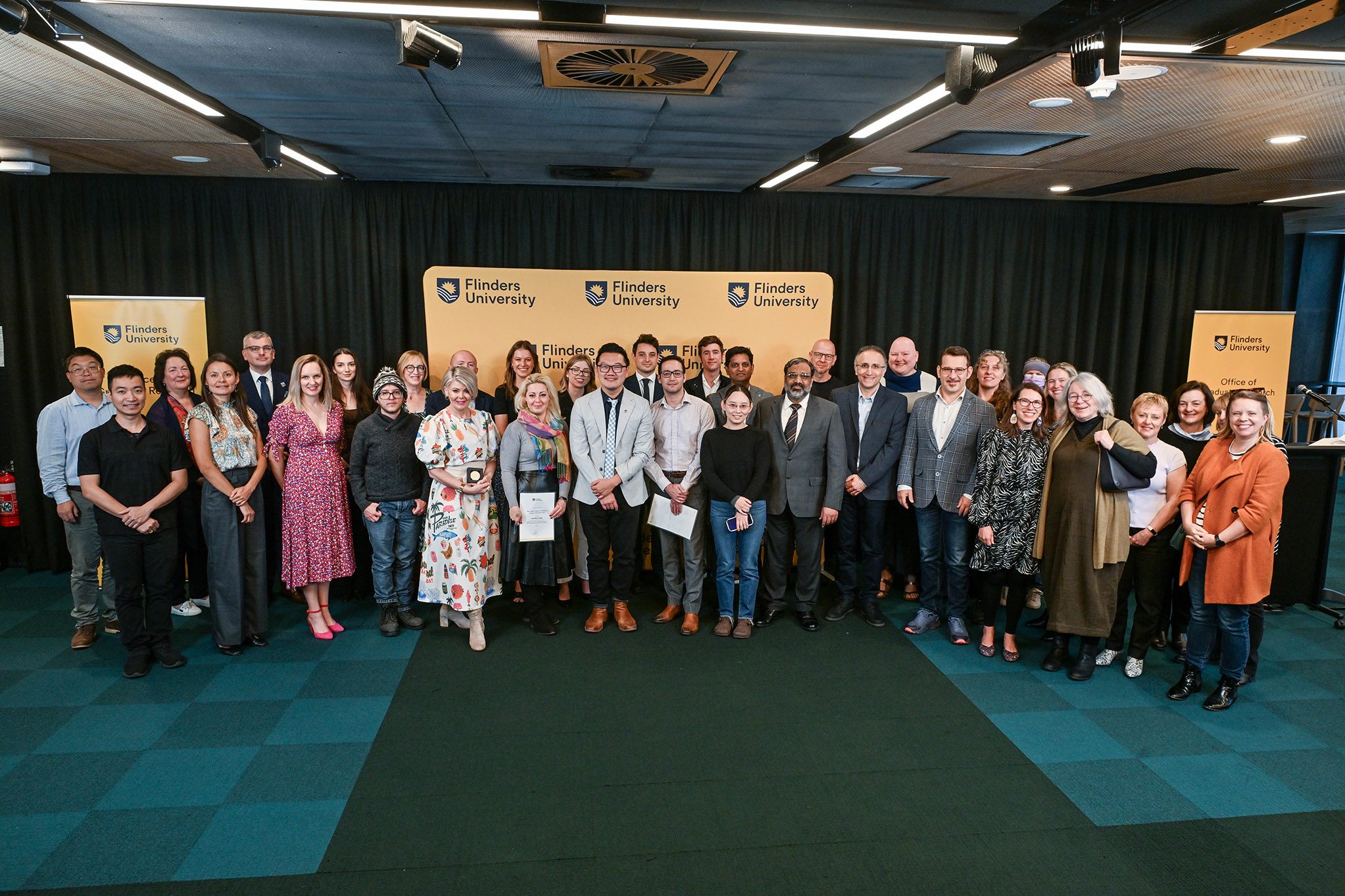
The invaluable contributions of Flinders’ fearless Higher Degree by Research students were recognised at last week’s Celebrating HDR Success event, an annual celebration that acknowledges the impact early-career researchers make at Flinders University.
Deputy Vice-Chancellor (Research) Professor Raymond Chan highlighted the importance of the annual event, which celebrates the achievements of some of Flinders’ brightest up-and-coming researchers.
“In one sense, our HDR students are trainees of sorts, in the early stages of bright and promising careers, learning the ropes thanks to the wisdom and guidance of your supervisors,” said Professor Chan. “One the other hand, you are the future of research, and the driving force behind new research ideas, where your intelligence, skills and new perspectives are tackling major research questions.”
Professor Chan also praised the input and contributions of Flinders’ HDR supervisors.
“Not only are our HDR students making a real difference to real-world problems, but they are fortunate to be privy to the insight and experience of accomplished academics who serve as their supervisors and who are at the forefront of their respective fields. These wonderful and dedicated supervisors provide our students with the knowledge and skills they will need to succeed with their HDR studies and their future, irrespective of the direction their career path takes them,” said Professor Chan.
The Vice-Chancellor’s Award for Doctoral Thesis Excellence recognises 12 Doctoral theses each year that have been of a particularly high standard. This year they covered a wide range of research areas, such as the veracity of traditional media versus social media reports; the effect of political despair on personal well-being; ageism in contemporary Australian literature; agitation in the adult intensive care unit; self-management for older people with urinary incontinence, and the behavioural ecology of delphinids.
 This year’s recipients are:
- Mohammad Akhib (CBGL) for their thesis “Exploring the consumer perceived veracity of traditional media vs social media reports in an organisational crisis context”.
- Lara King (CEPSW) for their thesis “A dual conceptualisation of personal authenticity and its relationship with offender defensiveness and moral repair”.
- Lucy Bird (CEPSW) for their thesis “”We despair”: Understanding the effect of political despair on personal well-being and actions to promote social change”.
- Susan Arthure (CHASS) for their thesis “A long, long way from Clare to here: An archaeology of the Irish in colonial South Australia”.
- Rebecca Carpenter-Mew (CHASS) for their thesis “Ageism and the older woman in contemporary Australian literature: the tonics and the toxins”.
- Rebecca Lindsay (CHASS) for their thesis “Settler Reading Postures: Reading Ruth in Settler-Colonial Australia”.
- Lisia Barros Ferreira (CMPH) for their thesis “Effects of Inflammatory Cytokines on Human Retinal Endothelial Cells”.
- Andrew Hayles (CMPH) for their thesis “Hydrothermally Etched Titanium for the Mitigation of Implant Associated Infection”.
- Anne Mette Adams (CNHS) for their thesis “Non-pharmacological prevention, minimisation and management of agitation in the adult intensive care unit. Development of preliminary Danish and Australian patient-centred clinical practice guidelines.”.
- Fang Yan (CNHS) for their thesis “Construction and Application of a Hybrid Self-management Model for Community-dwelling Older People with Urinary Incontinence.”
- Mohsen Feyzi (CSE) for their thesis “Tribocorrosion behaviour of Ti and CoCrMo biometals in metal-on-metal contacts: analytical modelling and experimental evaluation”.
- Jonathan Syme (CSE) for their thesis “The behavioural ecology of mixed-species groups of delphinids”.
The HDR Impact Prize recognises two Doctoral theses to recognise the quality and impact of research, and this year awards went to Alison Dymmott and Matthew Iasiello, both from the College of Nursing and Health Sciences. Alison was awarded for work that looks at “The Allied Health Rural Generalist Pathway: A workforce strategy”, while Matthew received recognition for research into “Investigating the dual-continua model of mental health: Assessment of mental wellbeing in the context of psychological distress” .
 The awards for the Best HDR Student Publications were presented to students who have demonstrated excellence in research dissemination, which sees students present and share their work with the wider community.
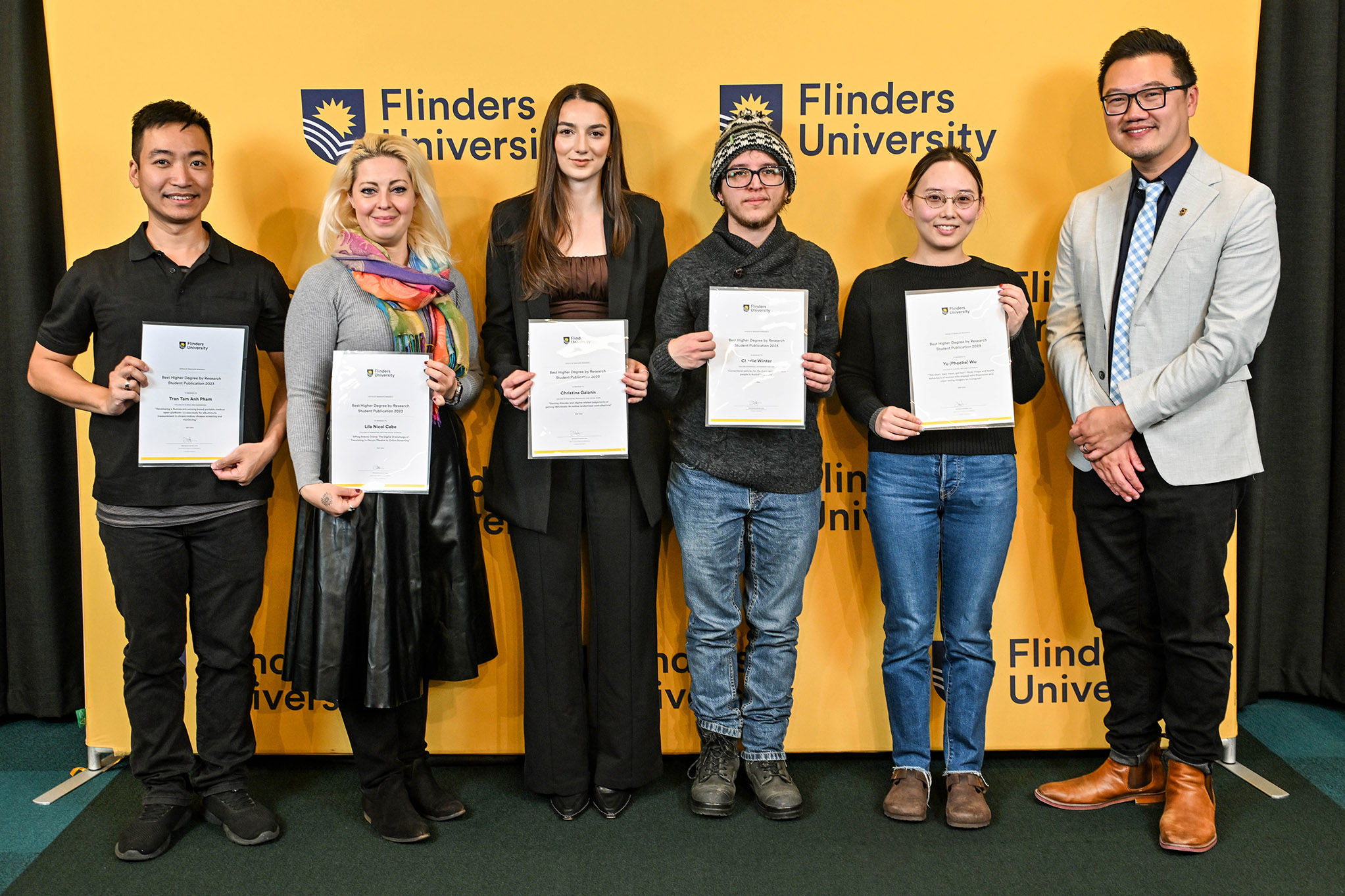 This year’s winners are:
- Charlie Winter (CBGL) for the article “Correctional policies for the management of trans people in Australian prisons”, which explores current correctional policies surrounding the management of trans people in Australian prison systems, detailing and comparing these policies against national and international human rights benchmarks.
- Christina Galanis (CEPSW) for the article “Gaming disorder and stigma‐related judgements of gaming individuals: An online randomised controlled trial”, which involved an experiment that tested whether the WHO’s gaming addiction diagnosis would affect stigma-related judgements of different types of gamers, including casual, highly engaged or problematic gamers.
- Lila (Nicol) Cabe (CHASS) for “Effing Robots Online: The Digital Dramaturgy of Translating In‐Person Theatre to Online Streaming”, which explores how she translated her sci-fi-inspired fringe festival solo performance into an online streaming show, and how in-person theatre techniques relate to digital performances including pandemic-era digital theatre.
- Bradley Menz (CMPH) for the publication “Health Disinformation Use Case Highlighting the Urgent Need for Artificial Intelligence Vigilance Weapons of Mass Disinformation”, which explores the risks associated with publicly accessible artificial intelligence (AI) tools, specifically their potential to deliberately generate misleading health information (disinformation) in various formats, including text (e.g., blog posts), images, and videos. Understanding these risks is imperative given the rapidly advancing AI ecosystem, as the consequences for public health could be significant in the absence of adequate safety mechanisms.
- Laura Gantley (CMPH) for the study “Functional Characterisation of the Circular RNA, circHTT(2‐6), in Huntington’s Disease”, which explores the functional role of circHTT(2-6) in the pathophysiology of Huntington’s Disease.
- Yu (Phoebe) Wu (CNHS) for the publication “”Eat clean, train mean, get lean”: Body image and health behaviours of women who engage with fitspiration and clean eating imagery on Instagram”, which explores the relationship between engaging with (i.e., viewing, posting) fitspiration and clean eating imagery on Instagram and body image, disordered eating symptomatology, and compulsive exercise among women. It also examines the mediation role of internalisation of appearance ideals in the relationships.
- Tran Tam Anh Pham (CSE) for the publication “Developing a fluorescent sensing based portable medical open-platform ‐ a case study for albuminuria measurement in chronic kidney disease screening and monitoring”, which introduces an open portable medical platform to monitor fluorescence assay for in-field and point-of-care analysis of albumin levels in human urine, following by the medical cases that the platform performs the measurement on the urine samples from patients having kidney-related diseases; also, the study provides proof of concept that the developed device can measure the concentration of different biomarkers if the biomarker detection follows the rules of fluorescence sensing.
- Samuel Tonkin (CSE) for the publication “Thermal Imaging and Clandestine Surveillance usingLow‐Cost Polymers with Long‐Wave Infrared Transparency”, in which develops a new infrared transparent polymer. The polymer can be used to make high quality lenses for thermal imaging, with applications in medical, transport or even space industries.