

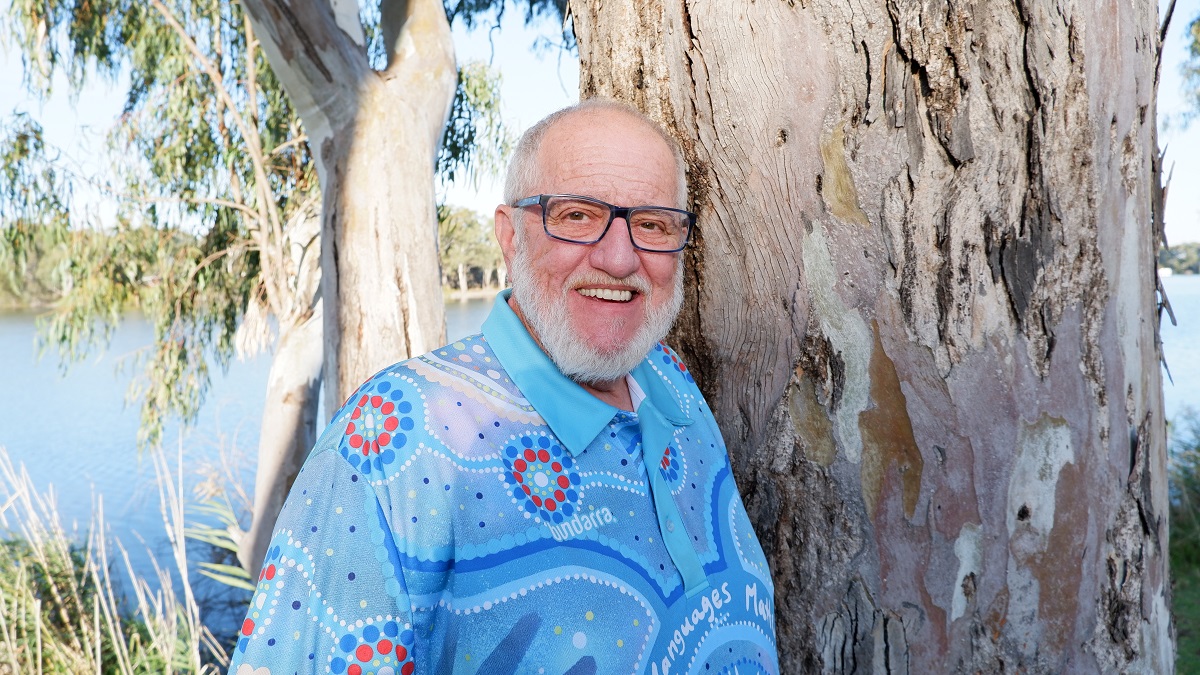
We caught up with Lecturer of Indigenous Knowledge and Culture Uncle David “Tarnda” Copley to chat about his journey with Flinders University that began back in 1986.
What is your role here at Flinders?
I am a Lecturer of Indigenous Knowledge and Culture in the College of Medicine and Public Health, and a part of Rural and Remote Health SA at the Riverland Campus.
Tell us a little about your journey to Flinders.
Wow that is a really interesting conversation. I started doing a Nursing Course at the Sturt campus is 1986, however after a year I was told they didn’t think I was suitable and I was transferred to the Developmental Disabilities Course (which I completed). I returned and completed a Degree in Nursing and a Post Grad in Mental Health Nursing.
Flinders was a lot different back then – there was no Indigenous support like there is today and no Reconciliation Action Plan (RAP). In fact, you just didn’t identify as you felt it would be detrimental to you achieving. Even in the early 2000’s I was often asked why, having fair skin didn’t I want to identify, or how Aboriginal was I.
Flinders as a university has come a long way since then.
What is your area of expertise?
My career at a clinical, research and teaching level has centred around three main areas: Indigenous Mental Health, Indigenous Cancer Control & Prevention and Cultural Safety Training. I was honoured and surprised to receive a Flinders University Distinguished Alumni Award for my work in 2020.
How did you get into it?
Nursing and Mental Health Nursing was a choice I made, as was my decision to work specifically with Indigenous peoples. My teaching career started way back when Indigenous health was an optional topic in Nursing, and I was invited to be a tutor. This just grew in stages, when the late Professor Denis McDermott asked me to do more teaching in this space.
The cancer direction was not a chosen journey! Firstly, you need to realize that cancer survival rates amongst Indigenous men is often less then 10%. When I was diagnosed with Colon Rectal Cancer is 2007, the Indigenous bowel cancer survival rate was pretty much 0% and my prognosis was 18 months. I was lucky. Someone who was involved in both Cancer Australia and Menzies School of Health Research found out there was an Indigenous health professional in Adelaide who was two years post diagnosis and invited me to work with them on a number of research projects. So I really just fell into this space, and it grew.
What is one piece of wisdom you’d like to pass on to the Flinders community?
Am I wise, I am not sure about that. Flinders has a motto of being fearless and this is a major thing I have learnt as part of the Flinders community.
Be fearless in your studies (you have the ability, it’s up to you how you use it), don’t be afraid to question and explore and most of all be fearless in yourself.
Before Flinders, I had no faith in myself. Over the past 38 years I have learnt that I have value as me.
What’s your favourite part about working at Flinders?
Flinders is like a family (at least for me) and like most families I have experienced the bad times and disappointments and the highs.
But through it all, it’s been both colleagues and the students. Colleagues who are there to support, mentor and push you to expand your horizons. These are the people you can vent with, laugh and cry with and they don’t judge. The graduation of students is our primary goal, and for me, particularly Indigenous students. So when you run into a student a year or two after they have graduated and they thank you for your input, it makes you feel that you have also achieved.
Do you have any regrets?
I am not sure it’s a regret, maybe a disappointment with myself. I have focused on my clinical & teaching work (but these are my passions) that I sometimes feel I let myself down by not having completed my Doctorate. But these are the choices we all make and should not be something that detracts from all the good things.
How do you spend your spare time?
I am trying to plan for retirement (that scares me more than cancer), so I am dedicating more time to working on the couple of collectable cars I have in the garage and learning how to go off road exploring in my 4wheel drive.
Spending time with my children & five grandchildren in Adelaide is always a good weekend get away.
The garden probably takes up the rest of my time.