


Flinders University’s very first computer was an IBM 1130 with what at the time was considered a whopping amount of storage – 1MB! It had one card reader, one line printer and could only process one thing at a time.
Before you ask what a card reader is, let’s not judge the IBM 1130 too harshly. It was purchased in July 1967 to help with local tasks while the heavy computer lifting was done at the University of Adelaide. This was well before wi-fi, so all computational instructions were fed into the computer by cards that were couriered between Flinders and Adelaide.
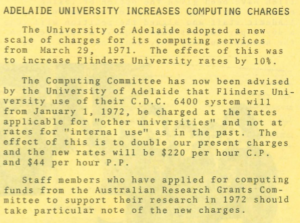 It was a helpful arrangement charged at internal rates until 1971 when Adelaide declared Flinders an external provider and started charging $220 an hour for computing services. A note in the 5th edition of the staff newsletter, On Campus, shared the new rates and suggested that researchers who have applied for computing funds take note. No wonder the poor IBM 1130’s workload increased to 24 hours a day!
Interestingly, it wasn’t just Flinders using this computer. There was another IBM 1130 in town – it belonged to The Advertiser which occasionally needed the Flinders machine for reloading tasks when the newspaper’s team had to change their typesetting disc pads.
By 1975, when the Adelaide-Flinders arrangement and the hourly rates became too much to contend with, Flinders purchased the DEC-10 which had an impressive 450MB of storage, along with 48 terminal lines, 4 card readers and 4 line printers. If you’re wondering, 450MB is the size of a 30-minute podcast file.
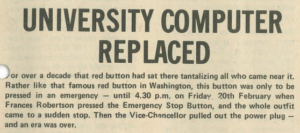 The next upgrade to the PRIME-750 took the storage up to 600 MB, with 64 terminal lines and no need for a card reader, finally putting the old IBM into retirement in 1981.
One of the main users of Flinders’ first computer was Frances Robertson. Her computing responsibilities included processing all student enrolments, university finances, and examination results. Still working at the University 14 years later, she was invited to hit the red emergency stop button on the old IBM, while Vice-Chancellor Keith Hancock AO ceremoniously pulled the plug.
With the arrival of the new PRIME-750 in 1981, much was made of the fact that users, including students, would no longer need to feed cards into the machine itself. It was considered extraordinary that the introduction of terminals meant computer users might never actually see the computer!

From the Flinders Week newsletter of the time:
“It was interesting for those present to watch the old 1130 in action for one last time, making comparisons between it and the newer computers… For instance, the DEC-10 has 17 large cabinets containing the central processor, core storage and control units, whereas the new, more powerful PRIME-750, sits compactly in one filing cabinet size container.”
Just for comparison, AI tells us (let that sink in!) that we could fit approximately 450 iPhone 17s (without packaging) in a standard filing cabinet drawer. At a minimum, each iPhone 17 has 256GB of storage, so that’s 115,200GB of storage we can now squeeze into a filing cabinet drawer.
Unless, of course, we choose to carry 256GB of storage, together with a super high resolution camera, around in our pocket. Something that may have been difficult to imagine in 1967!
The Flinders staff newsletter has had a few names over the years. The main sources for this story were Flinders On Campus Edition 5 (13 August 1971) and Flinders Week Edition 1 (2 March 1981).
Thank you to the staff at University Archives for generously helping us to access the Flinders’ archives.