

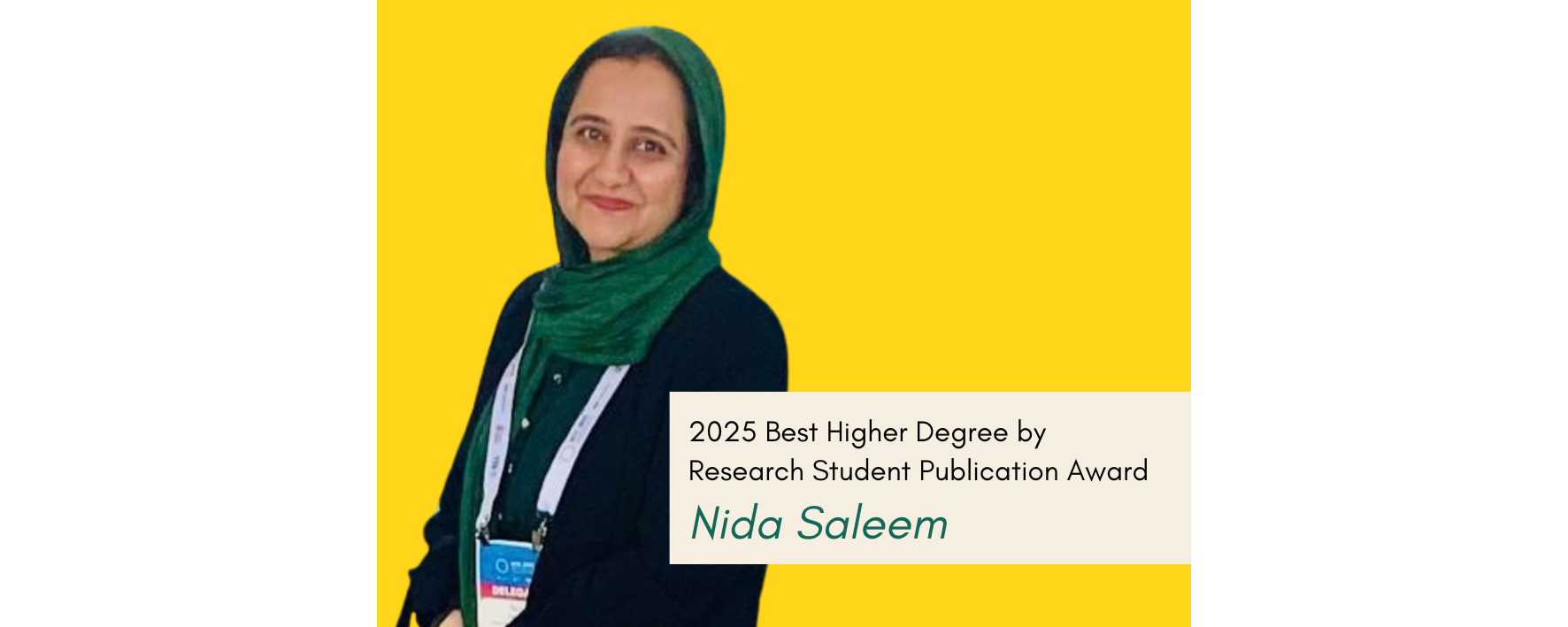
Nida Saleem is from the College of Medicine and Public Health and is one of the recipients for the 2025 Best Higher Degree by Research Student Publication Award and is supervised by A/P Annabelle Wilson, Professor Germaine Wong, Professor Billie Bonevski, A/P Jacqueline Stephens.
Nida’s publication was titled “Cancer screening in chronic kidney disease and solid organ transplant recipients and strategies to improve outcomes”
We invited Nida to share insights into the PhD journey and what winning this award means.


What does your publication explore?
Cancer is the second leading cause of death among solid organ transplant recipients (SOTRs), with the risk 2-3 times greater than in the general population. Immune checkpoint inhibitors (ICIs) have revolutionised the management of advanced cancers in the general population by significantly improving survival outcomes. Despite the proven benefits in the general population, the effectiveness of ICIs in SOTRs remains unclear, mainly because they have been excluded from clinical trials due to concerns about graft rejection and reduced anti-cancer efficacy resulting from concurrent immunosuppression.
Leveraging the largest available dataset of 343 participants, this systematic review provides a comprehensive analysis of 128 studies involving SOTRs treated with ICIs. Through meta-analysis of individual participant data, we assessed cancer-related and survival outcomes and identified factors associated with graft rejection, graft loss, and patient survival.
The results demonstrate that cancer response in SOTRs is comparable to that in the general population, with a better response observed in patients with cutaneous squamous cell carcinoma (cSCC) compared to other cancers. However, overall survival remains limited, particularly in recipients of non-kidney transplants. Importantly, our data showed that maintaining mTOR inhibitors and steroids may lower rejection risk without compromising ICI-mediated cancer control.
These findings highlight that ICI therapy should be individualised based on cancer and transplant types. For instance, initiating ICI early, particularly for kidney transplant recipients and those with cSCC, may improve cancer and survival outcomes. For other cancer and transplant types, ICIs may be considered as salvage therapy when other treatment options are limited or ineffective.
What is your research about?
Utilising the largest dataset to date, 343 transplant recipients from 128 studies, this review evaluates the safety of immune checkpoint inhibitors, particularly the risk of allograft rejection, as well as their efficacy in terms of cancer response and overall survival among solid organ transplant recipients.
Tell us about your PhD journey so far
My PhD journey has been both challenging and deeply rewarding. It began with a clinical question about cancer screening in transplant recipients, an area where I observed considerable uncertainty in practice. That initial curiosity evolved into a comprehensive research program examining screening uptake, barriers, facilitators, and strategies to improve outcomes, including the safe use of immunotherapy in this population.
Coming from Pakistan as a Renal Physician and transitioning into the Australian healthcare and academic system was initially challenging. Adjusting to a different clinical culture, regulatory environment, and research framework required resilience and adaptability. However, this transition ultimately strengthened my confidence, broadened my perspective, and accelerated my professional development.
Throughout my PhD, I have developed strong skills in evidence synthesis, quantitative and qualitative methodologies, and critical appraisal. Balancing clinical responsibilities alongside research was demanding, but it enhanced my time management, discipline, and clarity of purpose.
Overall, my PhD journey has been a blend of curiosity, perseverance, and growth. It has shaped me not only as a researcher, but as a more reflective, analytical, and strategic clinician.
What does winning this award mean to you?
Winning this award is incredibly meaningful to me. It represents recognition not only of the research itself, but of the perseverance, discipline, and resilience behind the journey.
Coming from a different country and adapting to a new healthcare and academic system, there were many challenges along the way. This award feels like validation that the hard work, late nights, setbacks, and persistence were worthwhile.
More importantly, it reinforces my commitment to improving care for transplant patients. For me, this award is not just personal achievement, it is encouragement to continue striving for meaningful, patient-centred research.
What advice would you give to current or prospective PhD students?
My advice would be to choose a research question that genuinely matters to you. A PhD is a long journey, and intrinsic motivation will carry you through the difficult periods.
Be patient and prepare yourself to work hard. Progress can feel slow at times, and results may not come as quickly as you expect. Stay focused, ignore negativity, and remain true to your work and values.
Accept that differences of opinion are part of academia. Learn to respect feedback, adapt to change, and refine your ideas, these experiences will strengthen both your research and your character. At the same time, be kind and genuine with your colleagues. Research is a team effort, and supportive professional relationships make the journey much more meaningful.
Seek good mentorship and collaborate widely. Your supervisors and peers will influence not only your project but also your growth as a researcher.
Finally, try to maintain work–life balance, if possible. I will admit this was challenging for me at times! But protecting your wellbeing is essential for long-term sustainability.
A PhD is not just about producing publications; it is about developing resilience, critical thinking, and maturity. Those qualities will stay with you long after the degree is completed.
Why did you choose to commence a PhD?
I chose to commence a PhD for both professional and personal growth. Coming from a different country with limited formal research experience, I wanted to build strong research skills and develop as an academic clinician.
The PhD provided structured training in evidence appraisal, methodology, communication, and teamwork, while helping me adapt to the Australian healthcare and academic system.
It also offered financial stability during my transition and strengthened my pathway toward specialist registration in Australia.
Ultimately, I saw the PhD as an opportunity not just to gain a qualification, but to grow in confidence, capability, and career direction.
How did you choose your supervisor?
I applied for a PhD position advertised through Australia New Zealand Society of Nephrology (ANZSN), where my supervisors were looking for a candidate for this project. I interviewed with them, and we had a positive and encouraging discussion about the research and expectations. Luckily, they chose me, and from that conversation, I felt it was the right fit for both of us.
What are your future goals and plans? / Where do you see your career heading in the future?
I am currently working as a Renal Fellow at St George Hospital. My immediate goals are to complete my PhD and obtain specialist registration in Australia.
In the future, I hope to continue as a clinician–researcher, potentially undertake a postdoctoral position, and remain actively involved in hospital-based research alongside my clinical practice.