

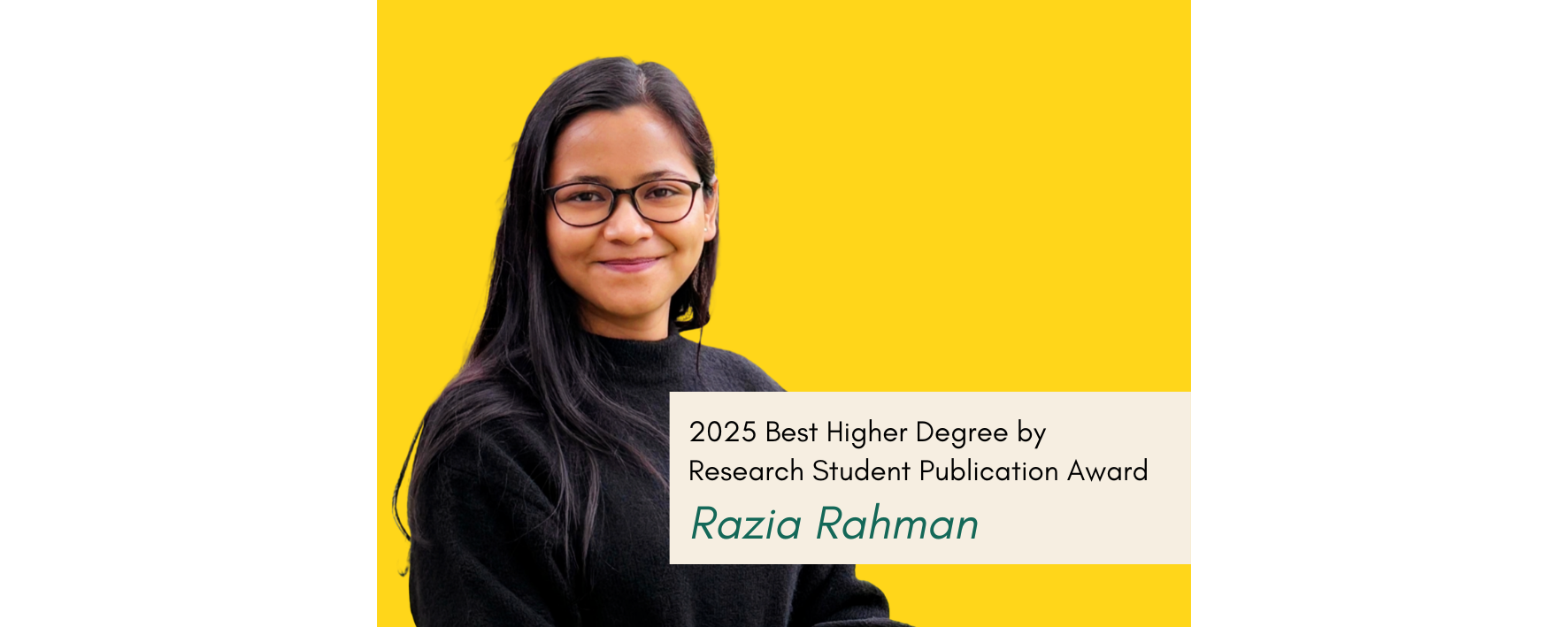
Razia Rahman is from the College of Medicine and Public Health and is one of the recipients for the 2025 Best Higher Degree by Research Student Publication Award and is supervised by Prof. Luke Selth and Prof. Simon Conn.
Razia’s publication was titled “CDK9 inhibition constrains multiple oncogenic transcriptional and epigenetic pathways in prostate cancer.”
We invited Razia to share insights into the PhD journey and what winning this award means.


What does your publication explore?
This study identified CDK9 as a promising therapeutic target in prostate cancer and demonstrated that inhibiting CDK9 with a newly developed and orally bioavailable CDK9 inhibitor – CDKI-73, disrupts key cancer-related gene expression programs and epigenetic processes that drive tumour growth and survival. The findings highlight the potential of CDK9-targeted therapies, particularly for aggressive or treatment-resistant prostate cancer, and support further clinical investigation of CDKI-73 to improve patient outcomes.
What is your research about?
My research focuses on understanding the key mechanisms that drive prostate cancer growth and survival, with a particular focus on how certain proteins control molecular responses in cancer cells. By targeting these processes in clinically relevant patient-derived models, we aim to identify new strategies to inhibit tumour growth, improve treatment responses, and ultimately develop therapeutic strategies that can help patients with aggressive or treatment-resistant prostate cancer. This work is exciting because it bridges fundamental biology with real-world impact, offering hope for more effective, targeted treatments for patient benefit in the future.
Tell us about your PhD journey so far
My PhD journey has been anything but linear – and that’s what has made it even more meaningful. I pursued a PhD in cancer medicine driven by curiosity and a desire to contribute to something larger than myself. Very quickly, I realised that a PhD is not just about experiments, data, or publications. It is about resilience. It is about learning how to think independently, solve problems creatively, and persist when results don’t go the way you expect. There were moments of uncertainty and failures along with the constant pressure to adapt. But those challenges strengthened my resolve. They taught me flexibility, patience, and the importance of supportive supervisors and colleagues. Research may look individual from the outside, but it is deeply collaborative.
One of the most rewarding aspects of my PhD has been contributing to cancer research that has real-world implications. Knowing that the work we do in the lab could one day help improve patient outcomes gives purpose to the long hours and failed experiments. Every setback became a lesson, and every small success felt significant. Above all, this journey has taught me that growth rarely happens in comfort. A PhD pushes you beyond what you think you are capable of – intellectually, professionally, and personally. It has shaped not only the researcher I am becoming, but also the person I am becoming. I am grateful for the opportunity to contribute to meaningful science during my PhD and as my journey continues, I am excited for what comes next!
What does winning this award mean to you?
This award is both an honour and a reminder of the journey behind the achievement. A publication may carry one name as a first author, but it represents the collective effort of supervisors, lab members, collaboration of colleagues, and the support of a wider research community. This award reflects not just the final paper, but the persistence behind it – the late nights, the failed experiments, the revisions, and the resilience required to keep going when outcomes were uncertain. For me, it also symbolises growth. A PhD is as much about developing confidence and independence as it is about producing data. Seeing my work recognised reinforces that curiosity, hard work, and dedication truly matter. It reminds me that impactful research is built step by step, often through challenges that are not visible from the outside. Most importantly, this award motivates me to aim higher – to continue asking meaningful questions and striving for research that can make a difference, particularly in the field of cancer research where every advancement has the potential to improve patient lives. I am deeply grateful to my supervisors, colleagues, collaborators, funding organisations and the university for their support and this recognition is shared with everyone who contributed to the publication.
What advice would you give to current or prospective PhD students?
My biggest piece of advice is simple: focus on progress, not perfection. A PhD can feel overwhelming at times. There will be experiments that fail, papers that get rejected, and moments when you question whether you’re “good enough.” That is completely normal. Research, by its very nature, involves uncertainty. Growth happens in those uncomfortable spaces where things don’t work the first time.
Secondly, choose curiosity over comparison. It’s easy to measure yourself against others, but every PhD journey is different. Instead of competing, concentrate on asking meaningful questions and building your own strengths. The goal is not just to finish – it’s to develop the ability to think critically, solve problems independently, and contribute something valuable to your field. I would also encourage students to build strong support systems. Your supervisors, lab members, and peers are not just colleagues – they are part of your journey. Collaboration and communication make a significant difference, especially during challenging periods.
Finally, remember that a PhD is not only about producing publications. It is about becoming resilient, adaptable, and confident in your expertise. The degree is important, but the person you become along the way is even more valuable.
Stay curious, stay persistent, and trust that steady effort will compound over time. And most importantly, keep going and don’t give up just yet!
Why did you choose to commence a PhD?
I chose to commence a PhD because I realised, I was deeply motivated by curiosity – by the desire to not just understand what happens, but to ask why it happens and how it can be improved. During my earlier research experiences, I discovered that I genuinely enjoyed problem-solving and critical thinking. I was drawn to the process of exploring unanswered questions and contributing, even in a small way, to knowledge that could have real-world impact. In the field of cancer research, where scientific advances can directly influence patient outcomes, that sense of purpose felt especially meaningful. A PhD also represented growth. It offered the opportunity to develop independence, resilience, and confidence as a researcher. I knew it would be challenging, but I saw that challenge as a chance to push beyond my comfort zone and refine both my technical skills and my ability to think strategically. I didn’t choose a PhD because it was the easiest path – I chose it because it was the most transformative one. It was an opportunity to contribute to meaningful science while becoming a stronger, more capable and even better version of myself. And that, to me, made it worth pursuing.