

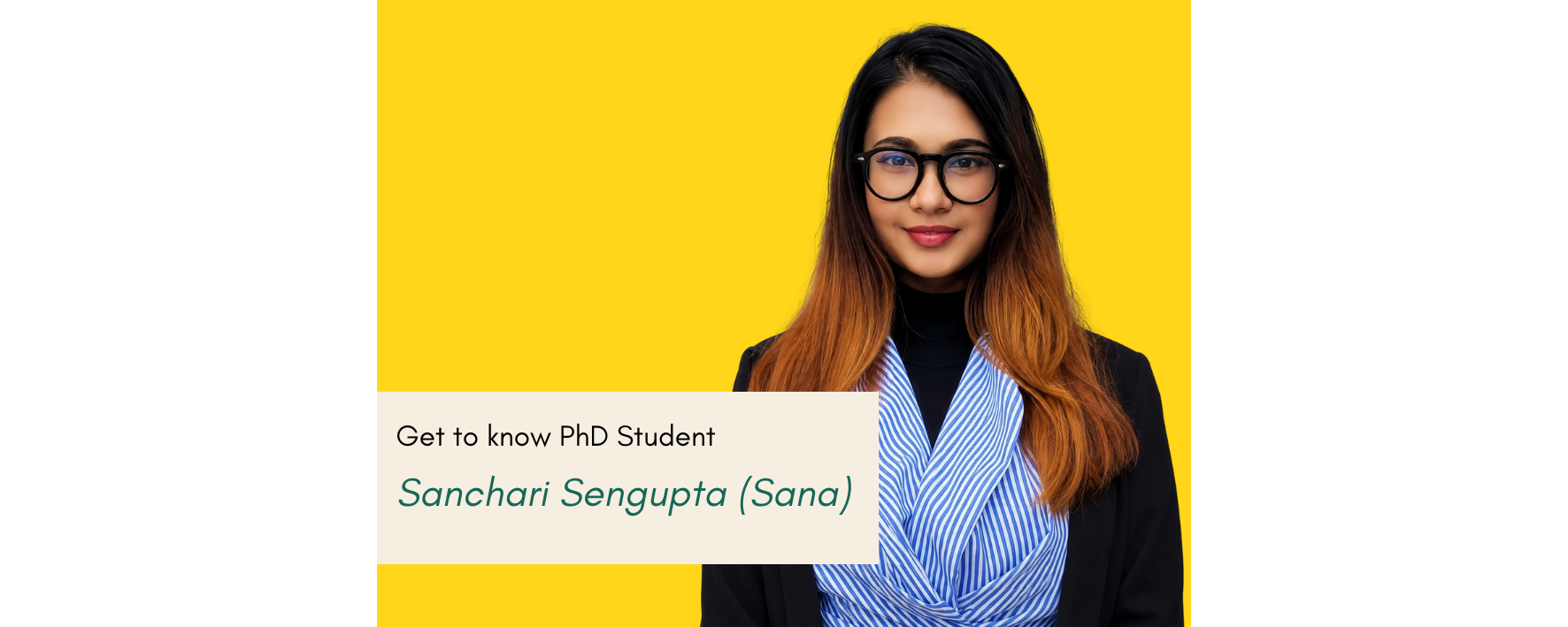
This month, we spotlight Sanchari Sengupta (Sana) from the College of Human Sciences and Culture. Through her own words, she shares a remarkable journey across countries and her mission to transform how children learn to read.

I am an international PhD student at Flinders University, originally from Calcutta, India. The road that brought me to Adelaide has run through more countries and research worlds than I once thought possible for someone with my beginnings. I grew up in a middle-class Indian household with parents who valued education deeply but could not have imagined their daughter would one day chase it halfway across the world. On some days, the fact that I am writing this from Adelaide still surprises me.
It started in India, where I completed my Bachelor’s and Master’s in Psychology, worked in hospitals and clinics, and spent a year mentoring children with learning differences at one of India’s largest EdTech platforms. That last experience was the one that planted the seed for everything I do now. From there I moved to the Netherlands for a specialised Master’s in Cognitive Neuroscience at Maastricht University, working on brain imaging studies of how the body processes pain. France came next, on a neuroscience project investigating motivation and mental health. Each of those places gave me a different lens. India grounded me in clinical and human realities. Europe gave me technical depth in cognitive neuroscience and stretched me into more computational ways of thinking about the brain. Australia, finally, is where all of those threads are starting to come together, in research that lives in both academia and industry.
Outside of work, I love good food, books, learning new languages, painting, travel, and the slow ritual of unfamiliar places becoming home.
My PhD looks at how AI tutoring tools should be designed to help children, especially those who find reading difficult, build their reading abilities, stay engaged, and grow into readers who actually love to read.
I study how Intelligent Tutoring Systems (ITS) should design their feedback to support children’s reading abilities, engagement and emotional wellbeing. My research combines large-scale analysis of how thousands of real children interact with a real reading app, co-design sessions with children and parents, and controlled experiments that test the next generation of feedback designs built to help children become better, more confident readers.
Having worked in EdTech before starting this PhD, I have seen first-hand how technology can either open up a child’s learning or quietly get in the way of it. Artificial intelligence is on track to become as everyday in children’s lives as computers and smartphones once did, and that kind of shift does not happen often in history. When it does, the design choices made early on end up shaping how an entire generation comes to learn. That is what makes this work important to me. I believe these tools have to be built to serve children and the adults who care for them, not the other way around. There is real urgency around the ethics and governance of AI in education and around protecting children while they are still forming their sense of who they are as learners. My hope is that this research helps tip the scales in the right direction, so that the children meeting an AI tutor today grow up not just as competent readers, but as readers who fall in love with reading.