


Flinders University’s Rural and Remote Health NT team had a strong presence at the 2025 IUHPE World Conference on Health Promotion, held in Abu Dhabi. The team — Professor James Smith, Dr Bryce Brickley, and Cameron Stokes — proudly represented the Northern Territory and its important contributions to global health promotion research and practice.
One of the major highlights was Professor James Smith’s election to the global executive board of the International Union for Health Promotion and Education (IUHPE), recognising his leadership and ongoing commitment to health equity and Indigenous health.

Spotlight on Remote Men’s Wellbeing
Dr Bryce Brickley and Cameron Stokes co-presented findings from the Enough Talk, Time for Action project, highlighting the role of men’s groups in promoting social and emotional wellbeing in very remote regions of Australia.
Adapting Programs for the NT Context
Dr Brickley also presented early findings from the pre-trial phase of a national randomised controlled trial, which is adapting the Aussie-FIT program to better suit delivery in the Northern Territory.
Innovations in Mental Health Promotion
In a joint presentation, Professor Smith and Cameron Stokes shared insights from the cultural adaptation of YBMenNT — a mental health and wellbeing initiative for young Aboriginal and Torres Strait Islander men, delivered via social media platforms.
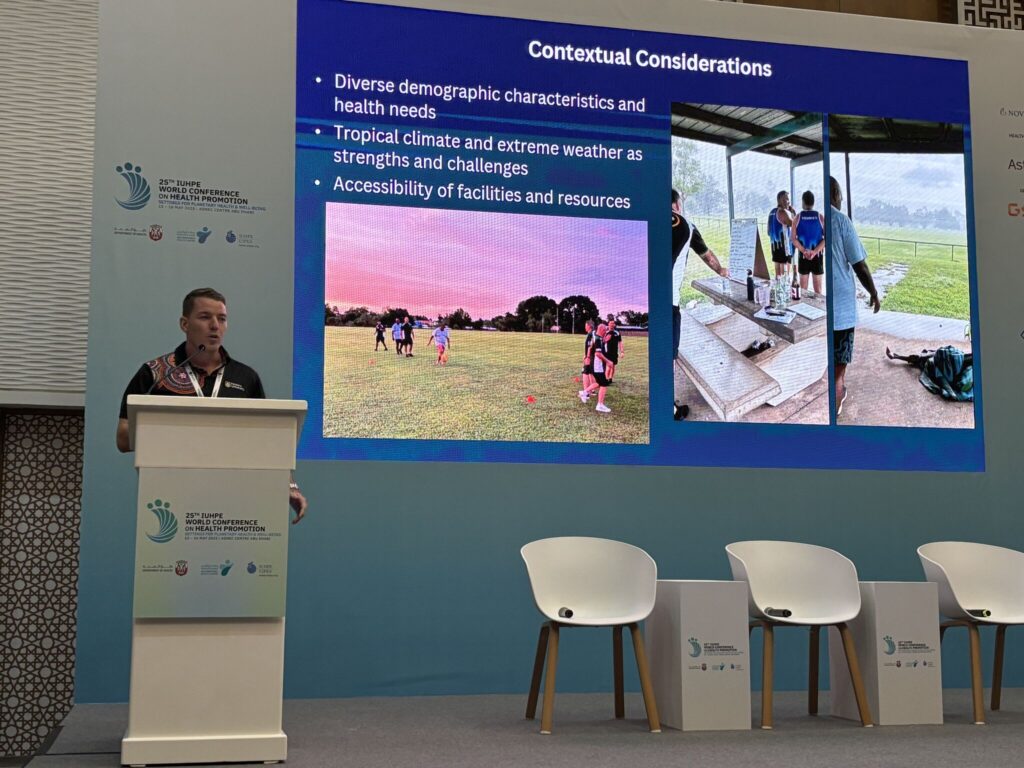
Dr Brickley also took on the role of session moderator for a panel titled Health Equity and Innovations in Access to Healthcare and Mental Health, contributing to broader conversations on how to improve equity and access.
Beyond the Conference
The team also enjoyed opportunities to connect with international and Australian colleagues, attend cultural events, and take in the local sights — including a visit to the iconic Sheikh Zayed Grand Mosque. They also met with health leaders such as H.E. Dr Rashed Al Suwaidi, Director General of the Abu Dhabi Public Health Centre.
This global platform highlighted the importance and relevance of health promotion research coming out of remote Australia, and the value of continued collaboration with international health leaders.