


Flinder’s College of Medicine and Public Health hosted the Inaugural 2026 Waterman Foundation Fellowship Symposium yesterday, a milestone event celebrating excellence and innovation in clinical and biomedical education.
The symposium opened with a Welcome to Country by Petiola Wilson, a proud Ngarrindjeri, Kaurna, Narungga and Tongan man, grounding the event in respect and connection.
Bringing together educators, researchers and leaders from across the College, the symposium showcased the impact of the Waterman Foundation Fellowship and recognised those shaping the future of medical education at Flinders.
About the Waterman Foundation Fellowship
The Waterman Foundation Fellowship supports excellence in biomedical and clinical teaching through innovative, high-impact projects aligned to the priorities of the College, University and broader medical community. It plays a key role in strengthening Flinders’ commitment to contemporary, evidence-informed education, preparing graduates for real-world impact.
Established in 1993 through a bequest from the family of Sir Ewen Waterman, the Foundation has enabled Flinders to connect with international experts and continuously evolve its medical programs.
At the symposium, Chris Waterman, representing the Waterman family, provided an overview of the Foundation and Fellowship, highlighting their enduring role in supporting educational excellence at Flinders.
Waterman Fellows have made a lasting contribution to the Doctor of Medicine (MD) program, and the Bachelor of Medicine, Bachelor of Surgery (BMBS) that preceded it, embedding a strong culture of innovation and improvement.
Showcasing 2025 Fellowship impact
A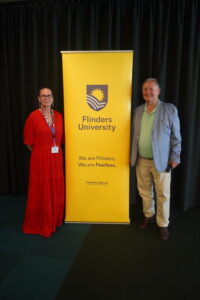 highlight of the symposium was the presentation from 2025 Waterman Fellow, Larissa Taylor, Lecturer in Indigenous Knowledge, Culture & Health.
Larissa presented the outcomes of her pilot project, the Cultural Reflective Audit (CRA) tool, a strengths-based framework supporting non-Aboriginal staff to embed Aboriginal knowledges more confidently and authentically across teaching and practice.
Central to this work is the Critical Reflection Companion (CRC) Tool, designed to embed cultural safety and humility in education.
As Larissa shared, “This work came from recognising that cultural safety cannot be taught through compliance — it must be built through reflection and relationship.”

Larissa’s work is accompanied by artwork by Sam Gollan (Meiwi Aboriginal Art), created in connection with the project and shared with permission.
Announcing the 2026 Waterman Fellow

The symposium also marked the announcement of the 2026 Waterman Foundation Fellowship recipient, Professor Jill Carr.
Professor Carr’s fellowship will focus on embedding sustainability in the medical curriculum, starting with the Bachelor of Medical Science (BMedSci) program.
Her work will map current curriculum content, engage staff and student perspectives, identify opportunities for integration, and evaluate outcomes, supported by cross-college consultation and international benchmarking.
Looking ahead
The inaugural symposium signals a new chapter, bringing the Waterman Fellowship community together to share ideas, showcase impact and drive future innovation.
As Flinders continues to evolve its medical and health education programs, the Waterman Foundation Fellowship remains central to that progress, supporting bold thinking, collaboration and the next generation of educators shaping health outcomes locally and globally.