

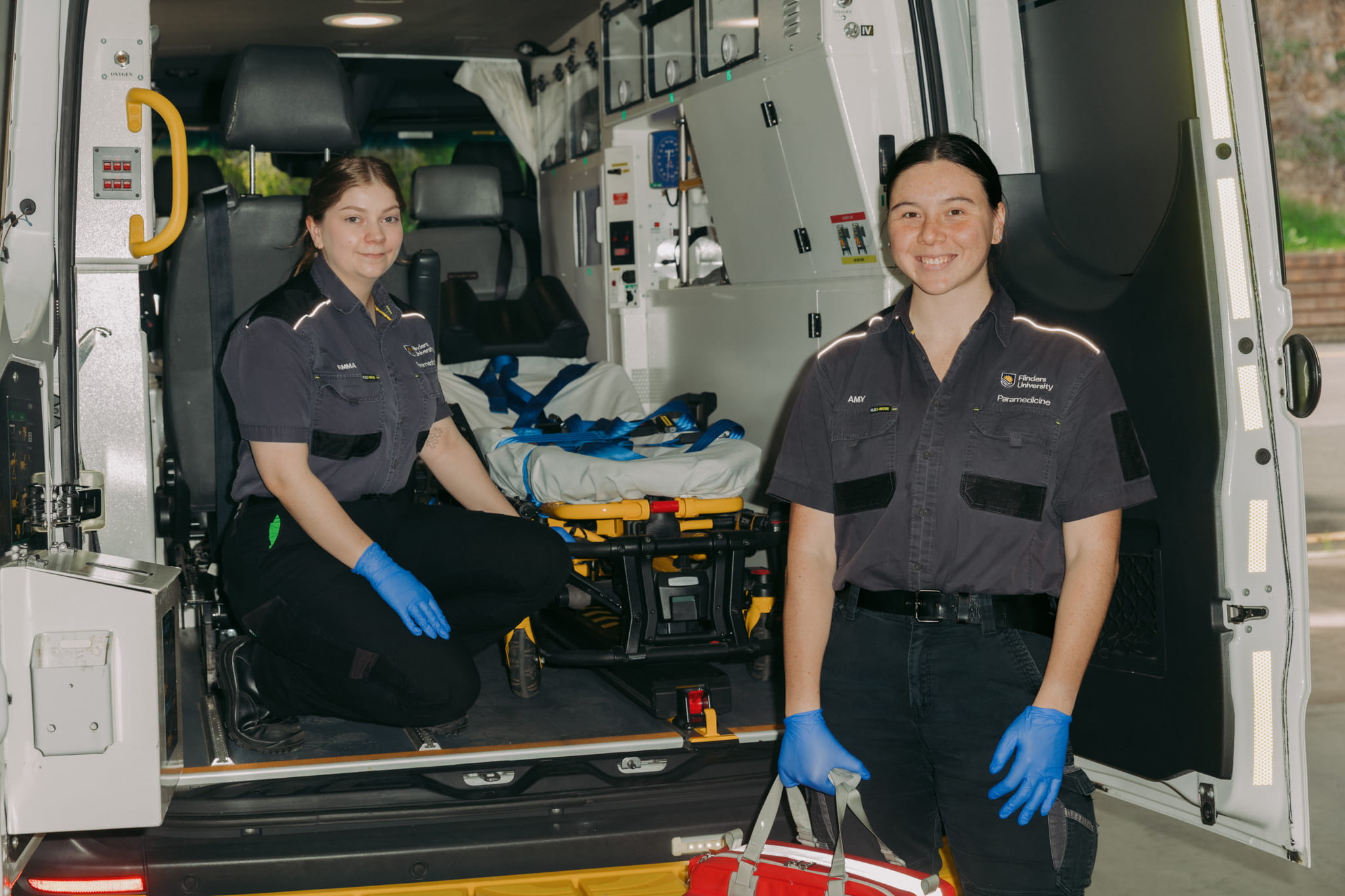
When Amy first began her study journey, she thought her future lay in physiotherapy. But after a year and a half of study, she realised she was looking for something different – a career that would bring new challenges, new experiences and the chance to make a difference when it matters most.
That search led her to Flinders University’s Bachelor of Paramedicine.
“Prior to commencing Paramedicine, I completed 1.5 years of a Bachelor of Physiotherapy,” Amy says. “This experience provided me with a strong grounding in anatomy and physiology, which has been highly transferable to Paramedicine. However, I was drawn to a more dynamic and unpredictable career path, which ultimately led me to transition into Paramedicine – a decision that has been both rewarding and fulfilling.”
For Amy, it’s the variety of the profession that makes it so rewarding.
“What excites me most about Paramedicine is its unpredictability. No two days are ever the same, and every shift brings new challenges and experiences. That sense of variety, combined with the opportunity to respond in critical moments, makes the work both engaging and meaningful.”
She says the opportunity to support people during some of the most vulnerable moments in their lives is a privilege.
“Being able to provide care, reassurance and clinical expertise during these times is incredibly rewarding. The opportunity to make a tangible difference in the community is what drew me to this career.”
Throughout her degree, Amy has gained valuable hands-on experience that has helped prepare her for the realities of paramedic practice. One standout opportunity was her placement in the Emergency Operations Centre (EOC), where she worked alongside call-takers, dispatchers and clinical telephone assessment paramedics. “It provided valuable insight into the complexity of pre-hospital care coordination,” she explains. “It highlighted the clinical decision-making involved in determining the most appropriate care pathway for patients, whether that be ambulance dispatch, referral to a GP or alternative care options. It was eye-opening to see how much coordination is required to ensure patients receive timely and appropriate care.”
 Among the highlights of the course is the third-year Mass Casualty Incident (MCI) training day, where students work together to respond to a realistic large-scale emergency scenario.
“It challenges students to step outside their comfort zones without the pressure of assessment, while gaining insight into the demands of real-world mass casualty incidents,” Amy says. “Support from SAPOL volunteers and the MFS enhances the realism of the scenario, providing an authentic representation of how a true MCI is managed. Overall, it’s a unique and highly valuable experience.”
For anyone considering studying Paramedicine, Amy encourages them to embrace every challenge.
“My main advice for prospective Paramedicine students is to embrace discomfort and challenge,” she says. “Some of the most valuable learning happens in situations where you feel uncertain or out of your depth. These moments are where the greatest growth occurs.”
“Paramedicine is a career of lifelong learning, regardless of experience level or qualification. Being open to feedback, willing to make mistakes and receptive to learning from others are essential qualities for success in this field.”
For Amy, stepping outside her comfort zone has led her to a career she genuinely loves—one where every day offers a new opportunity to learn, help others and make a meaningful difference.
Interested in becoming a Paramedic?
Study in either South Australia (SA) or the Northern Territory (NT), a Flinders Paramedicine degree equips you to play an integral role in the healthcare system, delivering best-practice patient care from site to hospital.
Find out more >