

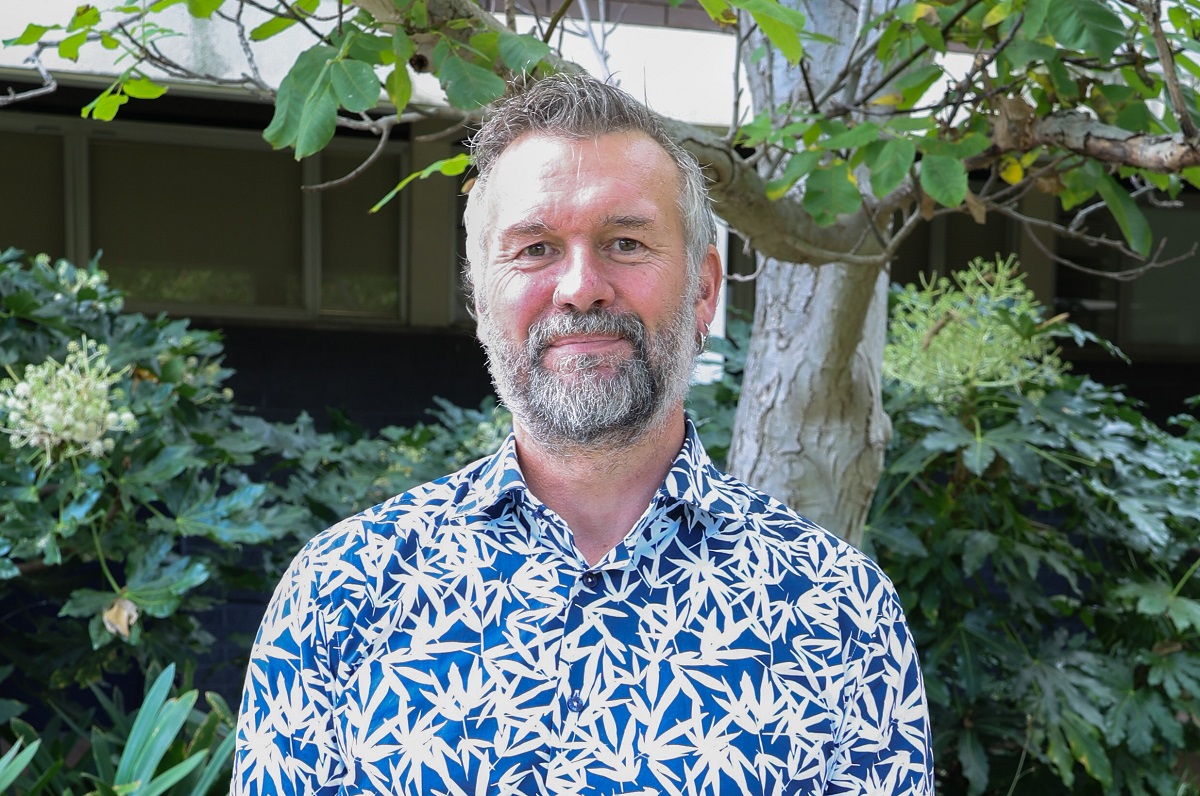
Fresh off receiving a VC Award for Mid-Career Researchers, we caught up with geoarchaeologist Associate Professor Mike Morley to ask him about his experience on one of the most important human evolutionary sites in Europe. He told us about the importance of dirt, and his recent ARC infrastructure grant that is going to boost capabilities in the Flinders Microarchaeology Laboratory.
What is your role here at Flinders?
I am Associate Professor of Archaeological Science here at Flinders. I am a geoarchaeologist, which very broadly means that I study landscapes and sediments (dirt) using scientific techniques to reconstruct past environments and identify features that might provide clues about what our ancestors were doing in the past. I am responsible for getting students interested in our deep time past and the many ways in which state of the art scientific techniques can be used to answer archaeological questions.
I work in the field of human evolution so I undertake my geoarchaeological analyses on dirt that was deposited in deep time – anywhere from ten thousand to a million years ago, or more! I primarily work overseas, with projects in Eurasia and Africa where we are trying to better understand what made our deep-time ancestors tick, and how and why they came to disperse around the globe. Since Covid, I also now work closer to home, in Australia, where I am working with local communities to the rich archaeological record. Much of my work is carried out in caves, places where our early ancestors often visited and sometimes inhabited as ready made shelters.
How did you get into this line of work?
When I was in my early 20’s, I volunteered to work on what was to become one of the most important human evolutionary sites in Europe, a site called Boxgrove where we recovered very well preserved human remains and stone tools made by people who lived on the coast of southern Britain half a million years ago. It was a completely fascinating site and I was immediately hooked and went off to study Archaeology a year later at Sheffield University. What really drives me in my line of work is my passion for reading modern day landscapes and thinking about how they looked in the past and how they were used by our deep-time ancestors. People often think of landscapes as immutable, but of course they are hugely dynamic and have changed markedly over the sorts of timescales I work at.
What’s one thing you’d like people to understand about your work?
Dirt is as precious as the artefacts from which they are recovered! Most people assume (probably justifiably so) that archaeologists excavate artefacts, bones and other material from sediments that are subsequently discarded. My work is looking at ways in which we can tease out the maximum amount of information from that dirt, and we are doing that in our Flinders Microarchaeology Laboratory at the micro-scale. There’s so much environmental and archaeological information locked in the dirt that is too small to see with the naked eye and we are working to identify and interpret those minuscule features.
Congratulations on your award in the VC Research Excellence Awards – how does it feel?
It feels great, really. It’s always a good feeling to be acknowledged for the work you do, so I am very happy to receive this. It’s worth noting that Archaeology involves large teams of people working on all of the different strands of archaeological evidence, so publications and other outputs that are used to apply for these awards are actually the work of big teams—often including Flinders students—and so these awards should also recognise those collaborations.
So, what’s next for you?
Well, I have just led a large international consortium of archaeological and paleontological scientists in successfully winning an Australian Research Council infrastructure grant. This will massively boost capabilities already existing in our Flinders Microarchaeology Laboratory to form a new laboratory: the Australian Microarchaeology and Palaeosciences Facility, or AusMAP. This project will start in the new year and will see the purchase of various pieces of new analytical equipment to not only analyse sediment, fossils and artefacts at the micro-scale, but will include a separate space for the ‘micro-excavation’ of sediment blocks for the finely-controlled recovery of micro-traces of human and environmental history.
Where’s your favourite place on campus?
The Tavern, obviously. Rob and Ben’s burgers are the best in town…and they serve beer.
How do you spend your spare time?
I have three young girls so spare time is a thing of the past. We also have chickens and sheep on our property in the hills so if it’s not the girls it’s the animals that need tending to. If the stars align and there is a short moment of peace then I will break it by dusting off the guitar and making a terrible noise.