

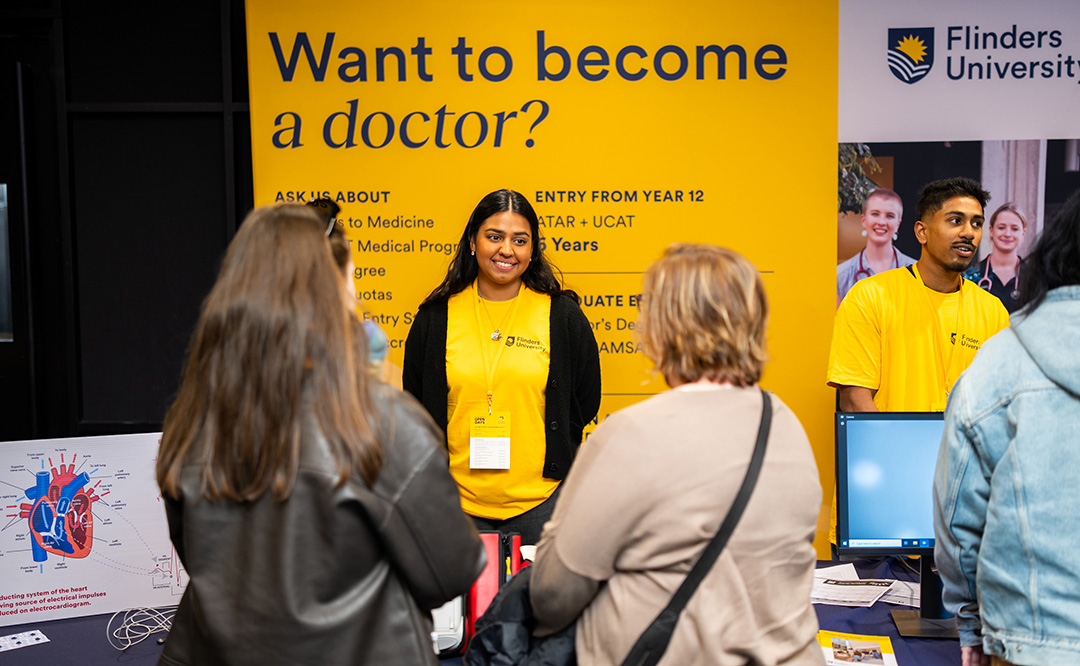
Anushrii Nair’s journey to medical studies at Flinders University highlights the value of completing an undergraduate degree before entering postgraduate medicine. Having already completed a Bachelor of Paramedicine, she entered the Doctor of Medicine (MD) program well-prepared, both academically and practically.
Anushrii’s motivation to pursue a career in health began with a “fascination with the human body” and “desire to be in a profession that combines both scientific problem-solving and compassion.”
Her decision to pursue medicine after completing her undergraduate paramedicine degree stemmed from a deep commitment to patient care and a desire for a broader role in healthcare.
“While completing the Paramedicine degree, I built a love for the profession, but knew I wanted to be able to follow my patients through their entire healthcare journey, leading me to pursue Medicine.”
Her undergraduate degree played a key role in preparing her for medicine, giving her a head start in some core subjects.
“Prior to beginning the Doctor of Medicine, the Bachelor of Paramedicine provided me with foundational knowledge in physiology and pathophysiology, as well as clinical practice skills. This background has been instrumental in preparing me for the rigorous and comprehensive Medicine curriculum.”
 Anushrii found that her earlier hands-on learning experiences further enhanced her preparedness.
“One standout experience during my studies at Flinders has been the exceptional practical classes in both the Paramedicine and Doctor of Medicine degrees.
Working in settings that replicate real-world environments has been incredibly beneficial for building clinical skills and confidence in high-pressure scenarios. The opportunity to apply theoretical knowledge in realistic simulations has been invaluable for my learning.”
For students considering an entry pathway into medicine, Anushrii encourages exploring undergraduate degrees like Medical Science, Public Health, or Paramedicine.
“Completing an undergraduate degree before the Doctor of Medicine program was one of the best decisions I made. Not only did it foster my love for healthcare and assured me that medicine was the career I was most passionate about, it helped me build connections with other people in the healthcare and medical field.
Academically, I learnt important skills essential for any tertiary study, including organisation, time-management, communication with different people and critical thinking.”
Anushrii’s future aspirations include a career in paediatrics, with dreams of practising globally and volunteering with organisations like Doctors Without Borders. Her journey underscores the strength of a multi-disciplinary approach to medicine, where undergraduate studies can enrich postgraduate experiences and lead to a more well-rounded medical career.
Want to become a doctor? Explore our pathways to Medicine.