

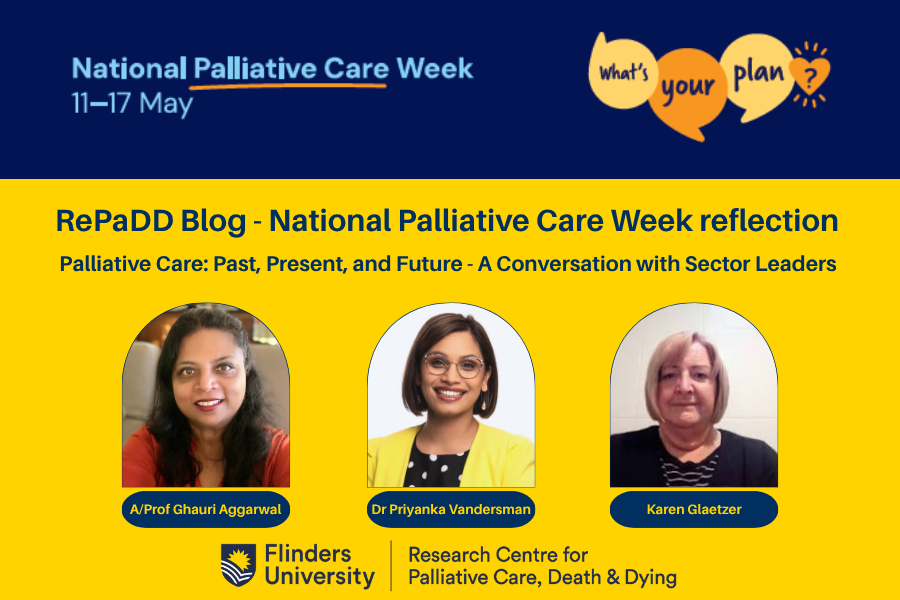
Written by Dr Priyanka Vandersman, Senior Research Fellow, RePaDD and End of Life Directions for Aged Care (ELDAC).
The transformation of palliative care in aged care is a crucial focus, as we navigate an aging population and increasing healthcare needs. The future of palliative care is about evolving past where we’ve been, assessing where we are now, and planning for what’s to come. As we look ahead, it’s essential to consider the sector’s history, the current state of care, and the exciting possibilities for the future.
As part of National Palliative Care Week, we had the pleasure of speaking with two pioneers in the field: Associate Professor Ghauri Aggarwal, long-time Head of the Department of Palliative Care at Concord Hospital and current Deputy Clinical Director of Cancer Services and Palliative Care at Sydney Local Health District, and Karen Glaetzer, Australia’s first endorsed Nurse Practitioner in Palliative Care, who led innovation in the sector until her retirement in 2018.
In this discussion, we explored how far we have come in palliative and end-of-life care, especially for older Australians and what the future might hold.
Reflecting on the Past: A Journey of Change
Historically, palliative care in aged care has been fragmented, with many providers focusing more on acute care rather than end-of-life support. In the past, palliative care was primarily seen as something for cancer patients, with little emphasis on the broader needs of those in aged care or those with non-cancer conditions. This gap in care left many people with unmet needs, as evidenced by the struggle for resources and skilled care providers within the aged care sector.
Over time, the awareness of palliative care needs in aged care has grown, but the sector still faces challenges such as limited access to specialised care and under-resourced services. As A/Prof Aggarwal highlights, there is a growing recognition that palliative care must be mainstreamed across all healthcare services, not just confined to the specialist sector. This is an important first step, but it’s not enough. Palliative care must also upstream into primary care and other areas that have traditionally been less involved.
Current State: Progress and Challenges
At present, significant strides have been made in integrating palliative care into aged care settings, but there is still a lot to be done. Karen Glaetzer emphasises the critical role of executive support in fostering this transformation. In her own organisation, palliative care has moved from a part-time role to a core component of care, demonstrating how far the sector has come. However, the demand for palliative care continues to outpace supply, as evidenced by the increasing referrals for palliative services in aged care homes.
Despite these improvements, significant challenges remain. One of the major hurdles is the shortage of trained palliative care nurses and practitioners. In many cases, aged care facilities lack sufficient staffing to meet the needs of residents who require end-of-life care. There’s also the ongoing issue of under-resourced services, with a clear need for greater investment in training, staff retention, and the development of specialised roles.
Looking Ahead: A Vision for the Future
So, where do we go from here? The future of palliative care is bright, but it requires intentional planning and a shift in how we think about care. A/Prof Ghauri Aggarwal stresses the importance of upstreaming palliative care, urging us to look beyond traditional settings and think about how we can work together to address care gaps in underserved populations, such as those in rural areas or those from culturally diverse backgrounds.
Looking forward, the focus must also be on empowering clinicians, particularly nurses, to take leadership roles in transforming palliative care. The sector needs nurses who are trained and confident in delivering palliative care as well as leading innovation and advocating for change. As Karen points out, this can be achieved through mentorship, continued professional development, and the creation of leadership pathways within the sector. We need to invest in the education and training of nurses to ensure they are well-equipped to manage the complex palliative care needs of an aging population.
Moreover, executive support is critical in driving these changes. It is not enough to simply add palliative care as a service; it must become an integral part of the care model, supported at every level of the organisation.
Conclusion: Shaping the Future of Palliative Care
As we look to the future, we must continue to build on past successes, address current challenges, and plan for the next generation of palliative care across all health and care setting. This means integrating palliative care across all levels of care, ensuring nurses and clinicians have the training and support they need to lead, and committing to the continuous improvement of services. Together, these efforts can ensure that we deliver compassionate, high-quality end-of-life care that meets the diverse needs of our aging population.
The path ahead may be complex, but it is clear. We must continue to strengthen palliative care by drawing on lessons from the past and preparing for a future that offers high-quality support to people nearing the end of life, those receiving care, and the families and care partners who support them.