


Financial wellbeing isn’t just about how much money you have. It is also about whether you feel in control of that money. Social Work student Jenny, on placement with BetterU, shares the mental shifts that have helped her better manage her spending. I suspect they will help you too.
Hi folks. I’m Jenny, a social work student on placement with the BetterU News Team and a finance graduate. While I learned how money works on paper, living as an international student showed me how it actually feels. Managing rising costs, budgeting on my own, and navigating daily decisions made me realise how closely finance is tied to stress, choices, and wellbeing.
This article comes from that experience. Rather than providing budgeting strategies, I will focus on the psychology of spending and small, realistic ways to feel more in control and build a healthier relationship with money.
Let’s begin this blog with a question.
What actually makes you happy?
Is it:
- Feeling close to people who care about you?
- Feeling financially secure and not stressed about bills?
- Feeling like you’re moving toward something meaningful in your life?
Research from the Australian Unity Wellbeing Index says it is all three and calls it the Golden Triangle of Happiness, the three core pillars that shape our long-term wellbeing.
We may all know that money isn’t everything, but financial stability sits right in the middle.
In many ways, when your finances feel out of control, your life can start to feel out of control too. And that’s why building even a small sense of financial control really matters to your overall wellbeing.
Financial stress can affect your wellbeing more than we realise. It can show up:
In how you sleep: lying awake at night thinking about money.
In your mood: feeling more irritable, anxious, or drained than usual.
In your focus: struggling to concentrate in class or stay present, with your thoughts constantly circling around upcoming payments.
In your relationships: you may hesitate to make plans or pull back from others.
You might even start doubting your future or feeling like you’re falling behind compared to everyone else.

When I first moved to Australia, budgeting just meant “don’t spend too much”. But then, inflation hit. Groceries went up. Rent went crazily up. ☕ Coffee went up (urghhh). Suddenly, financial wellbeing wasn’t just about money. It became about stress, sleep, and focus, about feeling in control, connected, and even self-worth.
” Money can provide calm and control, allowing us to buy our way out of unforeseen bumps in the road” (Blanding, 2022)
If you’re interested in learning more about the Golden Triangle of Happiness (and the other 2 factors – sense of purpose and strong relationships), you can visit Dr. Gareth’s blog.
If you want to dive into financial wellbeing, stay with me!
Here are some small tips that helped me and might help you too.
Tip 1: Shape Your Mind Before You Shape Your Budget
Being a student comes with a wide range of emotions: stress, pressure, loneliness, and sometimes FOMO. With so much going on, it’s easy for spending to become a way of coping.
A bad day can quickly turn into an online shopping cart, or saying yes to plans can feel easier than missing out. Later, that “why did I do that?” voice pops up when you check your bank account. 👉 That’s a cycle.
If this feels familiar, you’re not alone. Many of us use spending as a quick way to manage how we feel in the moment. It works, but only temporarily.
Pause for a second and ask yourself: “What do I actually need right now?”
Usually, it’s not the item itself. It might be the comfort after a long day, the connection with others, or simply a break. Instead of spending straight away, try some low‑cost or free ways to soothe those feelings first: going for a walk, talking to a friend, listening to music, tidying your space, or giving yourself time to reset.
Research shows that spending at least 120 minutes a week in nature is associated with better health and wellbeing. At Flinders, there’s a program called “Forest Walks” 🍀 run by Oasis every Fridays from 10:30 – 11:30 am during the semester that you can join to refresh your mind.
Even a short pause can make a difference. Delaying emotional decisions allows the intensity of the feeling to settle, so you can respond more intentionally rather than react automatically.
Spending is often driven by emotional wants, not rational needs.

Tip 2: Needs vs Wants – Do I really need this?
Let’s try something together.
Next time you’re about to spend money, pause for a second and play this quick game:
Is it a Need, a Want, or… It Depends? No overthinking. Just go with your first instinct!
Round 1
- Groceries for the week
- Uber Eats after a long day
- New sneakers (you already have a few pairs)
- Textbook for class
- Coffee every morning
Round 2
- Buying lunch because you forgot to meal prep
- Eating out because you’re too tired to cook
- A weekend trip with friends
- That hoodie you saw “on sale”
So… how did you go?
Some answers are clear: Groceries, rent, and transport are needs. But others sit in the grey area. Because spending is often emotional.
- That coffee might be routine… or it might be comfort.
- That dinner out might be convenience… or burnout.
- That concert ticket might be fun… or FOMO.
So, what feels like a “need”… might actually be a feeling.
If it’s not a clear need, please don’t rush the decision. Let it sit.
That pause helps you figure out:
“Do I really need this… or do I just feel something right now?”
And that’s exactly what the next part is about. The 7-Day Rule simply builds on this moment, turning a quick pause into a habit that protects your money and your wellbeing.

Tip 3: 7-day Rule” (My Favourite Anti-Impulse Hack)
We all know the feeling of fast dopamine when we see something we want. For me, it was a cute, fluffy Harry Potter‑themed Oodie I saw advertised late at night after a long day at uni and work.
But hold on, wait a minute!
That’s the common thread across everything we’ve talked about:
💥 Big emotions can lead to impulsive decisions.
And the most helpful thing we can do is 👉 to create a pause.
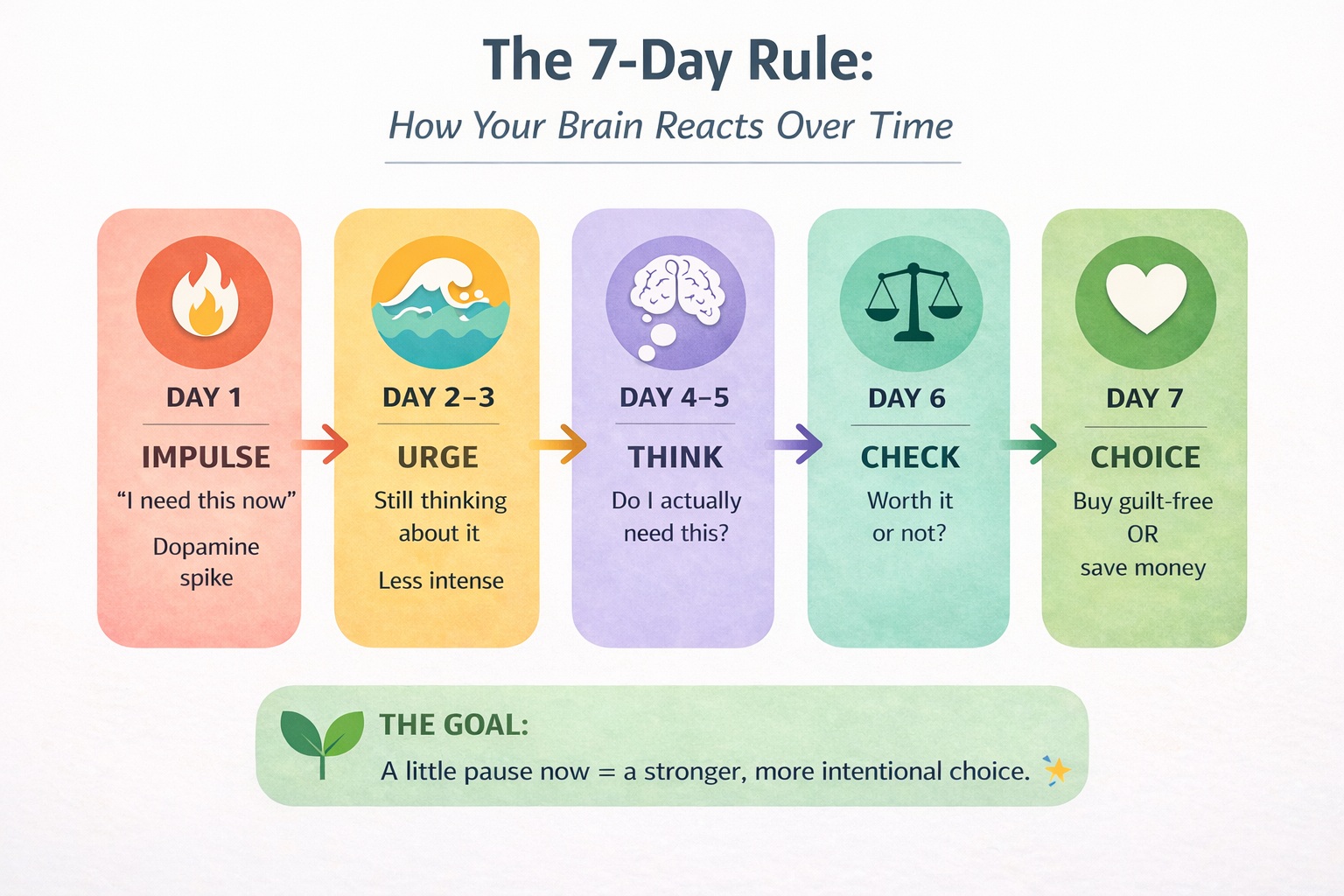
Impulse spending isn’t a lack of willpower. It’s how our brains respond to strong emotions. When we feel excited, stressed, or even left out, our decisions can become more reactive. 🙉 And a little pause gives us space to think clearly, consider alternatives, and make a more intentional choice.
That’s where the 7-Day Rule comes in, which has worked for me for years. So, I just want to share with you this simple, yet powerful tool to help us pause, reflect, and be less likely to make a regretful financial decision.
💡When you want to buy something that isn’t essential:
- Put the purchase on hold for 7 days.
- Over the next week, think about whether you still genuinely want or need it.
- After 7 days, ask yourself:
- Do I still actually want this?
- Is this purchase worth the money I’m giving up?
After the excitement has faded and you’ve had time to think clearly. If the answer is still yes, then go ahead and buy it.
Often, though, the urge passes — and you’ve saved yourself money.
In conclusion, after 7 days, you will either spend wisely or save up some money.
Tip 4: Be Willing to Ask for Help’
Coming from an Asian background, talking about money or asking for financial support can feel taboo. But after three years living in Australia, I’ve found people here genuinely want to help — sometimes you just need to ask 😊
At Flinders, we have:
✅ Financial counselling and advocacy – a safe, confidential space to talk through your situation, understand your options, and create a plan.
✅ Financial help, loans and grants – a range of services and financial assistance you may be eligible to receive.
✅ Oasis Community Market: FREE fruit, vegetables and bread, along with LOW-COST pantry items. Found at the Oasis Student Wellbeing Centre every Thursday during semester, from 11 AM – 1 PM.
Other related services:
✅ You can also use Ask Izzy to quickly find local support like free meals, financial help, and community services near you.
✅ Community meals in the city for students run by Scot church every Tuesday and Friday nights: Click here for more information
Final thoughts
At the end of the day, financial wellbeing is not about trying to be perfect in controlling cash flow. It’s about learning, adjusting, and being a little kinder to yourself along the way. Every small step counts, whether it’s pausing before a purchase, understanding your habits, or simply becoming more aware of your emotions.
You’re not expected to have it all figured out. You’re just figuring it out, and that’s enough.
As you slowly build a sense of control over your finances, you might notice something else too. You may feel a little calmer, a little more confident, and a little more in control of your life 💚
References
Blanding, M. (2022, January 25). More proof that money can buy happiness (or a life with less stress). Harvard Business School Working Knowledge.
Mead, R., & Cummins, R. (2015). What makes us happy? Fifteen years of the Australian Unity Wellbeing Index. Australian Unity & Deakin University.
Measom, C. (2023, October 8). The 7-day rule: This is how you stick to your budget. Yahoo Finance.
Topor, A., & Ljungqvist, I. (2017). Money, social relationships and the sense of self: The consequences of an improved financial situation for persons suffering from serious mental illness. Community Mental Health Journal, 53(7), 823-831.
White, M. P., Alcock, I., Grellier, J., Wheeler, B. W., Hartig, T., Warber, S. L., … & Fleming, L. E. (2019). Spending at least 120 minutes a week in nature is associated with good health and wellbeing. Scientific reports, 9(1), 7730. https://www.nature.com/articles/s41598-019-44097-3
Images by Canva and Gemini AI.