


Social Work student Rachel describes how an Aboriginal weaving workshop at Flinders showed how art can be both cultural expression and a powerful tool for student wellbeing.
When most of us think of “art,” we picture paintings in galleries or sculptures in museums.
But for Aboriginal communities, art is much more than that. It is culture, memory, healing, and a deep connection to Country.
🌸 About Me
I’m Rachel, currently studying a Master of Social Work at Flinders University.
My background is in media, where I became interested in how stories and creativity can support wellbeing, especially after volunteering with children in Bali.
At Flinders, I’ve been exploring the role of art and culture in student support, including workshops like Aboriginal weaving that highlight the healing side of creativity.
Outside of study, I enjoy painting, cooking, and discovering new places around Adelaide.
This article reflects my personal experience and learning as a student, and I write with deep respect for Aboriginal culture and tradition.
🧺 Ancient Craft, Modern Meaning
Weaving has been part of Aboriginal life for thousands of years. Using natural fibres like pandanus leaves, reeds, and grasses, Aboriginal people created baskets, mats, and nets that carried food, bush medicine, and cultural stories across generations.
Different regions developed unique techniques. For example, Queensland’s “two-horned” baskets were designed to leach toxins from bush foods, while Arnhem Land communities made beautifully dyed ceremonial mats.
Today, weaving continues to thrive in both traditional and contemporary forms. The Tjanpi Desert Weavers brings together more than 400 Aboriginal women who transform desert grasses into jewellery, crafts, and even large sculptures.
Renowned artists such as Yvonne Koolmatrie have revitalised Ngarrindjeri weaving, gaining international recognition and ensuring the practice continues for future generations.
🪶 Weaving as Therapy
Weaving is more than a cultural craft, it is also a calming, therapeutic practice.
The repetitive rhythm of looping, twisting, and binding fibres encourages focus and stress relief.
In group settings, weaving fosters community and creates space for storytelling, where the process itself becomes as meaningful as the finished basket or mat.
🎨 The Workshop at Flinders
Recently, the Flinders University Museum of Art (FUMA) hosted an Aboriginal weaving workshop as part of its exhibition Crosscurrents. Celebrated artist and weaver Sonya Rankine guided students through the cultural significance of weaving and demonstrated how Aboriginal communities have used natural fibres for generations to connect culture, land, and identity.
The workshop space was set with grasses, shells, feathers, and stones, surrounded by Aboriginal artworks that created an inspiring atmosphere.
Students learned step by step how to weave. At first, strands slipped and knots tangled, but with patience and encouragement, patterns began to take shape.

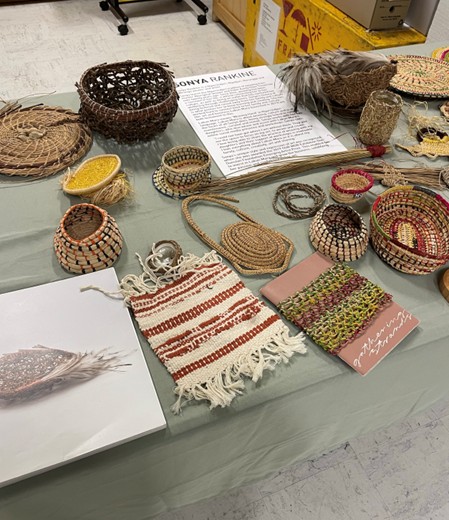
The room was filled with quiet concentration, occasional laughter, and conversations between students.
By the end, each participant had a small woven piece to take home, a symbol of personal achievement as well as cultural connection.
More importantly, the experience reminded students that Aboriginal art is not only something to observe but something to experience: a practice that brings calm, connection, and meaning.
💫 What the Workshop Meant to Me
During the weaving process, I felt a deep sense of calmness and focus. Each twist and knot helped me slow down, reminding me of the importance of being present in the moment. I also felt a sense of connection, not only with Aboriginal culture but also with my fellow students as we shared the learning space.
What struck me most was the vitality of Aboriginal art. It feels both ancient and alive, carrying stories, memories, and connections to the land. Every thread and pattern seemed to echo the heartbeat of Country, reminding me that art is not just a product but a living practice. The dots and fibres in Aboriginal art are like stars, rivers, and rhythms of life, simple yet profound, natural yet spiritual.
🖌️ My Connection to Art Therapy
I have always been drawn to art therapy because of its power to bridge expression and healing. Experiencing Aboriginal weaving deepened this interest: the art felt raw and full of life, as if each point and strand carried both history and spirit.
In addition, I have studied art history and practiced painting, which has helped me see how art provides powerful ways to express ourselves and process emotions. For me, art is not only about creating images but also about transforming feelings – whether heavy, relaxed, open, or flowing; or the sense of being trapped, constrained, or pressed down. These emotions can be expressed through visual forms, structures, and symbols.
As someone studying Social Work, I see the potential of art therapy to support people who may find it difficult to put feelings into words. Aboriginal art inspires me to consider how creative practices can honour both personal emotions and cultural traditions. It reaffirmed my belief that creativity, when rooted in life and spirit, can be a powerful tool for wellbeing.
💖 Why Art Therapy Matters
Art therapy matters because it provides space to slow down, create, and reconnect.
It supports mental health, helps reduce stress, and builds social connection.
For Aboriginal communities, weaving continues to be a practice of resilience and cultural strength.
For students, workshops like this highlight the powerful link between creativity and wellbeing.
🙏🏻 Gratitude and Acknowledgement
This workshop was hosted with the support of the Flinders University Museum of Art (FUMA).
I would like to thank them for making this experience possible and for creating opportunities for students to engage with Aboriginal cultural practices.
You can learn more about FUMA here and I recommend subscribing to their mailing list so you hear about upcoming workshops – https://www.flinders.edu.au/museum-of-art/subscribe
They are a wonderful opportunity to step away from study, learn something new, and experience the healing side of art.
📚 References
State Library of Queensland. (2017, June 2). Keeping culture alive through weaving. State Library of Queensland. https://www.slq.qld.gov.au/blog/keeping-culture-alive-through-weaving
The Guardian. (2025, August 6). Tjanpi Desert Weavers at 30: How 400 Indigenous women in remote Australia took the art world by storm. The Guardian. https://www.theguardian.com/artanddesign/2025/aug/07/tjanpi-desert-weavers-at-30-indigenous-women-in-remote-australia-take-the-art-world-by-storm
Yvonne Koolmatrie has talked a lot about weaving and her own healing journey. There is an article here https://beyondboundariesjournal.org/portfolio/yvonne-koolmatrie-practicing-culture/
