

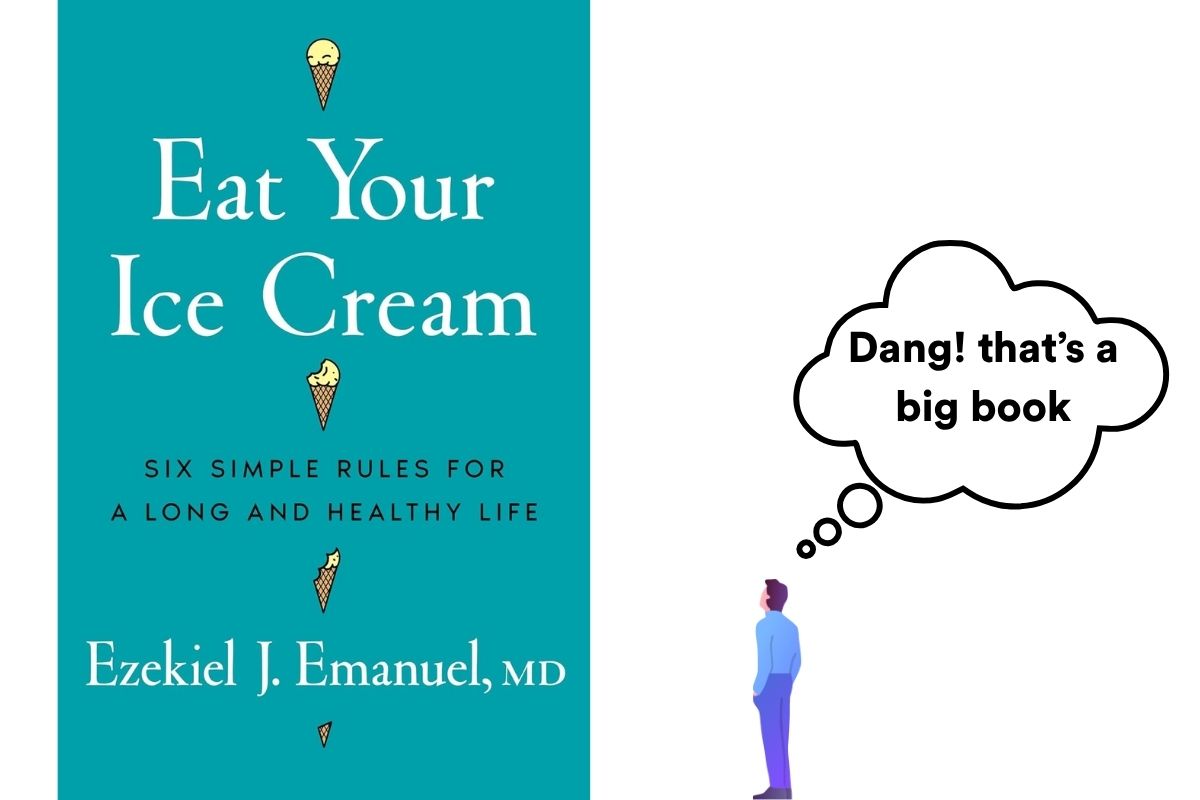
You can hold your applause for later, but I read a book. A decent one. With no-nonsense advice about how to stay alive and healthy. In the post I share a couple of thoughts about the book, something it did well, something it could do better.
I just finished reading Eat Your Ice Cream: Six Simple Rules for a Long and Healthy Life by Ezekiel J. Emanuel. It was the first book I read, having fired up my ereader again, which had been collecting dust in a bag.
As the title suggests, this is not a dense longevity manual full of complicated protocols, expensive supplements or intense self-optimisation routines. It reads more like a kindly, well-read doctor saying: “Look, we actually know a fair bit about what helps humans live longer and better. Don’t overcomplicate it.”
The six rules are straightforward:
- avoid self-destructive risks
- cultivate family, friends and other social relationships
- stay mentally sharp
- consume healthy food and drink
- exercise well and regularly
- get the rest you need
There is nothing especially shocking in that list. In fact, that is part of the book’s strength. It is a reminder that the core ingredients of a healthier life have been known for a while. We do not need to keep pretending that the next podcast episode, health hack, wearable device, supplement stack or morning routine is going to reveal the secret that nobody else has noticed.
And I say that as someone who works in the wellbeing space and who spends time searching for the “next thing”. What do I typically find? The “next thing” is often poorly evidenced, costs a bunch of money and appears to be a perverse projection of the person selling it. So, once you clear away the junk, you tend to come back to stuff we know well.
And I think Eat Your Ice Cream does that well. It gently pushes back against the current fetish for longevity and optimisation. It encourages the reader to spend less time obsessing over health and more time living in ways that are likely to support health.
This is a distinction that I am currently grappling with in my own life.
I spend a lot of time reading about, thinking about, talking about health behaviours, with a focus on psychological ones. And I find it relatively easy to argue that these behaviours are important. Sleep matters. Movement matters. Food matters. Relationships matter. Keeping your mind active matters. Avoiding unnecessary risks matters. But they are not supposed to become the whole point of life. They are supports for the bigger project, not replacements for it.
And admittedly, I find that bigger project harder to articulate. So, working in wellbeing, it is easy for the wellbeing practices to become the bigger project. Did I exercise? Did I sleep well? Did I meditate? Did I eat properly? Did I connect with someone? Did I do the thing that is meant to produce the benefit?
A slightly morbid image has been floating around in my head lately. I imagine myself on my deathbed being asked, “What mattered to you?” And I don’t want my answer to be, “I ate enough vegetables and got 150 minutes of moderate physical activity per week.” Although there is something darkly amusing about that.
Moreso, I want those things to have helped me do something else: love people, contribute, create, learn, be useful, enjoy myself, stay curious, and participate properly in the bizarre ride that is being alive.
To be fair to the book, it does have some additional protections against becoming just about health behaviours. Two of the six rules are about staying mentally sharp and cultivating social relationships. These are not just “health behaviours” in the narrow sense. They are also part of what gives life shape and meaning. A walk with a friend is exercise, but it is also connection. Volunteering outdoors might involve movement, purpose, social contact and exposure to nature. Reading a book might keep the mind active, but it might also change how you understand yourself or the world.
I also want to be kind about people retreating into health behaviours when the bigger life question is unclear. Sometimes “What do I want my life to be about?” is not an easy question. Sometimes you are just trying to get through the week, pay the bills, care for others, complete assignments, manage your health, or not fall apart. In those moments, focusing your attention on controllables like sleep, food, movement, social contact and keeping your mind active is a pretty sensible refuge. It may even be a decent form of future-proofing. A bit like saving for retirement before you know exactly what retirement will look like. You may not have the big picture sorted, but you are still giving future-you a better platform from which to act when things become clearer.
So I think the book handled that bit well – reminding the reader gently that these healthy choices are in the service of a good life, they themselves aren’t the good life.

Where I think the book could have gone further is in the behaviour change bit. Because knowing the six areas is one thing. Actually building them into your typical day or week is another.
I suspect this is one of the big engineering challenges for most of us, although please let me know if I am projecting here. But I see a lot of people grapple with the question of “How do I build a life that promotes mental and physical health, while also supporting the things that matter to me?”
And I think it is because the question is loaded with privilege, complexity and perfectionism.
Privilege, because not everyone has equal access to the conditions that make healthy behaviours easier. Time, money, safety, decent housing, flexible work, supportive relationships, access to healthy food, physical capacity, cultural fit, and predictable routines all matter. It is much easier to follow good advice when your life has been built in a way that allows you to follow it.
Complexity, because even when the conditions are decent, life is messy. People get sick. Semesters become intense. Workloads spike. Relationships become difficult. Motivation comes and goes. Advice that sounds simple in a book can become surprisingly hard to enact on a random Tuesday night when you are tired, stressed and surrounded by competing demands (and cheap plonk).
And perfectionism, because health advice can easily become another standard by which to judge ourselves. A sensible life can quietly morph into a perfectible life. Suddenly, you are not just trying to sleep a bit better or move a bit more. You are trying to optimise everything: the ideal diet, ideal morning routine, ideal exercise schedule, ideal screen habits, ideal social calendar, ideal productivity system.
The book, to me, didn’t really head into this territory. It did discuss implementation, within each of the health areas, but didn’t zoom out and really tackle that bigger topic of life design. And that is OK. It would have really farked with the sub-title “Six Simple Rules for a Long and Healthy Life”.

So, is it a recommend from me? Yeah, I think so. It is simple, referenced, readable and practical. It reminded me of things I already knew, but in a way that actually got me started again on a few lapsed behaviours. I can definitely see myself referencing this work in my lectures on self-care. In fact, I have one coming up this Friday where I might open with a brief discussion of the book.
For university students, the “long and healthy life” framing might feel a little distant. If you are 18, longevity may not be the most compelling hook. You might be more focused on getting through Week 9, finding friends, passing assignments, managing money, or working out who you are becoming. But it isn’t a difficult read, and if you can access through the library or a friend, the underlying advice still applies. And the earlier in life you can build good health literacy, the better. In fact, like investing, the earlier you start building some of these practices, the more they can quietly compound over time.
I think it is also useful, that in an information-overloaded environment, there are no-nonsense books like this, that push back against our attraction to quick-fix, novelty-heavy content.
I would just say that in reading it, be mindful of not treating the six rules as another list of things you are failing at. Treat them more like levers. When life feels off, one or more of these areas is often involved. Are you sleeping? Moving? Eating in a way that supports you? Staying connected? Keeping your mind engaged? Avoiding risks that are likely to hurt future-you?
You do not need to perfect them. Just try to keep them in the internal conversation about how you build a life that works for you.

I hope to do more book reviews here on BetterU. The next book I picked up after this one, The Certainty Illusion, deals with science communication, so I am interested to talk about that at some point.
If you’ve read a book, watched a lecture, attended a course that provided valuable guidance to you on living a good life, please consider perhaps writing it up to feature on BetterU. You can find more details on contributions here.