


There are many skills worth developing in life: juggling, joke-telling, changing a flat tire. A useful psychological skill is self-compassion.
I’ve spoken about self-compassion previously, including an exercise to help build self-compassion (self-compassionate letter). You can also find self-compassion exercises on sites like Greater Good In Action. We also talk about it quite a bit in the Be Well Program, that we trialled with students.
Self-compassion is treating yourself with warmth and understanding in difficult times. It is about acknowledging that making mistakes is a part of being human. It is about being mindful of negative thoughts and feelings, but not over-identifying with them, particularly the thoughts that are highly self-critical or demeaning.
Self-compassion can be used during times of high distress. It is a reminder that suffering is a part of life, that you are not broken or damaged because you are suffering, and that the first step to dealing with the situation is to be kind to yourself.
Self-compassion isn’t just about being kind to oneself. It is also a motivational strategy. Those who show compassion to self after failures or mistakes are more motivated to fix things and improve. Self-compassion isn’t letting oneself ‘off the hook’. On the contrary, it might actually be a strong basis for pushing ourselves to be better.
I can think of a number of experiences of being a student that involve significant setbacks: exam stress, getting a bad grade on an assignment, relationship breakups, being away from home and trying to juggle work and study. In all cases, our hope is that students are able to brush themselves off and get back to the task at hand. Learning how to be more self-compassionate may be an important part of the bouncing back process.
Having methods, tools and techniques to deal with this stress is part of what builds resilience and strong mind.
But self-compassion might not be a state of mind you can simply switch on when you need it. Depending on your biology, upbringing, self-beliefs and more, you might find it difficult to take a compassionate stance towards yourself.
That is where specific protocols designed to elicit certain states can be helpful. Learn and practice the protocol, grow the state over time.
I’ve got two for you for self-compassion.
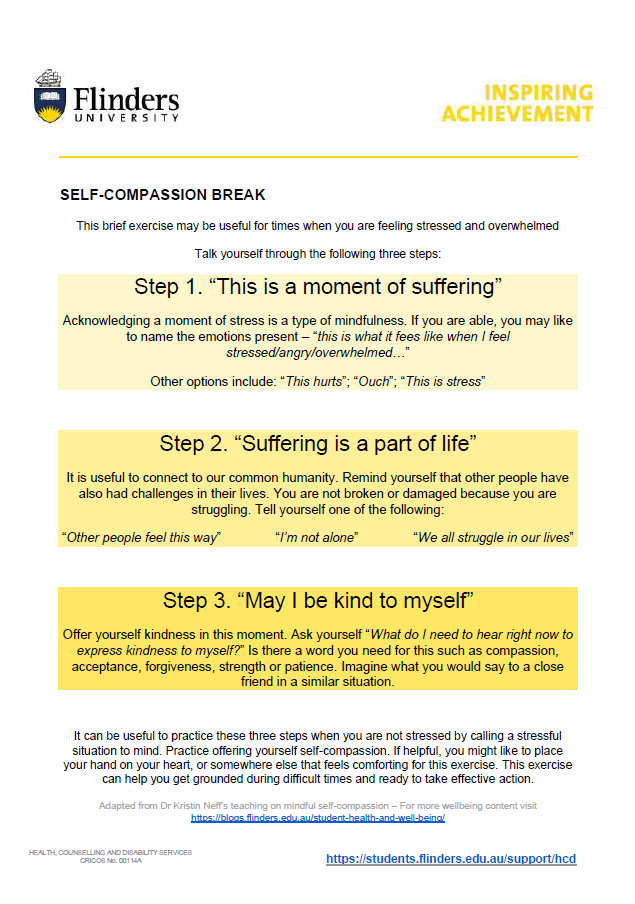
First, one of our counsellors prepared this “self-compassion break” 1-pager. If you are going through a stressful time right now, you might want to print this out and put it somewhere where you will see it regularly: bag, fridge, study spot, or perhaps set it as the background of your mobile phone. It is also a good reminder to be kind to oneself during these strange times we find ourselves in at the moment because of COVID-19, where setbacks and failures and mistakes are more common.
To access a pdf copy click here or the image below.
Second, there is a great article over at All About Psychology on “How to Stop Beating Yourself Up After Mistakes”, which takes ideas from sports psychology to describe a 3-step process for resetting after a mistake. I got my reliable work-buddy chatGPT to turn it into a step by step guide. It is pretty detailed, so you might need to study it a bit to learn the process. It shares some DNA with the self-compassion break (e.g. a focus on mindfulness) but is a more detailed protocol for resetting after a mistake. Click the image for the pdf, or click here.
