


It is normal to need help as you move through life. As a Flinders student, you have access to a wide range of university-based support services. But sometimes the help you need sits outside the university, in the broader community. This post gives you a practical way to start looking.
There are many support services and programs here at Flinders. They cover a range of areas: health/wellbeing, study/learning, financial, enrolment, technology, careers, international, Indigneous, HDR and security.
For many students, in many situations, Flinders-based services will be their first port of call. For example, international students who find themselves in difficult situations are first encouraged to contact ISS (International Student Services). Students who find themselves going through difficult personal situations that are impacting on their studies are encouraged to make contact with counselling services.
But getting what you need long-term in relation to housing, food, healthcare and otherwise may involve you accessing services in the community, not just those at Flinders.
We’re lucky in South Australia that we have many good quality community services that provide assistance to people in the areas of housing, food, family support, health, finances, counselling, legal, education, work and more.
The challenge is navigating your way to find the service(s) that are right for you.
Below is a guide to help you in the process.

Clarify the problem(s) you need help with
We typically reach out for help when things aren’t going right. We don’t have enough money, food, appropriate housing, necessary clothing. We’re struggling with some aspect of our health. We’ve experienced some kind of setback or adversity that we are having trouble coping with. We are confronted by problems that we don’t know how to solve. It may be multiple things happening at the same time.
Writing down what problems you are facing is a starting point for help seeking. Look at the problems you’ve written down and think about what kinds of assistance would be helpful in addressing those problems. It may be the case that a given problem can be tackled from a few different angles. For example, if you are struggling to pay your bills, you might decide to reduce your food costs using the Flinders Market from Oasis but also book an appointment to talk to a financial counsellor at FUSA. Externally, you might decide to make an appointment at Centrelink.
If you are facing multiple problems, you might also need to prioritise which ones to focus on first. That list of problems you identified earlier? Order or number them in terms of importance and work on taking a step to address the first on the list. Often once we get momentum on solving a single problem, it carries over to addressing the others.
Writing down and prioritising the problems/challenges we are facing is important in helping us take the first step to reach out for help. It provides just enough clarity to work out what to do next. And sometimes just taking those first few steps of reaching out for help is the hardest part.

Start here at Flinders
The service/program/resource you need might already exist here at Flinders. Start with the student support page and see if any of the options described seem relevant. If they do, initiate contact. It is ok to initiate a few contacts at the same time.
If the service/program can’t help directly, they can probably make your life easier by suggesting what to do, where to go next. For example, our counsellors can help give advice on accessing specialist mental health supports in the university.
Sometimes the service can provide some short-term solutions and help give advice on how to transition into longer-term solutions. For example, FUSA can often provide some short-term financial relief through food vouchers and similar, then provide financial advice on how to better manage your money.
Sometimes the university service/program will be sufficient to solve your issue. For example, you might end up joining the fitness centre to start your journey of improved health.
It always pays to inquire locally first, before setting off into the broader community service system. Not only might you find the necessary support here at Flinders, but even if you don’t, the support people here at Flinders will probably have a good idea of where to start your community search.
Utilise tools to help you find the right services in the community
If you need to look beyond Flinders, there are some excellent online tools that help you search for community services.
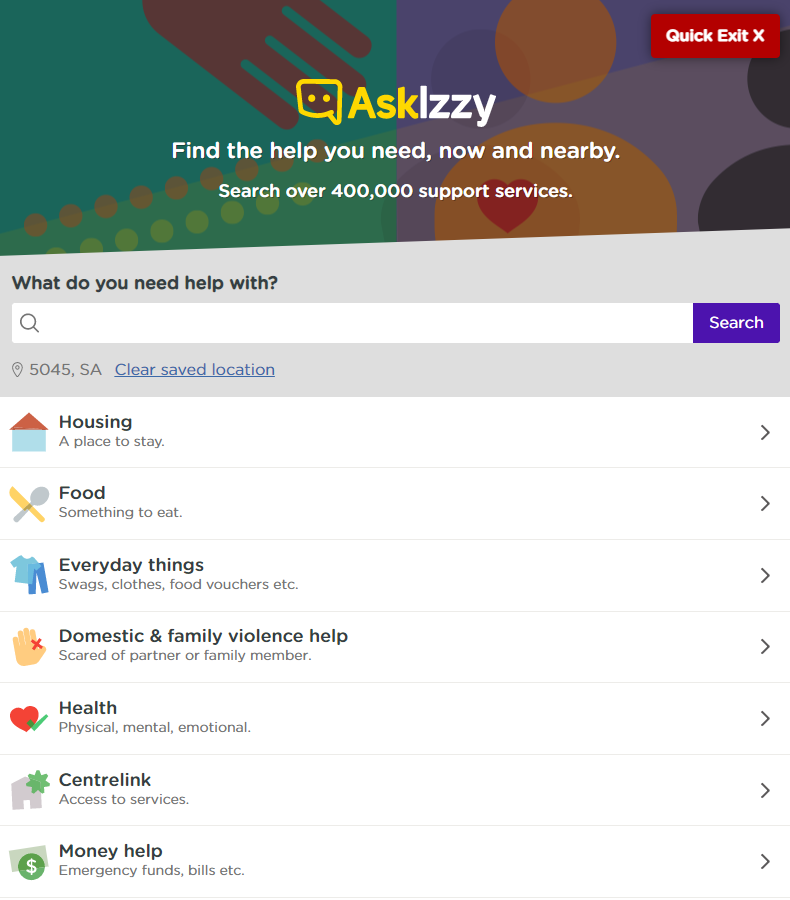
Ask Izzy is one of the easiest to use. It helps people find support for housing, food, money, health, counselling, legal issues, family violence and more. It works well on mobile and is designed for people who may need help quickly.
Affordable SA focuses on South Australian services and includes support for accommodation, money, transport, education, healthcare, food, legal issues, concessions, domestic violence and wellbeing. It is available as a website, app and helpline.
SAcommunity is a broad directory of South Australian community services, groups and organisations. It is useful not only for crisis or welfare services, but also for finding ways to connect with local communities, groups and activities.
Lifeline’s Service Finder is another excellent option. It lets you search more than 120,000 community services across Australia, including help with food, shelter, counselling and ongoing support.
These tools are useful because they let you search by location and type of need, rather than having to know the name of a service in advance.
Take the first step, even if it feels awkward
Shame, embarrassment, fear and other difficult emotions can stop us from taking the next step and asking for help. We might feel we should be able to cope on our own or be independent. We’re worried what people will think of us. We are worried about being judged.
The desire for independence and self-sufficiency is common and admirable. But the journey to becoming more self-sufficient inevitably involves reaching out and asking for help. People you know who are ‘doing well’ had to, at some point, rely on the kindness, generosity and help of others.
The truth is all of us will require help at some point in time. For you, that time might be right now and there is no shame in that. The unfortunate outcome would be that you knew you needed help, but didn’t take that first step and things got worse.
It is normal to face challenges that we can’t overcome just on our own. Reaching out for help is the activation of a core drive in humans. That is, to heal and grow with the help of others.
Be prepared to bounce around a few before finding the right one
The nature of how the community service/ support system is set up (i.e. it is very complex) means that you might go down a few dead-ends before finding the service or program that is right for you.
If that happens, try not to get discouraged. Sometimes a couple of failed attempts to reach out leads people to stop trying. Those attempts weren’t failures though, they were just practice for navigating a complex system. Even those of us who work in the support sector have trouble navigating it at times!
If you do make contact with a service that can’t help directly, ask them to suggest other services that might be able to help. Those referrals and suggestions will often lead to finding the service you need.

Some useful service areas to search for
Rather than trying to maintain one giant list that may go out of date, I recommend using the directories above to search for the specific type of help you need. Common categories include:
- legal help
- sexual assault, family or domestic violence support
- women’s services
- sexual health
- alcohol and other drug support
- disability support and advocacy
- counselling, coaching and mental health support
- Aboriginal and Torres Strait Islander health and wellbeing services
- gambling and gaming support
- food, clothing and emergency relief
- housing and tenancy advice
- employment and workplace rights
- support for carers
- support for refugees, asylum seekers and new arrivals
- LGBTIQA+ peer support and counselling
- social connection and community groups
If you find a service that has been especially helpful, let us know. We are always keen to learn about community services that students have had good experiences with.
And if you are unsure where to start, start with Flinders. You don’t need to know the whole system before asking for help. You just need one next step.
You might find our Phone and Chat services article useful as well as our Quick guide to Student Life services. Then there is the Service Brochure for Wellbeing Services.