

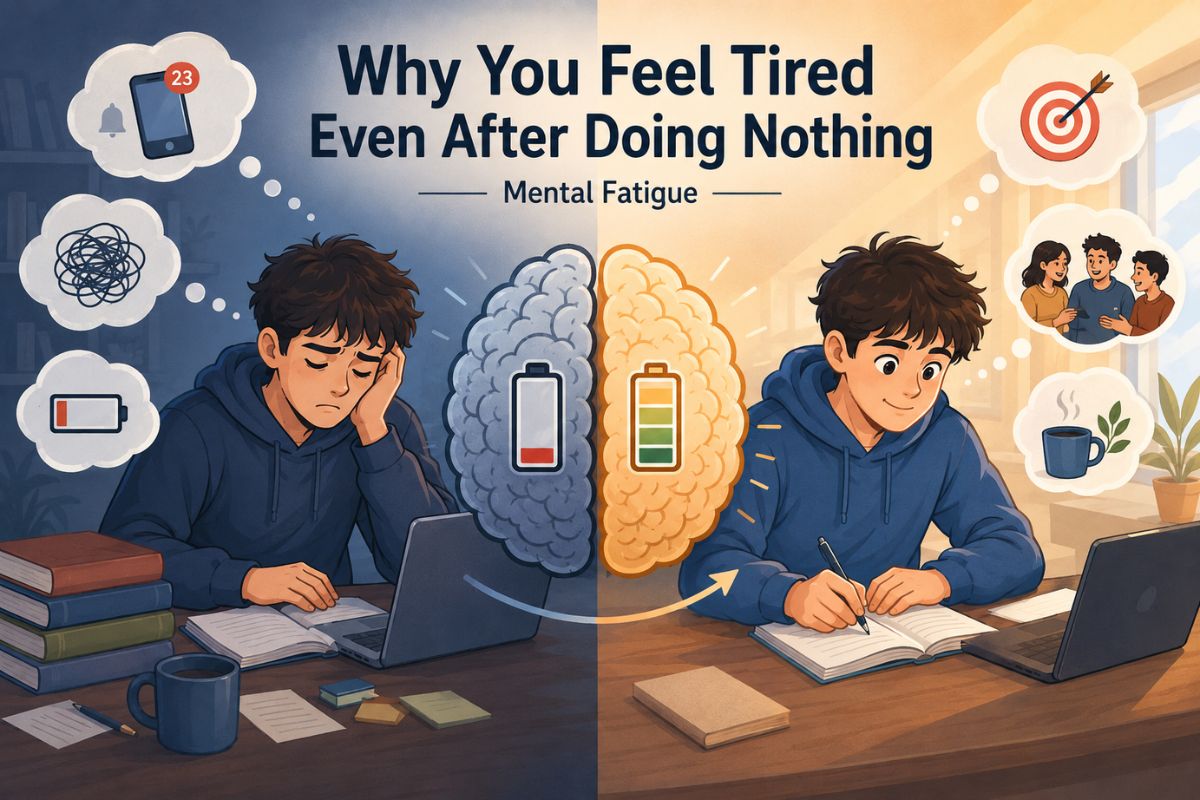
Public health student Fiyo, who has already written popular articles on sleep, study playlists and music and mood, explores what mental fatigue actually means, why it matters for students and what you can do about it.
Key takeaways
- Mental fatigue isn’t just about being “overworked”—it’s linked to how the brain evaluates effort vs reward.
- When a task feels meaningful or rewarding, we can sustain effort for longer with less fatigue.
- When perceived reward drops, the same task can suddenly feel much harder.
- Mental fatigue acts as a signal prompting us to reduce effort or disengage.
- Strategies that increase motivation (e.g., social study, variety, meaningful goals) can help reduce mental fatigue.
You get to the end of the day and think to yourself, “Why am I this tired?” Even on days where you haven’t done anything physically exhausting, your brain can still feel completely drained. It’s a strange kind of tiredness because it doesn’t always feel earned. There’s no obvious explanation for it, which can make it even more frustrating.
A review by Boksem and Tops (2008) helps explain why this happens through the idea of mental fatigue. The paper looks at how the brain responds to prolonged mental effort and why, over time, it becomes harder to continue focusing, concentrating, or staying motivated. What makes the research interesting is that it suggests fatigue is not simply about running out of energy. Instead, it is connected to how the brain evaluates effort and reward over time.

One of the main ideas in the study is that the brain is constantly balancing two things, how much effort it is using, and what it expects to gain from continuing that effort. When something feels rewarding or meaningful, people are often able to continue for long periods without experiencing the same level of fatigue. However, when the reward begins to feel low, the same amount of effort can suddenly feel much harder to maintain.
The study explains that mental fatigue acts as a kind of signal. Rather than just being a passive feeling of tiredness, it functions more like a message pushing someone to stop or reduce effort. As mental work continues, the brain keeps evaluating whether continuing is “worth it.” When the perceived benefits no longer match the effort being used, fatigue becomes stronger.
This way of understanding fatigue changes how we usually think about being tired. Often, people assume that feeling exhausted always means they have done too much. But this research suggests that fatigue is more complicated than that. It is not only about how hard a task is or how long it lasts. It is also about motivation and whether the brain sees value in continuing.
The paper also discusses how mental fatigue affects performance. As fatigue increases, people can experience reduced attention, increased distractibility, and more difficulty filtering out irrelevant information. In other words, the brain becomes less willing and less able to keep investing effort into a task. This can make it harder to stay engaged, even when someone is trying to continue.

For students, this can feel very familiar. There are times when studying becomes mentally heavy, even when the workload itself has not changed. According to the research, this may not simply be a matter of laziness or lack of discipline. It may reflect the brain’s ongoing evaluation of effort and reward. When motivation decreases, mental fatigue can increase alongside it.
One thing I started noticing in my own study routine is that I can work for much longer without feeling mentally exhausted when the studying feels more meaningful or rewarding in some way. For example, I’ve noticed that I stay more motivated when I study with friends, discuss ideas with other people, or even when I feel more personally connected to the content I’m learning. The effort still exists, but it feels easier to maintain. Reading this paper made me realise that mental fatigue is not only connected to how much work we are doing, but also how rewarding the brain perceives that effort to be. I think this is why some study sessions can feel mentally draining very quickly, while others feel easier to continue even when they last longer.
I also did a survey for small group of students to know what helps them stay motivated and manage mental fatigue while studying. Many students mentioned that studying becomes easier to continue when it feels more meaningful, enjoyable, or personally rewarding. Some spoke about studying with friends, listening to music, changing their environment, or taking breaks to avoid feeling mentally overwhelmed. Others said that reminding themselves of their future goals, feeling a sense of progress, or studying topics they genuinely enjoy helped them stay motivated for longer periods. One thing was that students were not necessarily trying to force themselves to “study harder.” Instead, they were finding small ways to make the effort feel more worthwhile and manageable. Reflecting on these responses made the research feel even more relatable because it showed how closely motivation, reward, and mental fatigue are connected within everyday student life.

What makes this perspective useful is that it suggests fatigue is not random. The paper discusses that different parts of the brain appear to be involved in monitoring effort, reward, and the condition of the body during mental activity. Some areas help evaluate how meaningful or rewarding a task feels, while others monitor strain and effort over time. This information is then combined to help the brain decide whether continuing the task is still worthwhile. In this way, mental fatigue can be understood as a signal produced by the brain when the system begins to favour disengagement from the task. The brain is constantly regulating behaviour by deciding whether continued effort feels worthwhile. The study even notes that when rewards are perceived as high, people can work for long periods without the same experience of fatigue. This suggests that the way effort is experienced depends partly on how meaningful or rewarding the activity feels.
Understanding mental fatigue in this way also changes how we think about recovery. If fatigue is linked to prolonged cognitive effort and reduced reward value, then managing fatigue may involve more than simply “pushing through.” It may also involve finding ways to restore motivation, reduce cognitive strain, or make effort feel more worthwhile again. The research explains mental tiredness as something more active and regulated than I originally thought. The brain is not simply “running out” of energy. It is constantly making decisions about whether continued effort is worth maintaining. That makes mental fatigue feel less confusing, especially during periods where staying focused and motivated becomes difficult.
So maybe the question is not always, “Why am I tired when I didn’t do much?” Maybe the better question is, “How long has my brain been working without enough reward to make the effort feel worthwhile?”
References
Boksem, M. A. S., & Tops, M. (2008). Mental fatigue: Costs and benefits. Brain Research Reviews, 59(1), 125–139. https://doi.org/10.1016/j.brainresrev.2008.07.001