


An absolute ripper of an article from Sam Highcock, one of our comms legends in Student Life. Let the record show that she totally single-tasked this article.
Multi-Tasking (and why it’s the devil)
Written by an organisation nerd who’s not a psychologist, has twenty tasks to do and actually gets them done (after years of feeling like I’m failing because my to-do list wasn’t checked off)
If you’re anything like me (type A, cannot sit still, needs multiple projects to feel like I’m doing enough) you might find yourself jumping between tasks, hobbies, assignments, and responsibilities (or more, you over-achiever).

It’s been five years since I’ve completed my Bachelor’s degree (eek) and while I did okay, I certainly didn’t make it easy for myself. Especially with the three casual jobs, small business (that absolutely flopped—but it was fun!), and practical-heavy courseloads. I was juggling my social life, mental health, and uni work while the trajectory of my career hung in the balance.
You see, I didn’t feel like I was being productive. My checklist never got smaller, in fact it grew larger day by day with readings, lit reviews, homework, and catching up on lectures (hello, Covid. You were hell). It felt like I was going around in circles that wound smaller and smaller until I was just spinning on my axis, and productivity and getting things done was a loose faraway dream.

But fear not! I’ve recently figured out what the problem was: the thing that I thought was allowing me to do everything I wanted to do, was actually hindering me. I present you the enemy that is multi-tasking.
So, let me share with you the wisdom I have learned and wished I knew when I was navigating uni.
The problem with multi-tasking
It’s a simple problem: the more we multi-task the worse we get at everything.
You know that saying: a jack of all trades is a master of none? Same goes for your to-do list.

Multi-tasking increases error rate and stress, and tasks can often take double the time it usually would.
I attended a professional development workshop discussing all things multi-tasking and focus and we completed an exercise. You had to write the alphabet and it’s corresponding number on two lines, one after the other (see below), all while the moderator was talking at you about something completely unrelated.

Initially, I thought this task would be easy.
I was wrong.
The amount of information that was hitting my brain made it hard to concentrate on what number belongs to the letter ‘O’. The whole process took me around two minutes.
Next, the moderator told us to write the alphabet in its entirety, and then the numbers underneath. I finished that bad boy in one minute.

And that, my friends, is called cognitive shift.
What is cognitive shift?
Cognitive shift is a rather annoying thing that happens in your brain and if we didn’t have what I’m calling the ‘cognitive shift hurdle’, doing multiple things at once would be fine. But alas, we are human and our brains have limits.
Your executive function is solely controlled by your prefrontal cortex (don’t ask me where that is but I’m pretty sure it’s the front part of your brain—yes, I’m too lazy to Google it).
From an evolution standpoint, your prefrontal cortex is the newest part of your brain and is therefore, more susceptible to stress and fatigue. Which is great (note the sarcasm) because what do you mean the part of my brain that I use to organise and prioritise gets tired more easily than the rest of my brain? Sounds counter-productive if you ask me.

By jumping from one task to another constantly, you’re fatiguing your brain and encouraging a cognitive shift.
Here’s a real-world example.
Picture this: you’re working on your assignment and you’re halfway through writing a sentence when your phone lights up—a new message, and it looks semi-urgent. You pick up your phone, unlock it and type a reply back. Then you see Instagram has that red notification dot in the corner (you know the one) so you open the app and a reel captures your attention. Next thing you know, you’ve been doomscrolling for ten minutes, and you haven’t even read the DMs you opened the app to read in the first place. You’re mid-way typing a reply to a post your friend sent you when your stomach gurgles. You realise it’s 8pm and you haven’t eaten. So, you move to make some ramen (because that’s a goated form of energy and it’s a uni student staple). While the water is boiling, or the microwave is humming, you look over at your desk—
The half-finished sentence in your assignment is glaring back at you, and the blinking line at the end is saying, “you gonna finish me, or what?” It takes you reading the last paragraph twice to get back into writing-mode, but you still feel clunky and awkward.
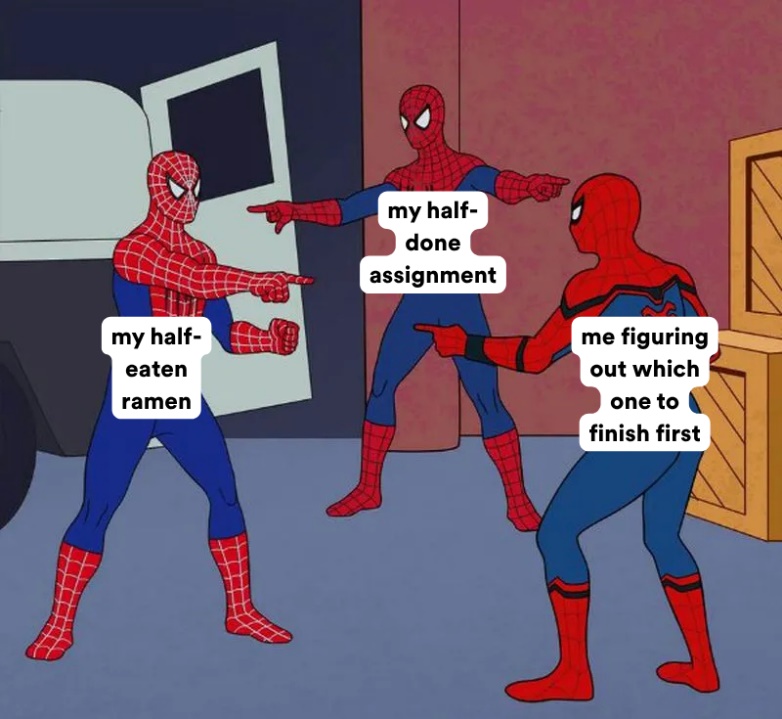
And there’s a reason for this.
Your brain has made so many switches in just half an hour: writing an assignment, answering a message, processing the 20 reels you watched (and the 20 that you skipped past), answering messages from your friends, finding where the last packet of ramen is and starting the process of making it. Of course, you’re not going to be writing your assignment with your best foot forward, and it will remain on your to-do list for a bit longer.
Studies show it can take 20-25 minutes to get back into ‘flow state’ if you’re working on something that requires a lot of attention, after a distraction or interruption. If you have three interruptions a day (i.e. jump to a different project), that’s 60 minutes of productivity gone. That’s 6 weeks a year. All that time wasted because of cognitive shift!

But there are a few fixes, and I have tried them out for you
Fix No.1 – Simply don’t multi-task
If you’ve read up to this point, it’s sounds self-explanatory that single-tasking (doing one task at a time) is more effective, aaand you get the dopamine of completing tasks. Increased dopamine means increased focus. Increased focus means you hand up that assignment on time without the crazy amount of stress you’re used to.
Try out the Ivy Lee to-do list method: write down 6 key tasks per day, either prepped from the night before or first thing in the morning, and prioritise them in order so you can work from top to bottom – single-tasking each one until it’s completed.
Fix No.2 – Turn off notifications
It’s really that simple. Put your phone on Do Not Disturb, or create a new ‘Focus’ setting just for studying (so your mum can call you in case of emergency, but no Instagram, WeChat, or WhatsApp messages come through). No notifications means not accidentally checking your phone when your screen lights up, which also means not having a micro-cognitive shift by reading what the message says. This goes for emails or Teams messages too, if you have those. It also helps to not have your emails or messages open in the background when you’re working on an assignment or completing a task.

Fix No.3 – Use a timer
Using a timer creates room for your attention to be on your task, it gamifies the process, and builds awareness of how long tasks take you. All good things, I would say.
Studies show that it takes fifteen minutes of working on a task for dopamine to rise enough to let you focus. Your brain loves dopamine and once it has it, it’ll be kind enough to left you finish that assignment.

The timer provides space for those first fifteen minutes (the hardest part of starting a task) to get worked through.
Timer suggestion: ‘Forest Timer’ – if you’re using your phone.
Fix No.4 – Create your own soundscape
Retreat to a quiet place to reduce auditory distractions – we have great sensory rooms on campus. If you can’t go to a quiet place, noise-cancelling headphones are also a treat. If you prefer to have background noise (personally, I do) instrumental music, 60 – 90 beats per minute, is great for concentration.
If you want to get real fancy, binaural beats (40Hz) are also great for focus. They must be listened with headphones though, since binaural means sounds goes to each ear individually.
All music can be turned off whenever it gets too much, it just creates space for your mind to truly focus and get into the concentration state.
Authors note: When I was in uni, I listened to all kinds of music when I was studying. I didn’t necessarily have a study playlist (which still surprises me), but I have noticed I work better with soft background noise. The 60 – 90 bpm suggestion came directly from that multi-tasking and focus workshop I attended, but I can also say that ‘Forest Sounds’ playlists on Spotify (which is most definitely not 60 – 90 bpm) has helped me lock-in to write this blog post. So… listen to whatever you want.
Also 8Hz binaural beats are great for sleep 😉

Fix No.5 – Move more often
Try to get up and move every hour. This could be just stretching your legs, standing up from your chair, getting a snack from the vending machine, or a drink from those cool Flying Turtle machines at City Campus.

There is science behind this fix, and while I dropped science in Year 10, let me tell you this science-stuff works (I had no doubts). Focus wanes usually after an hour due to less oxygenated blood going to your brain, and movement increases oxygen in your blood. Bing, bang, boom. Science.

Fix No.6 – The beauty of a bookmark
If you do get interrupted, make a note (a cognitive bookmark) on your to-do list of where your thoughts were at with a task next to it. This will remind you when you sit back down ready to start again, and you won’t have to re-read the last paragraph you wrote twice.
So, there you have it. Multi-tasking is the enemy and single-tasking is the way to go. Everyone is different and some of these fixes might not work for you, but please do try them all to see what fits.
You’ll hear from me again when I have attended another professional development workshop that I found useful—until next time.
Sam
AKA, the person who sends you Ping! every fortnight. You know, the email that tells you about all the cool prizes and things happening around campus. You should totally open it (and follow hey_flinders) 😉