


We have students on placement with us from different disciplines. Jingyi (Lucy), the author of this article is from Public Health. I invited Lucy to write about her discipline and consider where BetterU fits in that world. Please take a moment to support Lucy’s writing and learn a bit about the world of Public Health at the same time.
When you hear the words ‘public health’, what first comes to mind?
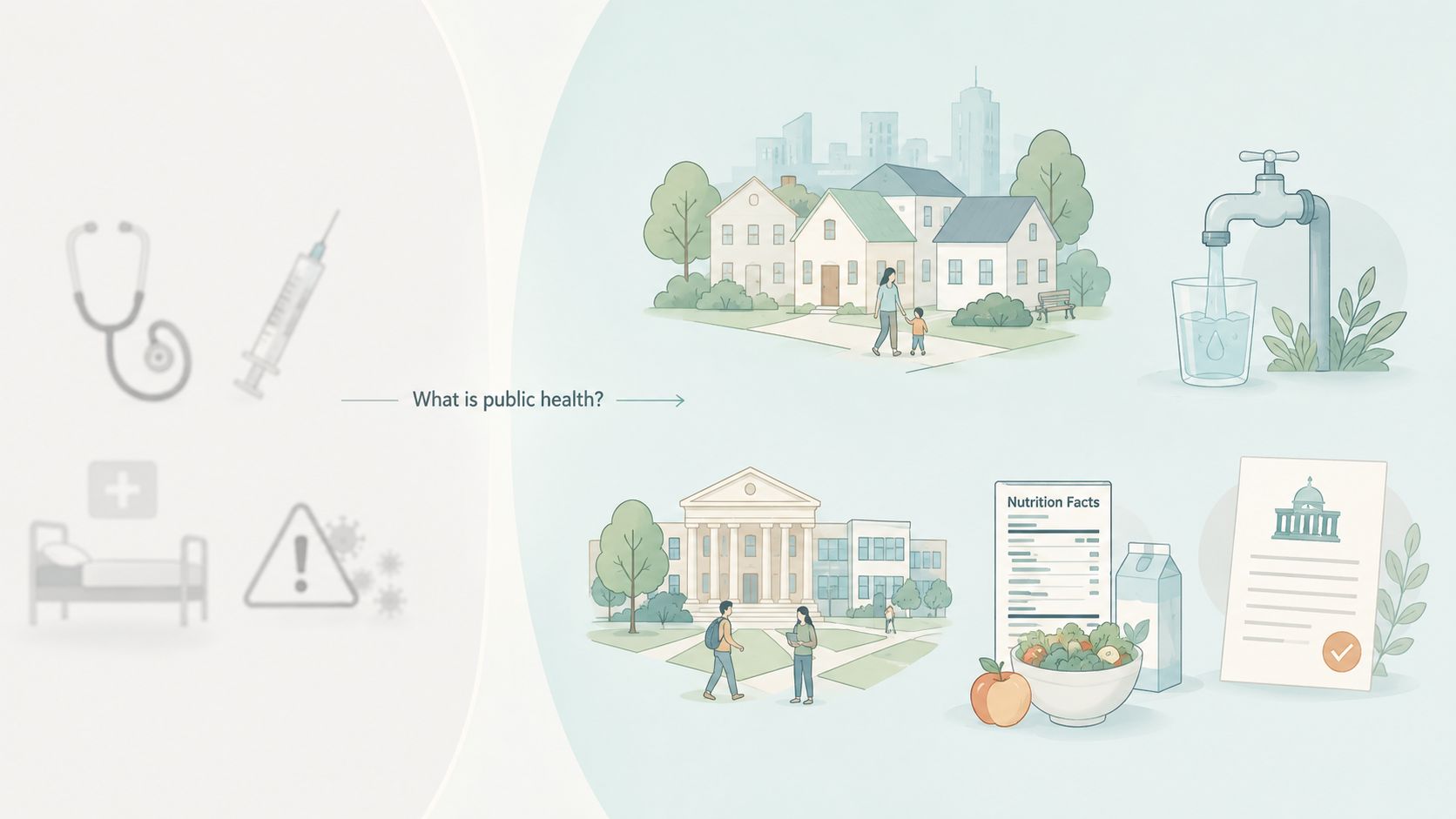
You might think of hospitals, doctors, vaccines or disease outbreaks. Before I began studying public health, I also connected health mainly with medical treatment. I thought improving health mostly meant helping people after they became unwell.
When I first heard about this field in China, it was introduced to me as Preventive Medicine. At the time, the word “medicine” made me imagine a pathway similar to clinical medicine: studying medical science and technical knowledge before graduating to work as a doctor. I therefore understood health mainly through disease, medical knowledge and professional treatment.
When I came to Australia to study Public Health, my understanding began to expand. I learned that public health involves medical and scientific knowledge, while also examining the social and environmental conditions that influence health. It asks how housing, education, employment, income, culture, policy and access to services shape the health of communities and populations. It also considers how health problems can be prevented through supportive environments, effective policies, accessible information and community action.
Looking back, I do not think the two terms describe completely different fields. The important change was in my own understanding: I began to see that preventing illness involves much more than medical knowledge alone.
Understanding Public Health
Healthcare often focuses on helping individuals who are already experiencing illness or injury. Public health looks at the health of whole communities and populations.
Public health is a broad field, but three important ideas can help us understand much of its work: health protection, disease prevention and health promotion. Health protection includes measures such as food safety standards, clean water and infectious disease control. Disease prevention aims to reduce the risk of illness before it occurs, for example through vaccination and health screening. Health promotion helps people and communities gain greater control over their health through education, supportive services and healthier environments.
These three areas often overlap. Together, they help public health professionals respond to existing health risks, reduce future illness and create conditions that support healthier lives.
Public health asks broader questions:
- What health issues are affecting a community?
- Which groups face greater health risks?
- Why do some groups experience poorer health than others?
- What can governments, organisations and communities do to prevent illness and improve wellbeing?
Public health professionals may collect and analyse health data, identify patterns of disease, develop health education programs, evaluate community services or contribute to health policies. Their work can involve many areas, including infectious disease control, mental health, nutrition, environmental health, workplace safety and health equity.
While public health includes many different activities, one of its most important insights is that health is shaped by more than healthcare alone. Understanding this broader view of health helps explain why public health pays attention to social and environmental conditions, not just medical treatment.

Why Health Is About More Than Healthcare
One of the most important things I have learned is that health is influenced by many factors outside healthcare. The World Health Organization describes the social determinants of health as the conditions in which people are born, grow, live, work and age, together with their access to power, money and resources (World Health Organization, 2025). These conditions include education, housing, employment, income, access to nutritious food and social support.
These influences are visible in student mental health. A systematic review found that academic pressure, difficulty adjusting to university, limited social connection, poor mental health literacy, unhealthy lifestyle behaviours, sleep and engagement in learning or leisure activities can influence student wellbeing. Strong and supportive social networks were consistently associated with better mental health (Campbell et al., 2022).
For international students, these factors may interact with language barriers, cultural adjustment, distance from family and unfamiliar support systems. A student may have access to a service on paper and still struggle to use it because they are unsure where to begin, worried about being judged or unable to recognise which service matches their needs.
This helps explain why two people can make similar personal choices but experience different health outcomes. Telling people to eat healthy food may have limited impact if affordable and nutritious food is difficult to access. Encouraging people to seek mental health support may also have limited impact if services are difficult to navigate, culturally unsuitable or affected by stigma.
Public health therefore pays attention to health equity. Health equity means working towards a fair opportunity for everyone to achieve good health while recognising that some people and communities face greater barriers and may require different forms or levels of support.
These ideas may seem broad, but public health influences our lives every day. Many of the systems, services and environments that support our wellbeing are examples of public health in action.
Public Health in Everyday Life
Public health influences many parts of our daily lives, although we may not always notice it. The clean water we drink, the safety standards applied to our food and the vaccines we receive all help protect our health. Smoke-free public spaces reduce exposure to second-hand smoke, while food labels, air quality policies and mental health campaigns provide information and create safer environments. These examples show that public health works quietly in the background and benefits individuals and communities throughout their lives (The London School of Public Health, 2025; AIHW, 2016).
This means that all of us have already been influenced by public health. The air we breathe, the water we drink, the places where we study and work, and the health information available to us all shape our wellbeing. Many of these influences begin before we make an individual health decision.
These examples can be seen not only in society more broadly, but also within universities. Student health is supported through a combination of clinical services, prevention activities and wellbeing initiatives that reflect many of the same public health principles.

Public Health at Flinders University
Clinical Care and Public Health Working Together
The Health, Counselling and Disability Services brochure shows that student health is supported through both clinical care and broader public health initiatives. The GP and nursing service, SA Pathology, individual counselling and after-hours crisis support mainly respond to the health needs of individual students. Even within these clinical services, there are preventive elements such as vaccinations, health screening, health education, early intervention and referral (Flinders University, 2026).
Other initiatives work more clearly at a public health level. Disability access plans and accessible facilities reduce barriers to participation and support health equity. Safety and Respect and Equal Opportunity initiatives help create a safer university environment. Oasis, the Flinders Community Market, mindfulness programs, Mental Health First Aid, Studyology, Good Vibes, forest walks and Flinders Mates promote wellbeing through social connection, skills, supportive environments and early prevention (Flinders University, 2026).
Where BetterU Fits
The boundary between clinical care and public health is not fixed. A clinical service may also prevent illness, while a wellbeing program may help a student recognise when professional care is needed. Looking at how these services connect gives a fuller picture of student health than placing each service into only one category.
BetterU is Flinders University’s central hub for student wellbeing. It brings together articles, self-help resources, programs and links to professional support. From a public health perspective, BetterU contributes mainly to health promotion, early prevention and health literacy. It can help students recognise a concern, learn practical strategies and identify an appropriate source of support (Flinders University, 2026).
Providing services is only one part of improving access. Students also need to know that a service exists, understand what it does and navigate booking or referral processes successfully. The HCDS brochure identifies awareness, stigma and concerns about privacy and confidentiality as barriers that can delay help-seeking (Flinders University, 2026). For international students, unfamiliar healthcare systems, language differences and uncertainty about costs or confidentiality may make navigation more difficult. Clear, culturally appropriate information and visible pathways between BetterU and professional services can therefore have a public health role.

What Public Health Means to Me
A Change in Perspective
Studying public health has changed the questions I ask in everyday life. When I see health information, I now consider who created it, what evidence supports it and whether people from different language or cultural backgrounds can understand it. When a service is available, I also think about whether people know it exists and whether cost, location, confidence, stigma or previous experiences might prevent them from using it.
I have also become more aware of prevention in my own life. I pay greater attention to reliable health information, early signs that I may need support, and the way sleep, stress, work, study and social connection interact. This perspective reminds me that caring for health involves daily conditions and habits as well as responding when illness occurs.
Future Interests and Directions
The areas that interest me most are health promotion, prevention and culturally appropriate health communication. Through BetterU, I have enjoyed translating evidence into clear and practical information for students [editor’s note: see Lucy’s other work here and here). In my future work in health, I can imagine contributing to programs or services that improve health literacy and access for culturally diverse communities, including international students.
Public Health Is All Around Us
I now see public health in the services we access, the information we receive, the policies that protect us and the environments in which we live and study. It may sometimes be difficult to see because many of its greatest successes involve preventing problems before they happen. However, it quietly shapes many parts of everyday life.
The next time you see a vaccination reminder, use a safe public space, attend a wellbeing program, access professional support or read reliable health information, you may be seeing public health in action.
If you would like a visual introduction to public health, you can also watch this short video:
https://youtu.be/Y6DPDC_Mf90?si=0mym5qd22PnUPbpt

References
AIHW (Australian Institute of Health and Welfare) (2016) Australia’s health 2016, AIHW, Australian Government, accessed 28 August 2026, doi:10.25816/5ec1e4cd2547f.
Australian Government Department of Health. (2021). National Preventive Health Strategy 2021–2030. https://www.health.gov.au/resources/publications/national-preventive-health-strategy-2021-2030
Campbell, F., Blank, L., Cantrell, A., Baxter, S., Blackmore, C., Dixon, J., & Goyder, E. (2022). Factors that influence mental health of university and college students in the UK: A systematic review. BMC Public Health, 22, 1778. https://doi.org/10.1186/s12889-022-13943-x
Flinders University. (2026). Health, Counselling and Disability Services brochure: Overview of our services and programs. https://blogs.flinders.edu.au/student-health-and-well-being/2026/02/23/health-counselling-and-disability-services-brochure-including-oasis/
The London School of Public Health. (2025, July 18). 10 ways public health impacts your daily life (without you realising it). https://thelondonschoolofpublichealth.com/10-ways-public-health-impacts-daily-life/
World Health Organization. (2025). Social determinants of health. https://www.who.int/news-room/fact-sheets/detail/social-determinants-of-health