


Honoka is a public health student on placement with BetterU. In this personal piece she shares her experiences of anxiety and the services (both here at Flinders and external) that have helped her. It is a thoughtful and honest piece that I suggest you check out, if you too struggle with anxiety.
Hi, I am Honoka. I am a placement student at BetterU and in the third year of the Bachelor of Public Health.
In this article, I would like to share my experience of living with anxiety. I have experienced anxious feelings since childhood, and it has taken many years to learn how to care for my mental health.
When I first started taking my mental wellbeing seriously, I often felt confused. I wasn’t sure what made me feel uncomfortable or what I could do to address those feelings. Some of you might also struggle to understand your own mental health experiences or to find reliable information.
That is why I wanted to introduce what anxiety is and share the services that have helped me.
What is anxiety?
Feeling anxious from time to time is completely normal. In fact, anxiety can sometimes motivate us to complete tasks or pay attention to things that matter (Healthdirect n.d.-a). People naturally try to cope with stress because stress feels uncomfortable (Cleveland Clinic, 2024). For example, if an exam is approaching and you start worrying that you haven’t prepared enough, that anxiety may encourage you to study (Cleveland Clinic, 2024).
A moderate level of anxiety can be helpful. However, when anxious feelings become intense, long lasting, or overwhelming, they can make it difficult to concentrate on or complete everyday tasks. You might be experiencing an anxiety disorder if your anxious feelings affect your ability to manage daily responsibilities (Healthdirect n.d.-a).
Common symptoms of anxiety
- Feeling restless or nervous
- Excessive worrying
- Fast heartbeat
- Rapid breathing
- Avoiding situations that trigger anxiety
If you would like to learn more about anxiety disorders, you can visit Beyond Blue or Health Direct.
My experience of anxiety
For me, anxiety feels frightening and is one of the reasons I sometimes avoid tasks. I experience anxiety most strongly when working on university assignments or before attending classes.
There have been times when I start breathing heavily or crying while studying because I worry about whether I can meet deadlines or pass my topics. Before classes, my heart races and I feel queasy from nervousness.
Anxiety also affects my sleep. I often wake up late at night or early in the morning and struggle to fall back asleep.
These symptoms began when I was in nursery school. I often imagined the worst possible scenarios and tried to avoid them by not doing tasks at all.
I blamed myself for causing trouble to people around me by being emotional, and I believed my anxiety was a personal flaw. This was influenced by the stigma surrounding mental health in my home country. Because of that, I thought I needed to manage everything on my own.
For five years, I tried to cope by searching online and following strategies I found on websites.
Eventually, I realised that I could not handle anxiety alone—and that I didn’t have to. Asking professionals for support became an important turning point.
Two services that helped me cope with anxiety
Two supports have been especially helpful for me:
- Cognitive behavioural therapy (CBT) training on Mental Health Online, and
- Counselling services at Flinders University.
Both helped me understand how I react to anxiety and what I can do to reduce its impacts.
1. Cognitive behavioural therapy training
Cognitive behavioural therapy (CBT) teaches people how thoughts influence emotions and behaviours. It helps individuals understand and address unpleasant feelings (Furber, 2026).
I completed the Anxiety and Worry Online program offered by Mental Health Online: https://www.mentalhealthonline.org.au/programs/anxiety-and-worry-online. The program is free, self‑paced, and developed by psychologists and researchers from the National eTherapy Centre.
It taught me what anxiety is, how it affects me, and what strategies I can use to live with it. Once you sign up, you can begin the modules immediately.
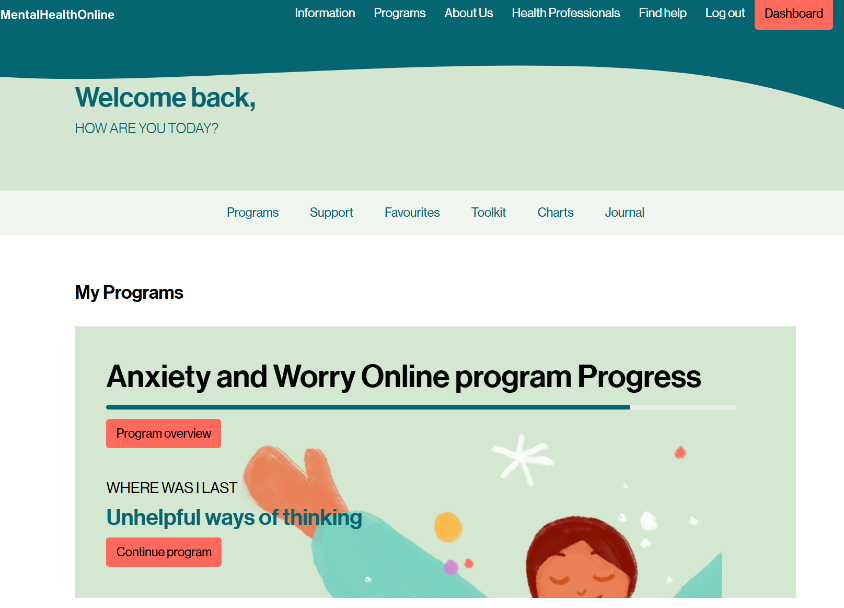
What online CBT looks like
One part of the program that stood out to me was the section on unhelpful thinking styles. One example is catastrophic thinking, which means assuming that the worst possible scenario will definitely happen. For instance, I used to worry that continuing my part‑time job would leave me with too little time to study, causing me to fail my topics. Then I imagined I would drop out of university and be unable to find another job. I believed this was the only possible outcome.
Through the modules, I learned that my thoughts were intensifying my anxiety. Recording the differences between my assumptions and what actually happened helped me recognise that my fears were often unrealistic.
I also found the relaxation exercises helpful. When my heart starts beating faster or my breathing becomes heavy, these exercises help me calm down. My favourite is progressive muscle relaxation, which involves tensing and relaxing different parts of the body (Swinburne University of Technology, n.d.). For example, clenching your fists for 10 seconds and then releasing them can create a sense of relaxation. This exercise helps me reduce worries before sleeping and when I wake up too early.

Mental Health Online offers several other programs, including Panic Stop!, Social Anxiety Online, and Depression‑Anxiety programs, as well as modules on depression, obsessive compulsive disorder (OCD), and post-traumatic stress disorder (PTSD). You can explore the options here: https://www.mentalhealthonline.org.au/programs.
There are also other providers of online CBT training which are highlighted in one of Gareth’s posts.
2. Counselling
Counselling provides a safe space to talk with qualified professionals who help you understand and address what you are experiencing (Healthdirect, n.d.-b).
Counsellors can help you explore your emotions, identify what triggers anxiety, and learn strategies to manage it (Vision Counselling, n.d.).
Counselling at Flinders University
Flinders University students can access free and confidential counselling through the University’s Health, Counselling and Disability Service.
The service offers short-term, solution-focused support to help students work through challenges affecting their wellbeing, studies, and daily life.
Before booking my first appointment, I read the frequently asked questions on the counselling webpage.
One question—“I’m not sure if I need counselling or a different service?”—helped me decide to seek support.
The answer listed issues that counsellors can help with, and two stood out to me:
- Perfectionism affecting studies
- Difficulty with motivation and procrastination
I had always assumed I needed to manage these issues alone but learning that professionals could help made me feel more comfortable seeking support.
Overcoming fear of booking an appointment
Even after reading the website, I still felt anxious about booking an appointment.
I lacked confidence in communicating with others and worried that a GP or counsellor might blame me for not managing my mental health well. This fear came from past experiences in my home country, where I felt judged when discussing mental health.
Some of you might also worry about how professionals will respond. In my case, they listened without judgment and appreciated that I reached out.
My friend encouraged me three times to contact a counsellor and accompanied me when I submitted the new client form. Without their support, I might have procrastinated for much longer.
I attended a counselling appointment through Flinders and later spoke with a GP, as the counsellor recommended.
Since then, I have continued receiving professional mental health support, which has helped me learn more about perfectionism and build strategies for managing anxiety.

What counselling looks like
In my ongoing counselling sessions, I am learning about perfectionism and exploring strategies I can try in daily life.
You can choose what to focus on during sessions based on the options your counsellor suggests.
Talking with a counsellor while also completing modules on perfectionism helped me understand where my perfectionistic tendencies may have come from.
I feel less pressure to change quickly because my counsellor reminds me not to push myself too hard.
Their perspective helps me recognise perfectionistic thinking more often, and I enjoy learning how to adjust my thought patterns.

The process to access Flinders counselling services
If you have not used the counselling service before, the process generally involves:
- Completing a new client form with your personal details, the issues you would like support with, and your availability for a phone call.
- Receiving a phone call from a counsellor to discuss your concerns and explore support options.
- Working with the counsellor to determine the most appropriate next steps, which may include a counselling appointment or another form of support.
- Completing any required paperwork and attending any appointments that are arranged.
In my case, my first appointment was at Oasis.
Final thoughts
Thank you for reading this article. If you are exploring ways to cope with anxiety and its impact on daily tasks, you have already taken an important step by visiting BetterU.
From my experience, anxiety cannot be removed completely. What we can do is learn about it and change how we respond. Addressing anxiety is an ongoing process rather than something that disappears after treatment.
Different strategies work for different people.
For me, counselling works better than self‑paced CBT modules because having scheduled appointments helps me stay engaged. I struggled to complete the online modules consistently and often put too much pressure on myself, which made it difficult to continue. It took me more than a year to finish them.
I believe there are many ways to manage anxiety, and each person has their own pace and preferences. I’ve provided a couple of places to get started. You might also find the options at Medicare Mental Health useful as well.
I did also mention perfectionism. If you are interested in learning about perfectionism, I recommend Lily’s article “Why ‘good enough’ is better than perfect: how perfectionism can hold you back”.
I hope you find moments of comfort and encouragement as you explore ways to live with anxiety.
References
Cleveland Clinic. (2024). Anxiety Has Its Benefits — But Only in Healthy Doses. https://health.clevelandclinic.org/benefits-of-anxiety
Furber, G. (2026, January 5). How to access CBT (cognitive behavioural therapy) online. BetterU. https://blogs.flinders.edu.au/student-health-and-well-being/2026/01/05/online-cbt-courses/
Gariev, V. (2025). Therapy session. Unsplash. https://unsplash.com/photos/two-women-talking-in-a-modern-office-setting-QxkvMblcaJ0
Healthdirect. (n.d.-a). Anxiety. https://www.healthdirect.gov.au/anxiety
Healthdirect. (n.d.-b). Counsellors and counselling. https://www.healthdirect.gov.au/counsellors-and-counselling
Kelly, J. (2021). Anxiety. Unsplash. https://unsplash.com/photos/woman-in-orange-sweater-and-skirt-rXrMy7mXUEs
Oasis. (n.d.-a). Mental and Physical Wellbeing. https://oasis.flinders.edu.au/mental-and-physical-wellbeing/
Oasis. (n.d.-b). Oasis. https://oasis.flinders.edu.au/oasis-centre/
Swinburne University of Technology. (n.d.-a). Anxiety and Worry Online program. Mental Health Online. https://www.mentalhealthonline.org.au/programs/anxiety-and-worry-online
Swinburne University of Technology. (n.d.-b). Progressive muscle relaxation 1 [Transcript]. https://www.mentalhealthonline.org.au/sites/default/files/audio/transcript/2023-11/Progressive%20muscle%20relaxation%20audio%20transcript.pdf
Vision Counselling (n.d.). How does counselling help anxiety? https://www.visioncounselling.com.au/how-does-counselling-help-anxiety/
What an interesting read! Thank you for sharing your experiences with us.
Thank you for your comment and kind words, Elias! I am glad that you are interested in this article😊