

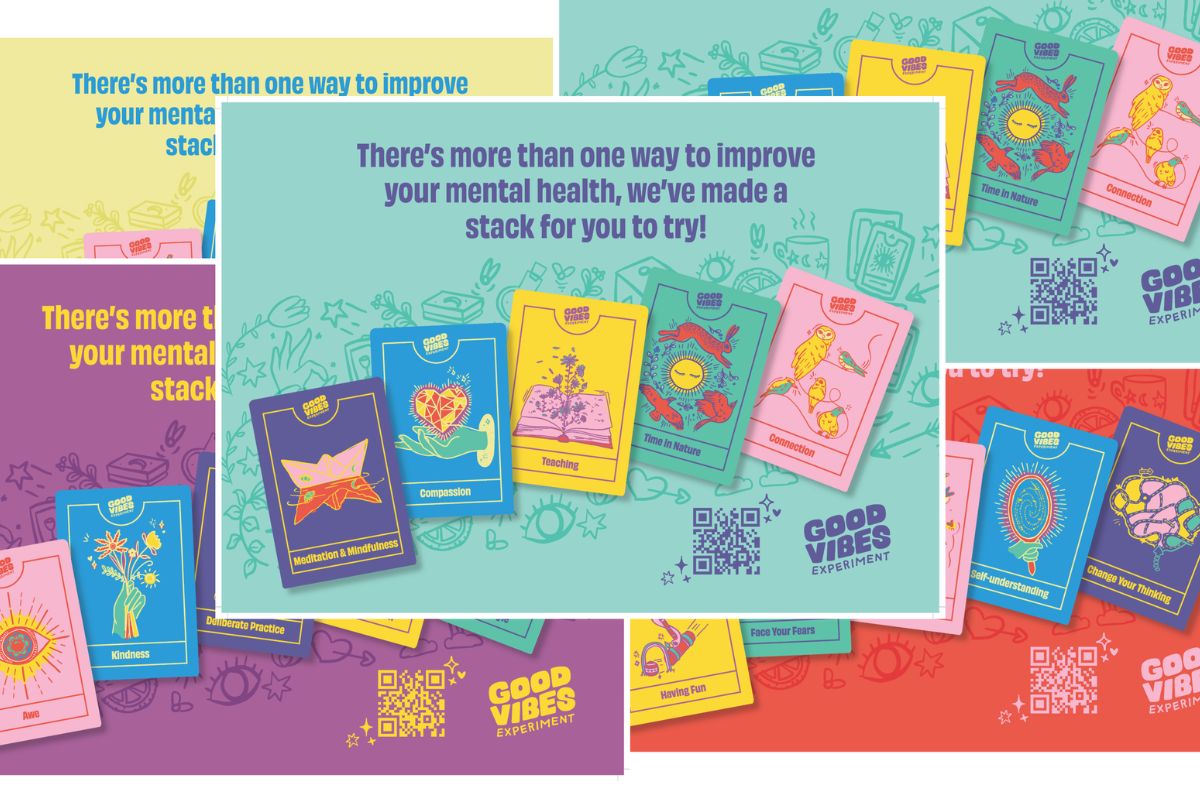
You may be aware from some recent posts (here and here), that we are gearing up to expand the Good Vibes Experiment (GVE) Universe. As that gets closer, I thought I’d share here a recent article on the Good Vibes Experiment that I wrote for a health topic. It is a modern retelling of the story of GVE, how it is still relevant today and how to utilise it for your own self-care.
What the Good Vibes Experiment Says About Looking After Your Mental Health
Mental Health Is More Than Mental Illness
When we talk about mental health, we often end up talking about mental illness.
That makes sense. A large part of mental health work focuses on recognising distress, identifying and diagnosing mental health disorders, encouraging people to seek help, and making sure effective treatments are available. That work is essential, and it remains a core pillar of mental health practice in the community.
Some of you will be studying degrees where you’ll come into contact with people experiencing mental illness — and some of you may even go on to provide treatment. But even if you’re not in a health degree, it’s very likely that mental illness will touch your life at some point. Australian data suggest that around 43% of people will meet criteria for a common mental illness across their lifetime — most commonly anxiety, depression, or substance use difficulties. If it isn’t you, it will almost certainly be someone you care about.
This reality is why community-level work by organisations like Beyond Blue and initiatives such as Mental Health First Aid (which you can complete here at Flinders) are so important. These efforts improve mental health literacy, reduce stigma, and make it easier to recognise when someone needs help. Sites like Medicare Mental Health are also making access to treatment more straightforward than it once was.
But mental illness isn’t the whole picture when it comes to mental health.
Most people don’t just want to feel less distressed. They want to feel more okay. More engaged. More connected. More capable of dealing with life as it shows up. They want to experience more positive emotions, not just fewer unpleasant ones. In more recent language, they want to flourish.
In that context, the Good Vibes Experiment was created to sit alongside the illness conversation — not to replace it — and to ask a different question:
What helps build and sustain positive mental health in everyday life?
That framing is central to the Good Vibes Experiment and to the research that informed it.
A Positive Mental Health Pathway
The Good Vibes Experiment was built in 2020 by a group that included students, mental health professionals, communications specialists, and creatives. The original brief was to design a mental health–focused campaign — and, as it turned out, the timing aligned neatly (and somewhat uncomfortably) with the arrival of COVID.
By that point, mental health professionals had access to a growing body of evidence showing that positive mental health is not simply the absence of mental illness. The two are related, but distinct. The things you might do to treat or manage a mental illness (e.g. structured therapy for anxiety or depression) can be different from the things that make your days feel more connected, meaningful, engaged, or rewarding.
One of the clearest illustrations of how far this work has progressed is the Greater Good Science Center and its Greater Good in Action catalogue. At the time the Good Vibes Experiment was developed, that catalogue included around 80 evidence-based practices for building positive psychological states. Today, it includes more than 100.
The idea behind Good Vibes was simple: students should know about these pathways to positive mental health, and not just as abstract ideas, but as things they could actually try. The challenge was how to translate a large, research-heavy body of work into something practical, approachable, and genuinely engaging.
What the Good Vibes Experiment Actually Is
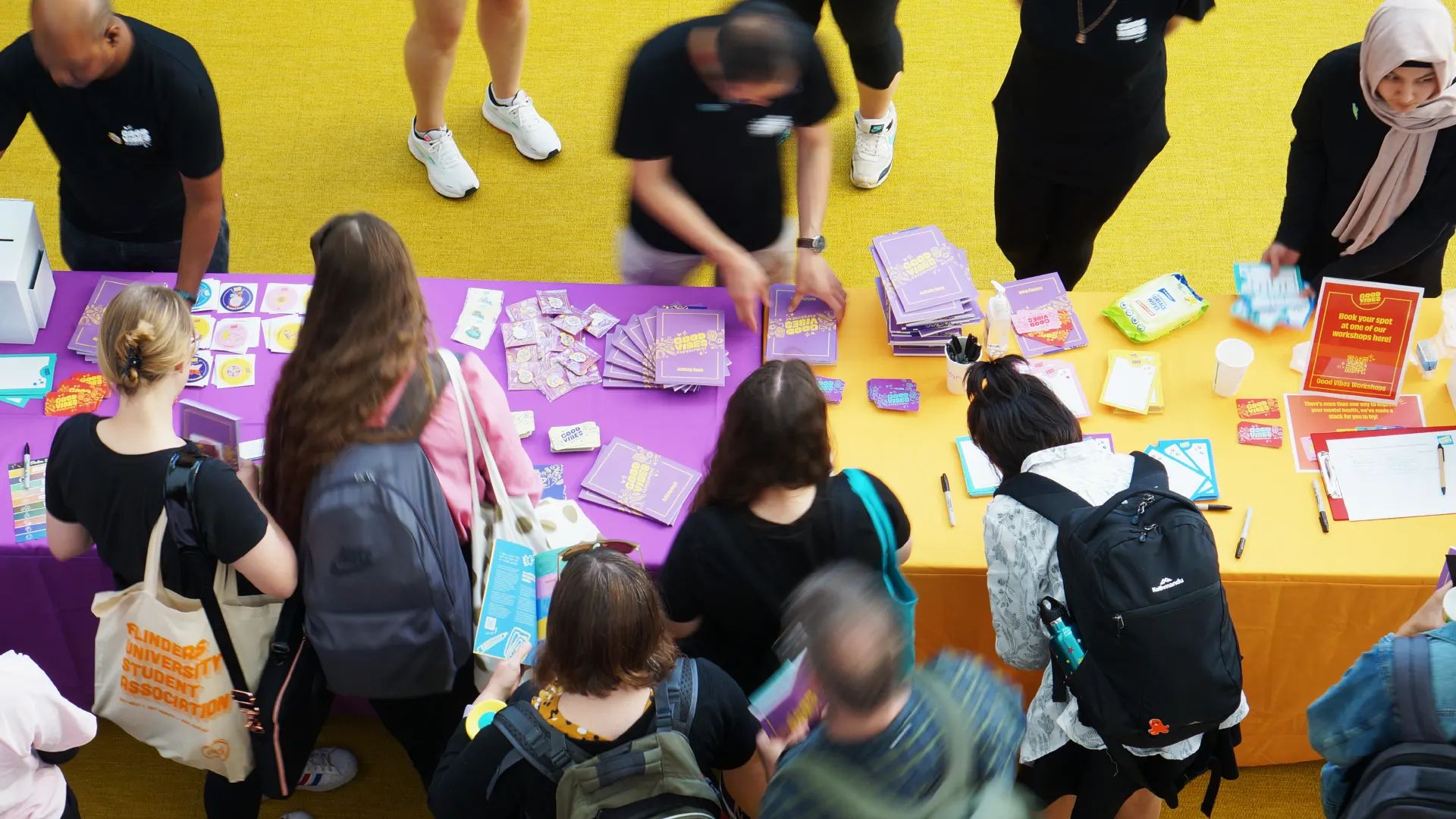
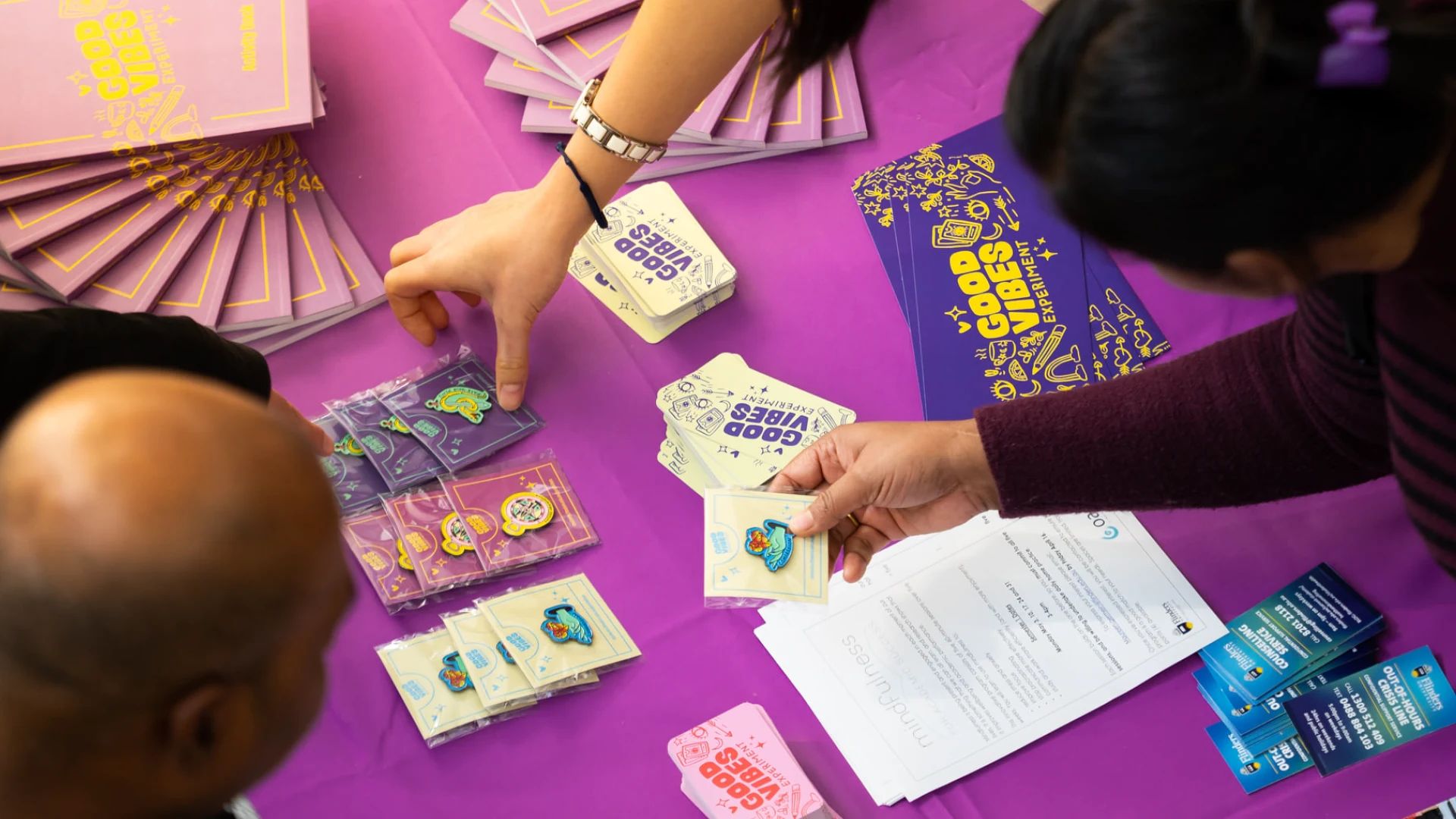
When it first launched, the Good Vibes Experiment was a full-on campaign. There were on-campus activations, a large gratitude wall, pins, T-shirts, posters, and handouts. Mango Chutney (the design firm we worked with) have a great page showing the campaign in full force – https://mangochutney.com.au/work/good-vibes-experiment
Over time, most of that has faded into the background. What remains, and what matters most (arguably), is the Activity Book.
You may already have been given a copy in one of your topics, or during wellbeing week. If not, students can order one to be posted out, pick one up on campus or contact us (goodvibes@flinders.edu.au). Staff can also request copies for use in teaching.
The book doesn’t avoid the reality of distress. It includes clear information about support and treatment options and acknowledges that for some people, mental health is currently about struggle. But the bulk of the book is devoted to experiments in positive mental health.
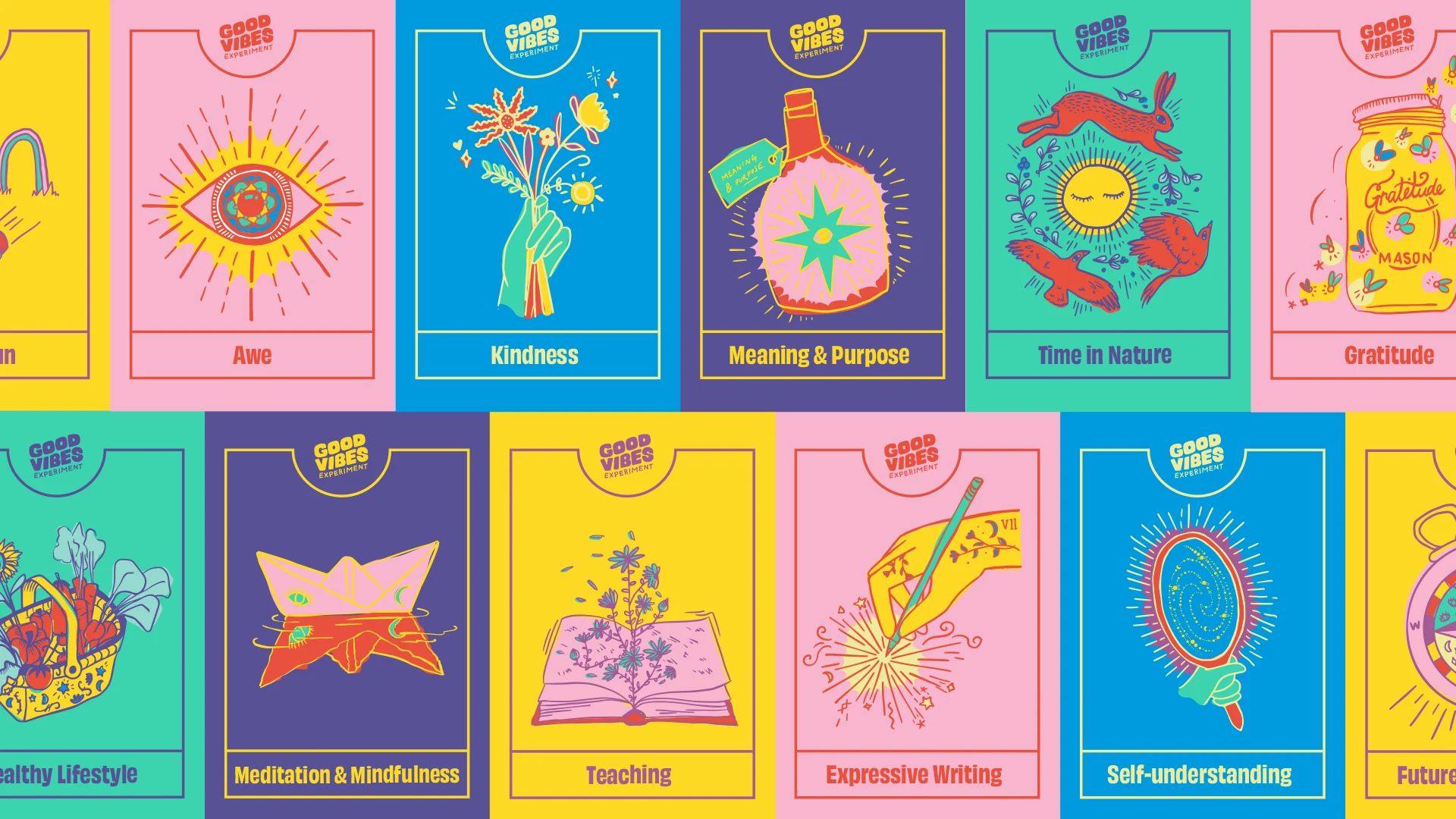
These experiments are organised around 20 wellbeing tactics, higher-level categories of activities that research shows are linked to improved mental health. They include things like mindfulness, gratitude, compassion, connection, meaning, productivity, time in nature, expressive writing, and future orientation.
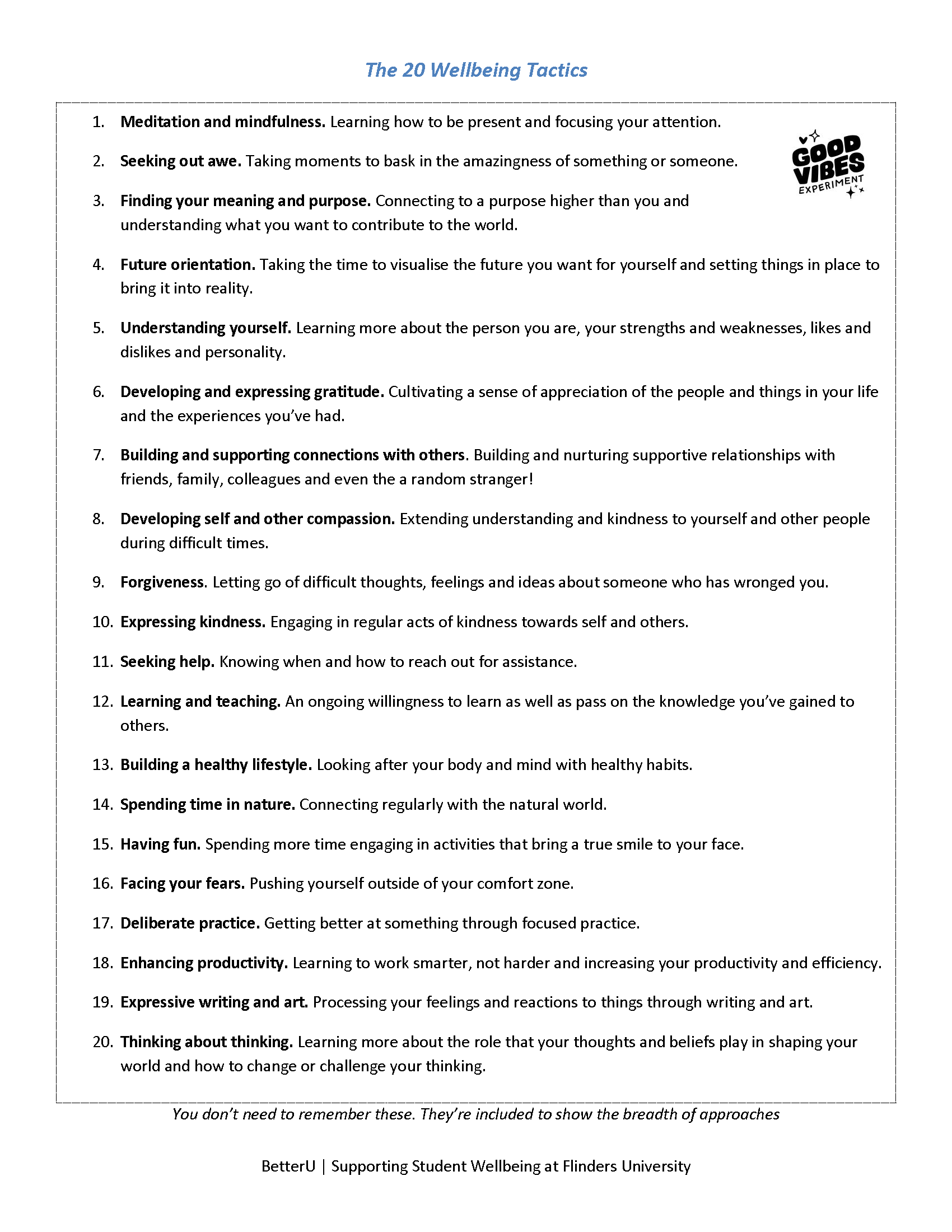
Some of these will feel familiar as common-sense ways of looking after yourself. Others might be newer ideas, such as deliberately seeking out awe, using expressive writing to process experiences, or practising future-oriented thinking.
Each tactic is represented by at least two playful, low-key activities in the book — around 40 activities in total. The goal was never to create a self-help manual or a treatment program. In fact, students involved in the design were very clear that they didn’t want the book to feel clinical.
Instead, each activity gives you a taste of an underlying psychological idea.
A good example is the values “find-a-word.” On the surface, it’s just a puzzle. But the words you’re searching for are values — the kinds of concepts people use to describe what matters to them and the sort of life they want to lead. You engage with a serious idea, but through something playful and accessible. If it resonates, you might explore it further. If it doesn’t, you move on.
That taste-testing approach sits at the heart of the project.
Where the Wellbeing Tactics Came From
The 20 wellbeing tactics were shaped by two main influences.
The first was the work of the Greater Good Science Center, mentioned previously, which catalogues evidence-based practices for cultivating positive psychological states.
The second was Be Well Co, a South Australian research group that developed the Be Well Plan — a five-week program that supports people to experiment with wellbeing practices and turn the ones that work into habits.
The shared philosophy across both bodies of work is important. Positive mental health isn’t built by doing everything. It’s built by experimenting, noticing what works for you, and gradually embedding those practices into everyday life.
The role of the mental health professionals involved in Good Vibes was to explain what each tactic looked like in therapeutic terms. The role of students, designers, and communicators was to translate those ideas into brief, engaging activities that didn’t feel like therapy.
That collaboration is why the book feels playful rather than prescriptive.
Some Key Principles Behind the Design
Mental Health Is Shaped by Regular Practices
Mental health isn’t only something to attend to when things go wrong. Like physical health, it’s shaped by what we do repeatedly and how we structure our days. The Good Vibes Experiment focuses on small, doable actions — not dramatic change — with the hope that a few ideas naturally find their way into your everyday life.
Choice and Autonomy Matter
There is no single recipe for good mental health. Different people benefit from different practices. That’s why the book offers variety rather than a fixed program. You’re invited to follow curiosity rather than compliance.
Action Matters More Than Insight
Understanding mental health is useful, but experience is shaped far more by what we do. That’s why this is an activity book rather than an information resource.
Diversity Is a Strength
Some people benefit most from movement. Others from reflection, creativity, connection, structure, or time in nature. The diversity of the 20 tactics reflects the reality that many pathways can lead to positive mental health.
It Helps If It’s Enjoyable
Wellbeing practices don’t need to feel virtuous or serious to be effective. Playfulness, curiosity, and enjoyment increase the chance that something becomes part of your life rather than another abandoned task. That tone is a feature of Good Vibes, not an accident.
How to use the book
The Activity Book actually includes a section titled How to Use This Book, where we make a slightly unusual request:
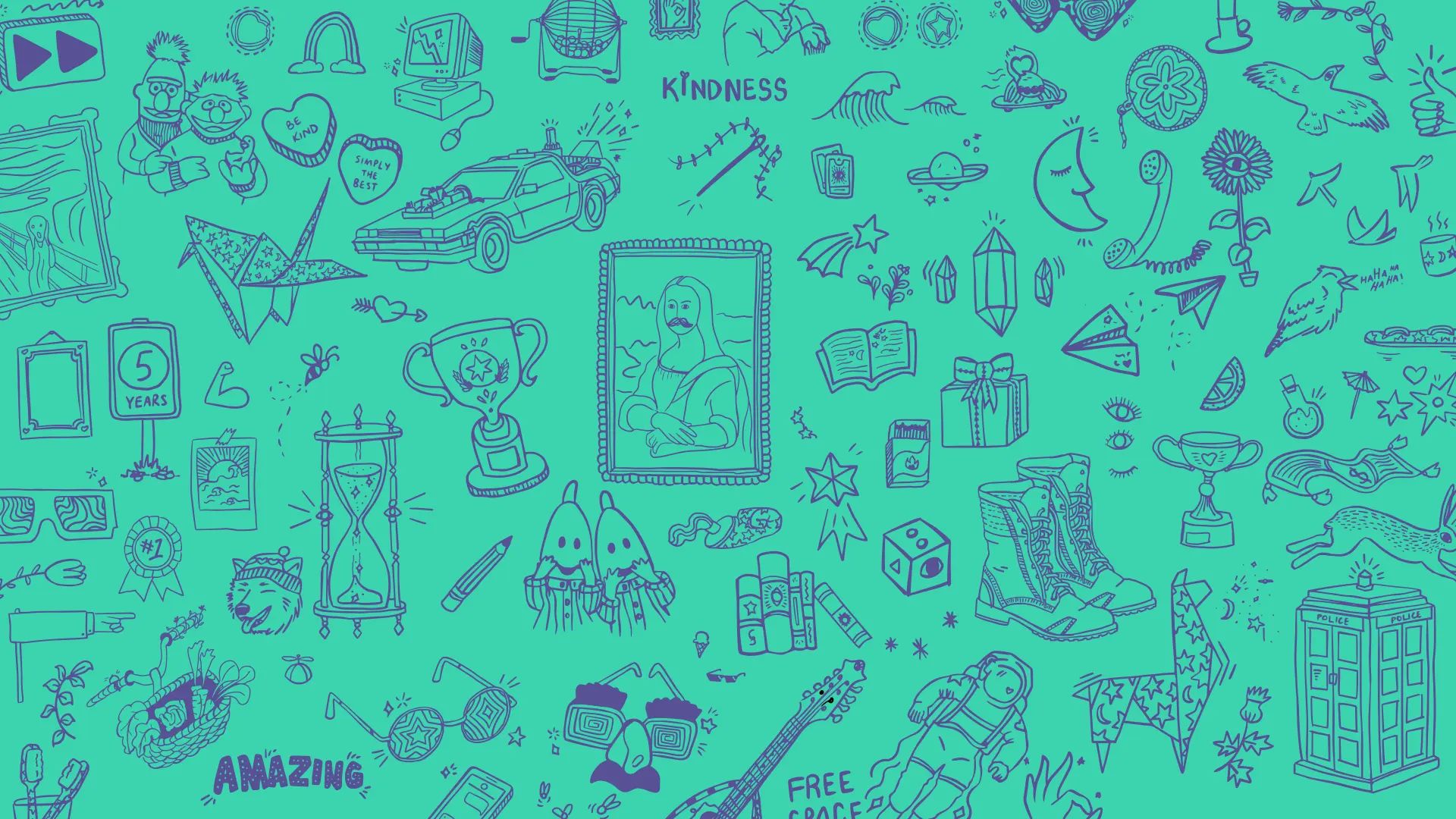
We want you to write, draw, scrawl, rip, bend, smoosh and scribble your way through it.
That invitation is intentional.
This isn’t a book you’re meant to keep pristine. It’s closer to a notebook or a sketchpad than a textbook. One of the inspirations was Wreck This Journal – the idea that a book is honoured through use, not preservation. By the time you’re done, it should look like it’s lived a life.
You don’t need to complete every activity. You don’t need to like all of them. Most people will only take away a handful of ideas: practices that feel useful, interesting, or worth experimenting with further. From our perspective, that’s a success.
As you work through the book, it can help to notice:
- what resonates
- what feels irrelevant
- what you already do a version of
- what sparks curiosity
If the book gets you thinking a little differently about mental health, then it’s done its job.
From Ideas to Ongoing Self-Care
Sometimes an activity will connect with you more than others. When that happens, it can be useful to pause and ask a simple follow-up question:
If I wanted this idea to become a small, ongoing part of my life, what might that actually look like?
For example, if the idea of kindness to strangers resonates, how could you operationalise that in a typical day? It doesn’t need to be dramatic. It might be as simple as:
- making eye contact and saying hello at the morning coffee line
- thanking someone by name
- offering patience instead of frustration
- doing one small, intentional act of kindness each day
This step of moving from a one-off activity to a repeatable practice is where self-care really starts to take shape. You’re not committing for life. You’re just exploring what might fit into your actual routines and context.
Using the Book With Others
There’s another way to engage with the Good Vibes Experiment that doesn’t always get talked about and that is using it with other people.
Mental health isn’t just an individual experience. Many of the ideas in this book become clearer, richer, or more grounded when they’re shared, discussed, or reflected on in relationship.
That might mean:
- comparing notes with a friend
- talking about which activities resonated and which didn’t
- noticing how different people respond to the same idea
- using the book as a starting point for a broader conversation
Sometimes this happens in a learning context (e.g. tutorial, workshop, or group discussion). But it can also happen informally. A casual “I tried this activity and it made me think about…” can be enough to open a useful conversation.
You might also choose to pass the book on to someone else. Not as a solution or a hint, but as a shared resource. Something like:
“I came across this book through uni. I found parts of it interesting — thought you might too.”
Handled gently, the book can act as a catalyst — not just for individual reflection, but for connection, conversation, and mutual learning. And often, it’s in those relational spaces that ideas really start to stick.
Using Good Vibes in a Learning Context
If you’re engaging with the book as part of a university topic, you may have built-in opportunities to discuss it with others. Those conversations often matter more than the content itself.
I’ve seen this repeatedly in teaching. Students often report that the value comes not just from watching videos or reading materials, but from discussing them together – comparing experiences, sharing strategies, and normalising challenges. Good Vibes can act as a catalyst for those conversations.
If discussion opportunities are available to you, as part of a topic, I strongly encourage you to take them up.
An Invitation Beyond the Book
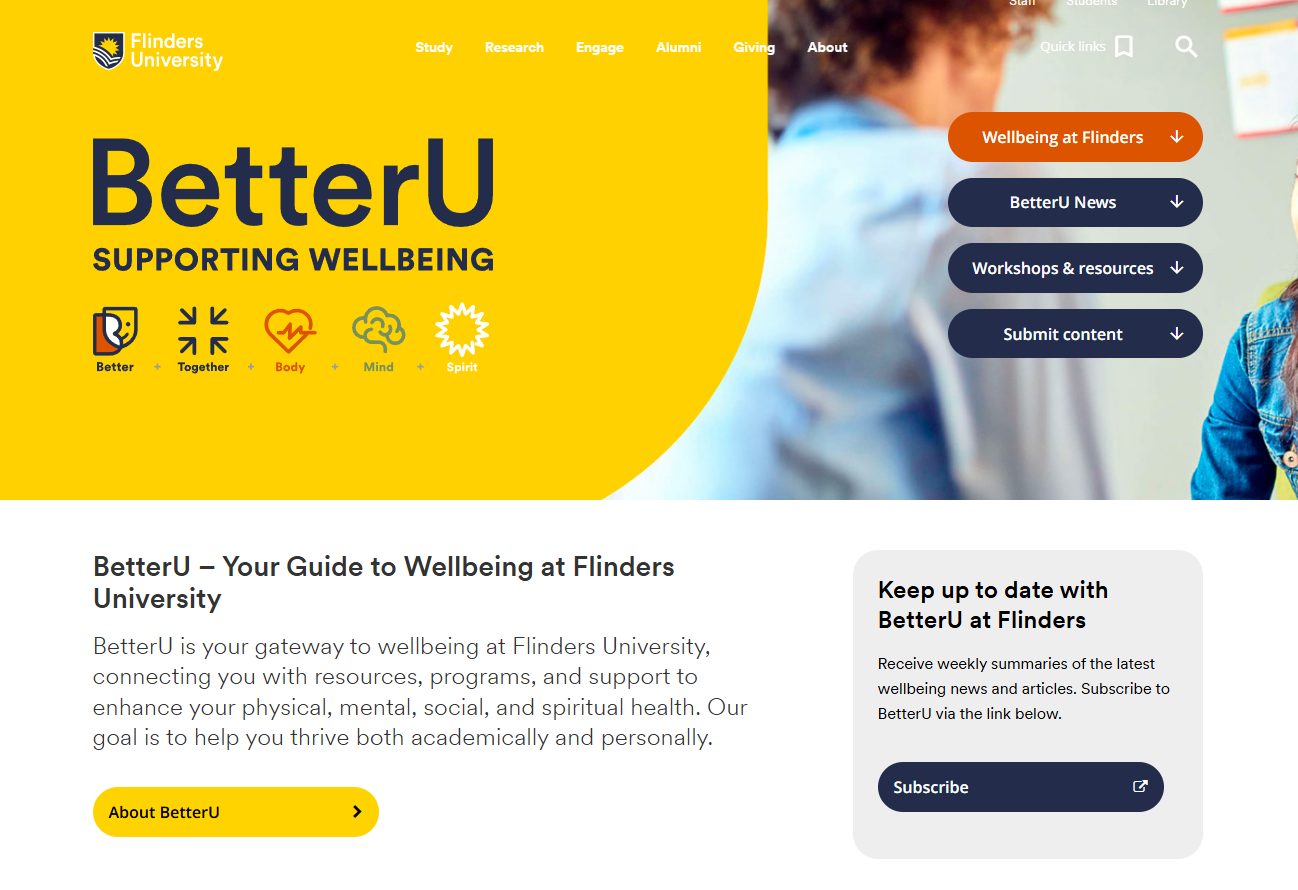
Alongside classroom work, I also manage BetterU, Flinders’ wellbeing hub. The site brings together articles, resources, support information, and a weekly newsletter.
We also actively welcome student contributions.
I don’t want BetterU to be just the ramblings of a middle-aged psychologist. If engaging with the Good Vibes Experiment sparks ideas, reflections, or creative responses, even a critique of the book itself, we’d love to hear from you.
A Final Word
The Good Vibes Experiment is a starting point. It helps you notice what supports your mental health, what keeps stress manageable, and what helps you feel engaged with life.
Because insight helps — but mental health is ultimately shaped by what we practise over time.
